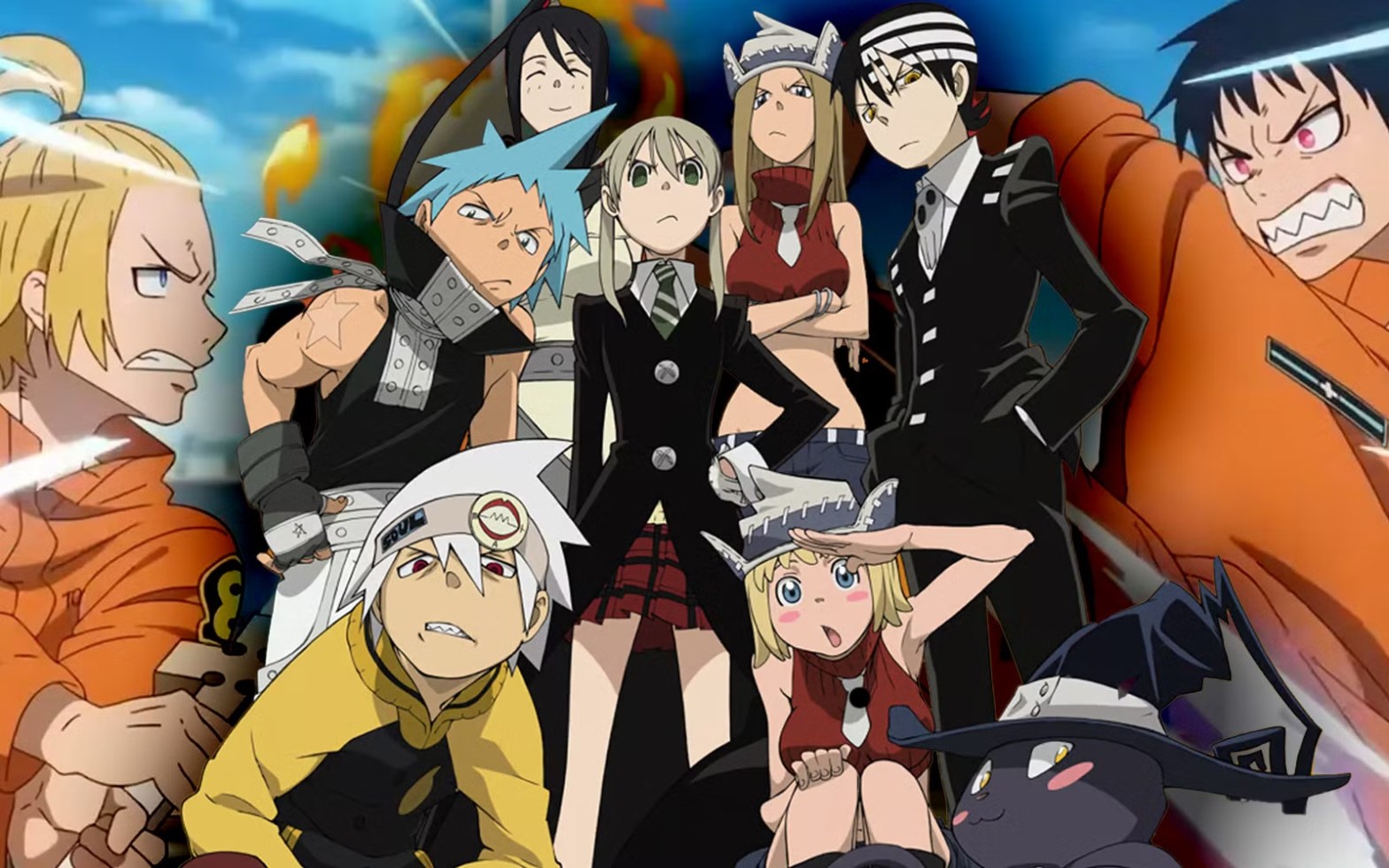
I can’t think of another writer whose work I feel this way about—loving it and hating it at the same time. I can think of writers or composers whose work I love and whose politics I hate, sure. But Ōkubo Atsushi is the only one whose *work* I both love and hate. That’s why it’s taken me so long to write this essay—at least since I finished season 3 of Fire Force back in March, but really since I finished watching Soul Eater for the first of many times back in 2018.
It would be hard to overstate my love for Ōkubo’s universe—the style of it, but also the heart of it. Ōkubo’s drawing style is perfect as far as I’m concerned, both in the manga and in the anime adaptations of Soul Eater and Fire Force (by Bones). His lines are all exactly in the right place, minimalist but expressive—most notably in his characters’ faces but also in the incredibly unique design of the series’ overlapping worlds. Both worlds are definitely cartoonish—SE’s aggressively so and for a good reason that becomes clear through the course of FF—but they’re also rich with layers of influence that combine to make something new and harmonious, like a Van Gogh oil landscape. In nearly every frame, you can see the watermarks of traditional Japanese architecture, Disney, pop art, Bauhaus, and Rube Goldberg. Whether it’s a nuclear reactor that evokes a Shinto shrine, or a Grim Reaper with giant foam hands, Ōkubo somehow makes every mashup work organically.
In terms of the heart of his universe, I’ll start by saying that—with very few exceptions—he makes the dualism typical of Japanese shonen (teen) anime work for me when I almost always find it jarring otherwise. Abrupt shifts between elegantly rendered frames and exaggerated, templated “chibi” ones are just non-stop in shonen anime, but Ōkubo employs them sparingly and with a deft sense of timing. Intead, he bakes an organic and winning dualism right into his characters: Death the Kid is the son of the Lord of Death and an extremely powerful Meister, but he turns into a whimpering puddle in the face of assymmetry; his father is a terrifying god who has attempted to make himself more relatable and less terrifying to the children he teaches at his academy by adopting those foam hands and a cute skull mask.
Ōkubo’s stories need these moments of lightness becuase his subject matter is generally dark: loss, trauma, guilt, sin, the nature of evil, the end of the world. I started watching SE when I was working through some of those issues myself, and I was amazed at how insightful the series was on those points—especially through Crona’s journey out of parental abuse. When he said in a bewildered tone, “I just don’t know how to interact with people…” while he was lopping heads off with a giant, possessed sword, I laughed out loud because that’s *exactly* how I felt sometimes: doing more harm than good while all I wanted was to connect to those around me. You end up caring about all of Ōkubo’s characters because they’re so realistically drawn, even and especially his villains, who are even more chilling because they’re so relatable: Asura is terrified of everything, and so his desire to make everyone mad is at its core a desire not to feel alone in his paranoia; in FF, Haumea thinks humanity needs to end because she’s been privy to all of our worst thoughts for the last 200+ years—who wouldn’t want the same in her shoes? Ultimately in Ōkubo’s universe, though it can be a very unflattering mirror at times, loyalty, friendship, courage, and hope do win the day.
I should say a word about his overlapping universes from the perspective of story and plot: they’re pretty amazing. Esoteric, technical, and yet well thought-out and logical. SPOILERS AHEAD: That the world of SE was created by the collapse of the parallel worlds of FF (essentially our world) and Adolla /Eidola, the world of ideals/idols (really the collective unconscious)—this tour de force takes a level of philosophical expertise and artistic mastery that manga don’t usually achieve.
So, you may be wondering, what’s there to hate? If the art is beautiful and unique, the story is philosophically rich, the emotions are deep and real, and it’s laugh-out-loud funny at all the right places? It’s simple: the boobs. Well, the boobs and the latent Objectivism.
This isn’t a hot take by any means: if you go on Reddit you’ll find scores of fans rolling their digital eyes in exasperation at Ōkubo’s tendency to succumb to “fan service,” by which they mean gratuitous sexualization of women (some of them teenagers). The fan service was borderline in SE but outrageous in FF, with poor Tamaki (at the canon age of 17 BTW) being cursed with the dubious 3rd-generation skill of “lucky lechery,” where her clothes fly off at key moments in battle and/or she trips and lands in sexual positions that either embarrass or arouse her opponents to the point where they tap out. Ōkubo makes a lame, 11th-hour attempt to hitch this blatant fan service to some high-minded Freudian argument about the life drive and its role in saving humanity, but whatever, dude—it’s just sexist. And when that sexism gets tied to some creepy-crawly Ayn Randian arguments about the need for heroes to save the masses from their own mediocrity, we end up with an Objectivist politics that undercuts a lot of the excellent arguments Ōkubo has made about recovery, hope, and humanity: i.e., if you’re a man, then obviously anything bad that’s happened to you is horrendously unfair and can and should be heroically overcome; but, if you’re a woman, or just average, then tough titties, you had it coming.
This is why I genuinely don’t know how to feel about Ōkubo’s work. I *really* love so much of it, and yet ultimately as a woman reader/viewer, I don’t really belong there. To be fair, his worst tendencies are much more reined in in SE, the earlier of the two works, where the lead roles are shared by a young man and woman, Maka, who’s not sexualized (though she’s mocked by her partner for not being sufficiently feminine). Maka does save the day (with her friends’ help). There’s still objectification of women to be found, but at least they’re women and not girls. Perhaps Ōkubo’s sexual politics regressed as he aged. Some might point out here that since the manga were published for a shonen (teenage boy) market, the universe wasn’t designed for women readers in the first place. OK, fine, but that doesn’t reassure me about the messages Ōkubo is sending impressionable young men around the world about the dignity and personhood of the women in their lives.
So, the tl;dr? Screen Soul Eater, skip Fire Force. It pains me to say that about FF because there really is so much beauty, genius, humor, and emotion in the later work, but it’s blunted by a lack of respect for (more than) half the human population.


One thought on “Cartoons for Grownups: A Deep(ish) Dive into the Universe of Ōkubo Atsushi (Soul Eater, Fire Force)”