I feel conflicted about Urobuchi’s work, too, but in a very different way from Ōkubo’s. Urobuchi and I don’t have any political disagreements to speak of—on the contrary, I think our world views mesh. He’s just willing and able to spend more time in dark places than I am. He’s undeniably a phenomenal storyteller, not just because he’s brilliant but also because he has a profound grip on human psychology—both its noblest and nastiest facets. Furthermore, he’s incredibly diverse in terms of the modes he’s willing and able to work in—everything from shojo (girls’) anime to Taiwanese puppetry. At the end of the day if someone were going to ask me who I thought the greatest living anime director is (since we lost Satoshi Kon much too young), I would unhesitatingly say Urobuchi.
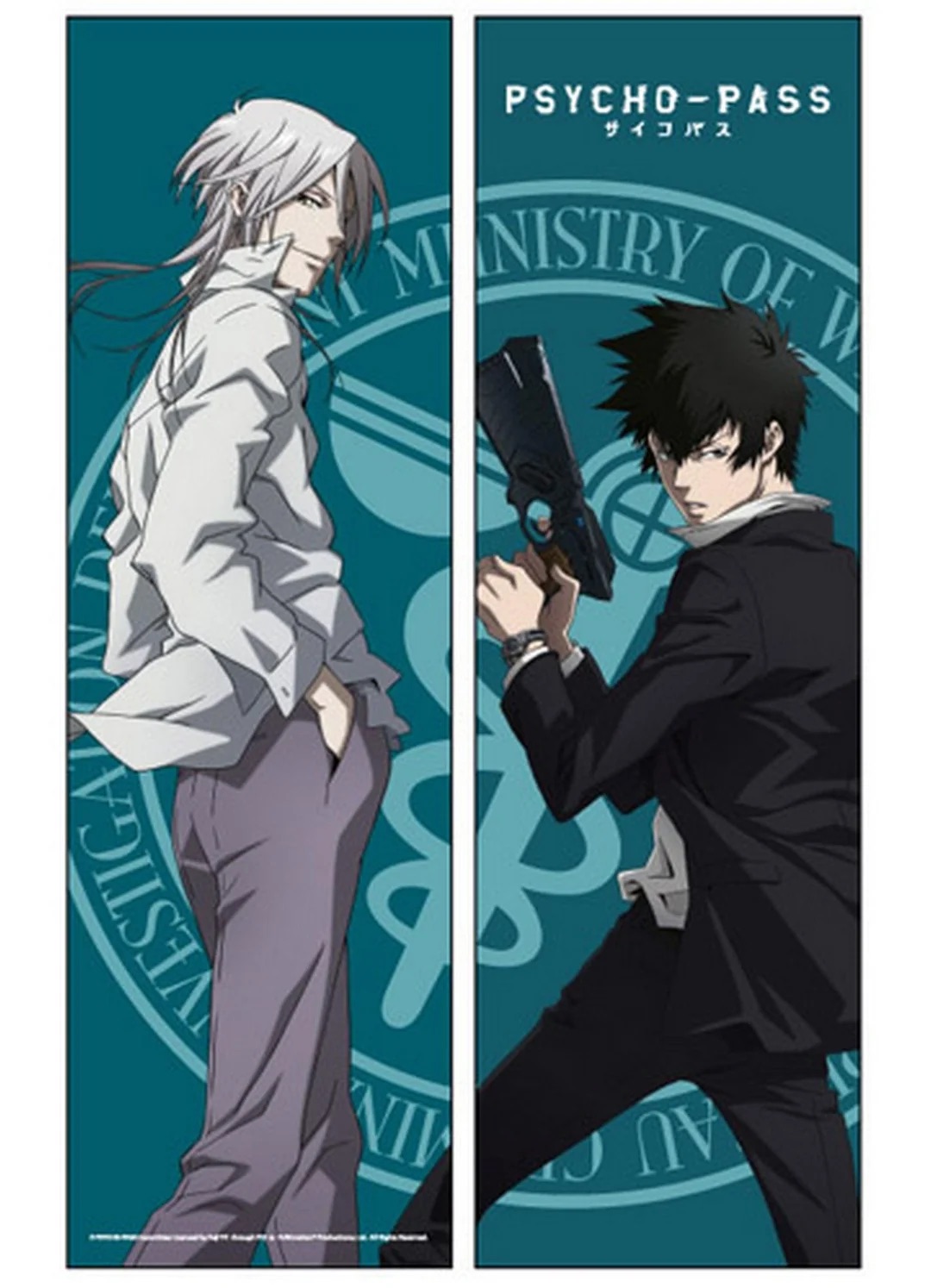
I got to know him through Psycho-Pass. Although heavily influenced by Phillip K. Dick (“Do Androids Dream of Electric Sheep?”/Bladerunner and “Minority Report” especially), the series ingeniously adapts Dick’s social-engineering ideas to a Japanese context. The story takes place in a not-so-distant future Tokyo whose citizens have accepted, as part of the cyber-infrastructure that makes their lives so easy (VR costume systems, self-driving cars, robot valets, government-assigned and paid jobs for everyone) the Sibyl System, which monitors people’s emotional states and thus predicts their criminal liability. To facilitate that monitoring, everyone is required to carry a “psycho-pass,” a sort of cyber-mood ring whose colors stay light if you’re happy and compliant and get darker as you experience dark or rebellious emotions. A little “clouding” of your Psycho-Pass triggers therapy orders. But if it stays clouded, you are branded a “latent criminal,” subject to a series of increasingly severe enforcement measures that can culminate in summary execution by Division One of the Public Safety Bureau.
You can probably immediately sense some interesting problems here: how does Sibyl judge people afflicted by depression or other long-standing emotional problems? And what about sociopaths, who don’t feel bad about hurting people? The series goes down both of those paths simultaneously—putting them in a sort of tense mutual attraction by personifying them in two main characters—Shinya Kogami and Shogo Makishima.
While Detective Akane Tsunemori with Division One is ostensibly our protagonist, much as in Hunter x Hunter and other great anime series, she’s really the foil against which the more interesting characters develop. Tsunemori herself is intriguing because though she’s seen gruesome murders and witnessed corruption among her higher-ups, her Psycho-Pass stays stubbornly clear. She always has hope or sees the bright side of every situation. That both impresses and irritates the heck out of her assigned Enforcer, Kogami, who was himself a brilliant detective on the path to promotion when he became obsessed with catching a serial killer and his Psycho-Pass clouded permanently as a result. Enforcers are all former detectives, now assigned to detectives to do their dirty work for them—chasing down and apprehending latent criminals or using the Dominator—a huge networked weapon connected to Sibyl that metes out “judgments” ranging from electric shock to immediate (and graphic) cellular liquidation. This way, the detective’s Psycho-Pass stays clear while the Enforcer avoids jail or execution.
Tsunemori and Kogami solve a number of cases, but quickly they lead the pair straight back into the obsession that caused Kogami to be stripped of his rank and become an Enforcer: Makishima, a sociopath who eludes judgment by the Sibyl System because, first, his Pscyho-Pass always stays clear and, second, he mainly instigates others to rebel against Sibyl in increasingly gruesome ways. This is where the attraction between Makishima and Kogami lies—because Kogami also hates the Sibyl System and what it’s doing to the citizens’ free will, but where he wants a better world for them, Makishima just wants to make a public spectacle of the torture Sibyl imposes on anyone who’s different from the norm—in other words, he wants people to see what he’s feeling. And so Kogami and Makishima become locked in a death spiral over the course of the series, with Tsunemori trying to save Kogami and convince him to discipline Makishima and Sibyl through legal channels.
Kogami and Makishima’s doomed mutual attraction—doubled in the beautiful character design by Akira Akane with Kogami all in black and Makishima all in white—forms the compressed, glinting core of Psycho-Pass; and, like a diamond, it refracts that energy through the rest of Urobuchi’s work. I love a bromance, and I’m using that term regardless of the gender of the characters involved, because the point of it is one I feel strongly about: love is a lot more than sex and romance. It’s complicated, enduring, often bitter. It’s as much or more about sacrifices and hard feelings than it is about hearts and flowers. Self-love even more so. And, at least in my experience, any on-screen pairing other than a bromance collapses all those interesting distinctions and problems too soon and too neatly. All my favorite movies (Heat, 3:10 to Yuma, Seven Samurai, the live-action Rurouni Kenshin quintet) feature bromances; even my favorite romantic films, like Ladyhawke, keep that space open for love to develop, in all its complexities and painful crystallizations, for as much of the 2-hour runtime as possible. This is where Urobuchi and I are very much on the same page.
Which is why it pains me to admit I never made it through his most famous and laureled series, Puella Magi Madoka Magica. PMMM also revolves around a doomed attraction between its main characters, Madoka Kaname and Homura Akemi. In this case, Homura is a “magical girl” charged with saving the world from “witches” (who are just magical girls overcome by despair—note the echoes to Pscyho-Pass), and for reasons that stay mysterious for several episodes, she seems hellbent on stopping the cheerful, friendly Madoka from making her own magical-girl pact with the adorable cat-like spirit Kyubey. If Tsunemori was the foil to the doomed lovers in Pscyho-Pass, then the foil this time is Madoka’s best friend Sayaka, who first becomes a magical girl and then transforms into a witch due to unrequited love. As Madoka struggles to save Sayaka and Homura to purge her, the action of the story pushes toward its climax.
Urobuchi’s dark-fantasy twist on the “magical girl” trope is as compelling as always—he always somehow manages to mine fresh ore from the veins of tired tropes. And the stunning visualization of the “witches”—disembodied, kaleidoscopic collages of images that are destructive (but never unambiguously evil, especially once you learn more about Kyubey’s motivations for creating magical girls)—is one of the many reasons this series won awards and has stayed on “classics” lists ever since. I just have never had much of an appetite for the occult, so where I could kind of cover my eyes through the disturbing bits of Pscyho-Pass, they were too constant in PMMM for me to make it through to the end.
It’s not that I think Urobuchi is wrong about the world, by the way. He’s obsessed with the battle between good and evil in the human heart, and I think he is very clear-eyed about the fact that good rarely prevails. I think he wants it to, though, and to figure out how to make that happen, he’s willing to plumb the depths of the enemy’s strategies in a way I’m not—partly do to my personality (I tend to be more of a sunny Tsunemori than a brooding Kogami by nature) and partly due to my faith. In other words, I think those are real powers that Urobuchi’s poking at with his stories, not just abstract collages of ideas, and I have a built-in aversion to the dark side of that due to my spiritual commitments. To put it in terms he would get: I’ve signed up as a magical girl, and while I’ll fight a witch, I won’t invite her in for tea and a chat.
I ran into that same dilemma with one of Urobuchi’s most recent efforts—which is also in my opinion his weirdest and coolest: Thunderbolt Fantasy. I think the story is that he ran into Pili (“Thunderbolt” in Taiwanese Chinese), at an anime convention. Pili is a troupe of traditional Taiwanese glove puppeteers that had been experimenting with updating traditional wuxia (martial arts) stories by filming the puppet show and adding CGI for battle scenes and magical effects. Urobuchi supposedly bought all their DVDs and took them home to Japan, where his production company Nitroplus negotiated their release on Japanese media. Once Pili heard this, they started looking for a way to collaborate on a new project. They ended up filming a spin-off wuxia fantasy with an Urobuchi-penned script that ran to four seasons (plus two spin-off movies) and featured a J-Rock soundtrack by Hiroyuki Sawano. It’s still on Crunchyroll if you want to watch it, and I highly recommend doing so if you’re an Urobuchi (or even just an anime) fan. You’ll never see anything like it again.
I didn’t even know TF was an Urobuchi joint when I started watching; I think the algorithm had just recommended it. But I was immediately hooked by the love-hate attraction between the two main characters: Sho Fu Kan, an ascetic swordsman who’s somehow stolen an Index of demon-slaying blades and smuggled them across a dragon-infested desert; and, Rin Setsu A, a gorgeous and enigmatic thief who’s very interested in getting his hands on that collection. Natural enemies, they end up allying to protect the Index from the Demon Nobles, who want the swords it contains so they can overthrow the Demon Lord and end his iron détente between their realm and the human realm—as well as a handful of other interested parties.
Was I surprised when I learned Urobuchi was the writer for TF? Not in the slightest because it all tracked, right down to the good guy being rough and rude (and black haired) and the bad guy being smooth as silk (and white haired). Of course, there was also the building ambiguity of what counts as good and bad: is stealing right? Of course not. Is saving someone’s life good? Of course it is. But the consequences of both of those choices meandered off down predictably unpredictable Urobuchi-esque paths as the seasons unfolded.
I loved the first season. After that, though, as our heroes are drawn down into the demon realm for various purposes, the mood of the show once again got too dark for me: I just didn’t look forward to spending so many hours in the bowels of the fantastically lurid hellscapes the Pili production team designed. If you can stomach them, though, it’s worth sticking it out to see how the story ends—it’s a novel and redemptive conclusion (if you’re wondering how I know, I skipped a bunch of episodes and dropped in for the finale). And I simply cannot overstate how amazing the puppet design is, the combat choreography, the soundtrack. It really is a monumental achievement. And it’s why I’ll keep riding along on whatever trip Urobuchi takes next (Ghost of Tsushima Legends! You know I’m there for that) even if I can’t always stick with it until the dark, bitter end.

