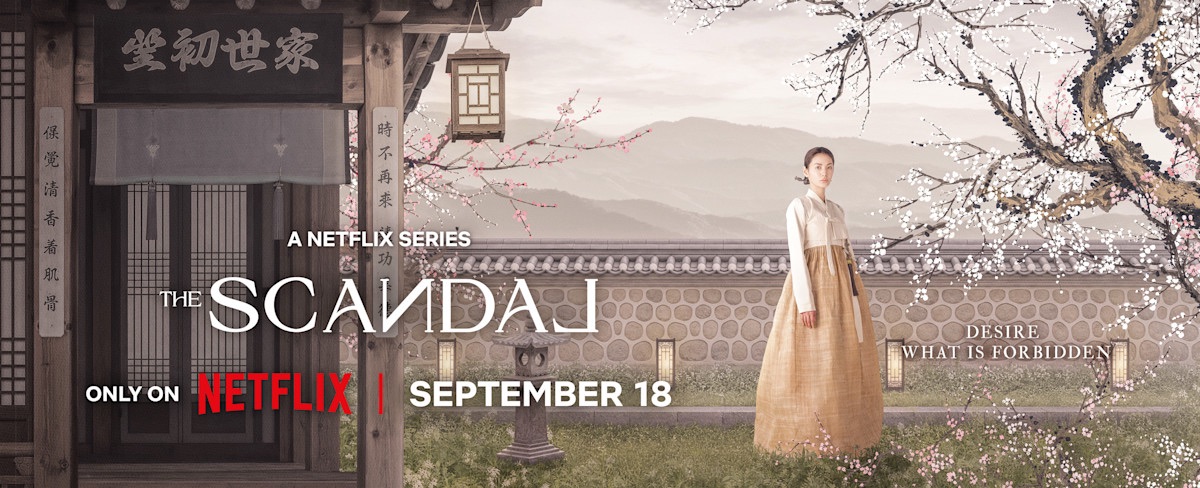
While it’s true that I’m contractually obligated to watch anything starring Ji Chang-wook, I wasn’t looking forward to watching his latest project, Netflix’s original series, “The Scandal.” I could tell immediately it was a retelling of “Dangerous Liaisons,” a story I’ve never liked. It’s just…bad people behaving badly, and I have to have at least one character I can root for in a story to stick with it.
I ended up finding that character—a couple of them, really—in “The Scandal,” which was a welcome surprise. Also, Jung Ji-woo, the director, made some savvy choices that humanized the story’s villains, and it didn’t hurt that it was gorgeously shot. So, I ended up sticking out “The Scandal” for reasons that had nothing to do with Ji Chang-wook, which was genuinely a surprise. I just realized that it’s possible you don’t know what he looks like? See Figure 1 below. You’re welcome.

It turns out that “The Scandal” was actually a remake of a Korean adaptation from the 1990s, one that had already translated the Pre-Revolutionary French novel into a Joseon context. That move turned out to be critical to my enjoyment of the drama because the Joseon setting (a) toned down the depravity of the main characters considerably and (b) altered the political context in ways that generated some sympathy for the characters—particularly the female ones, who were under some truly inhumane neo-Confucian expectations for noblewomen: for instance, that widows either kill themselves (preferably, to be less of a burden on their families) or remain celibate for the rest of their lives, even if they were “widowed” as virgin fiancées at the ripe old age of 17 or 18. Yikes. (And in case you think those days are over, I can tell you firsthand that a close Korean friend of mine who was widowed in her early 30s in the 1990s never remarried because she would be cut off by her in-laws, her only child’s grandparents, if she did so.)
If you’re not familiar with the original story, basically a pair of frustrated former lovers work out their sexual aggression on the people around them and come to a bad end as a result. Like a two-body problem, the plot revolves around (a) a nasty favor that Lady Cho (Son Ye-jin) calls in from her cousin Cho Won (Ji Chang-wook)—namely, to seduce and impregnate the hapless virgin her husband is planning to make a concubine; and, (b) an even nastier side bet that Cho Won won’t be able to seduce the virtuous widowed daughter-in-law of a powerful neighbor—a bet Cho Won initially makes only to incite Lady Cho’s jealousy and to claim as his prize a night of passion with her. Got the ick yet? Yep, that’s why I’ve never liked this story.
Fortunately, from that point everything in “The Scandal” gets much more interesting. CAVEAT LECTOR: From here on, there be spoilers. It turns out the only reason Cho Won secured a post as a court scholar is because young Lady Cho taught him to write and argue as his “literary friend,” exchanging letters in secret. As a woman, she couldn’t get a public education or serve the court, so she lived vicariously through her cousin. However, when he finally succumbed to his feelings for her and asked her to run away with him (their family would never approve a marriage between cousins), she chickened out and stood him up at the ferry dock. Since then, they have licked their mutual resentments like festering wounds. At the same time, the ways in which they complete each other make them unable to quit each other—which leads to the inciting incident of “The Scandal” (when Lady Cho reaches out to Cho Won for help humiliating her husband).
The other interesting twist in the Korean version is that the widowed An Hui-yeon is a closet Catholic (a trait from the original French story that they ported straight over). Catholicism isn’t legal in Joseon, so Lady An has to hide her bible reading and church attendance, but her newfound Christian faith is what catalyzes her reluctance to kill herself like her in-laws want her to—so they can collect a government memorial “award’ for her virtuous conduct (apparently this was a real thing in Joseon and eventually led to the changing of the prohibitions against remarriage—because families were literally offing their widowed daughters or daughters-in-law to collect the government benefit). Her desire to live is eventually what makes her fall into Cho Won’s arms.
By then, the irony is that he’s fallen for Lady An, so the bet with Lady Cho is off. “The Scandal” ends roughly like the original does—with Cho Won’s suicide as the only exit from a socially impossible situation—but everyone else comes out slightly better in the Korean version: in particular Lady An, who runs away and joins a secret conclave of Christians in the mountains. There’s also a side-plot involving an affair between her lady-in-waiting and Cho Won’s manservant, who eventually manage to find the happiness their masters never could. That Cho won is responsible both for making that happen and for saving Lady An offer his character two small redemptions. Lady Cho’s reputation isn’t ruined—as Madame de Merteuil’s is in the French version—but her fate is nearly worse: remaining locked in her stifling life, tending her silkworms and her husband’s illegitimate son, without anyone she to confide in.
To my surprise, it was actually these domestic scenes that captured my attention due to cinematographic choices: hovering drone shots of colorful peony beds, the quiet and yet insidious chewing of silkworms in heaps of mulberry leaves that echoes the endless gossip of the disenfranchised women who perform most of the labor required to maintain noble houses. One of the most striking scenes happens simply when Lady Cho gets up at dawn one morning and comes out, impeccably dressed in her rich silk hanbok as always, to start overseeing the day’s work. She just stops and stands in the courtyard for a long moment, looking at nothing. The breeze blows, a rooster crows, someone is chopping wood. And still she stands there. The scene says as much about the beauty of Joseon life as it does about the fate of an intelligent woman trapped within it, as unable to express herself with her wit and learning as she is in this moment with her face and body. Another gorgeous touch is found in the painted scrolls that move the story along at key points while coyly pointing to the salacious letters and drawings that circulate as part of the story’s gossip economy. These choices, as well as the director’s decision to let the female characters’ experience take the foreground in this version, made “The Scandal” amount to more than its title.

