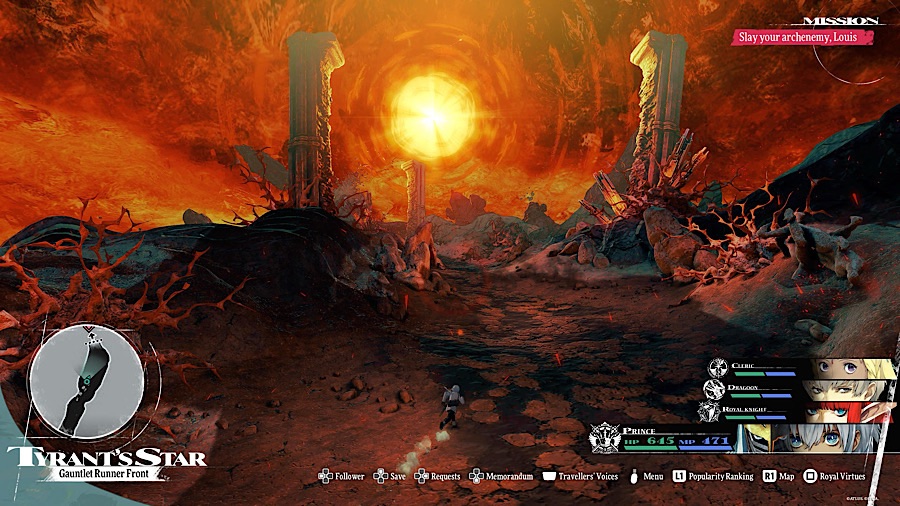
In the immortal words of my friend Zach, there comes a time in the life of every JRPG player when they must make a spreadsheet. And, at least in my experience, that moment always arrives a bit sooner in an Atlus game.
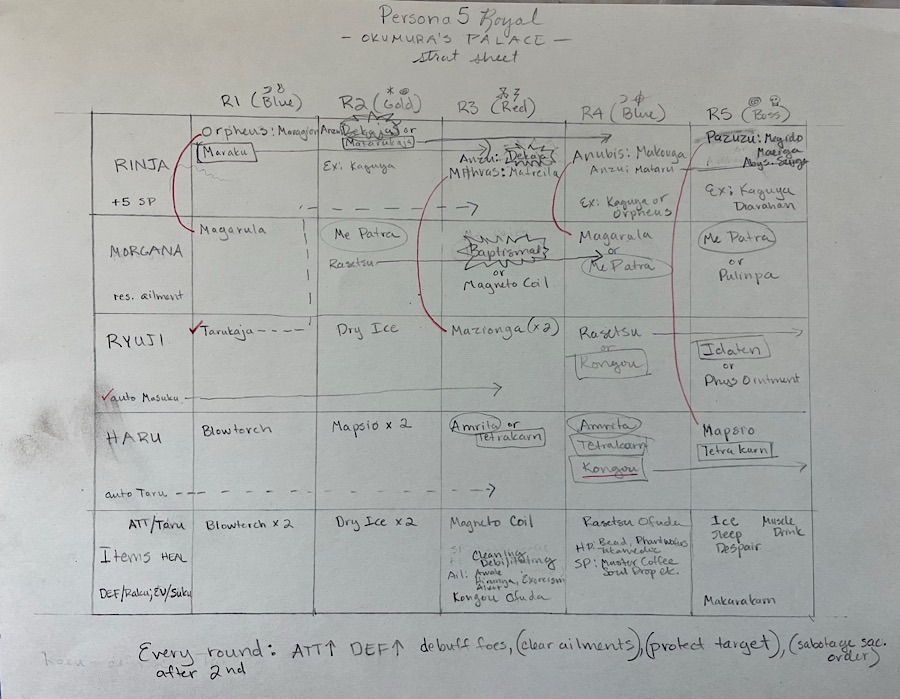
I played Persona 5 Royal several years ago on the Switch and really enjoyed it overall, and I think at the time it was my first JRPG, so that was quite a steep learning curve. The other JRPGs I’ve played since then (maybe with the exception of Final Fantasy VII) all find ways to simplify that crazy sudoku puzzle of matching number of battle turns to party members to skills—I think in the interests of not frustrating the casual JRPGer. Not Atlus: they build for the true turn-based believer, who apparently loves nothing more than spending 120+ hours optimizing the JRPG sudoku puzzle in order to break it—one-hitting bosses, stun-locking enemies, or getting endless drops. I, dear reader, am not that player. Notwithstanding, I can say that Metaphor: ReFantazio, like Persona 5, was so well-made that I stuck with it till the bitter end and had a good time doing so—even if I did have to build a spreadsheet or two, which is not my idea of fun. Look, here’s the one I hand-drew for Persona 5 (see if you can guess which fight it was for, if you’ve played the game!)
It’s not the story that draws me into an Atlus game so much as the game design—the world, the ability system, the dungeon design, and the social mechanics. The story itself is usually pretty straightforward without too many twists and turns (though you do usually end up having to fight someone you thought was an ally). But design-wise the game is so pretty; it’s like a puzzle that sounds and feels so nice in my hands, as I turn it this way and slide this piece one way that one another, that I can’t put it down.
What It’s About: Metaphor takes place in a fantasy kingdom called Euchronia stressed by divisions among eight humanoid tribes, attacks by monsters ironically called Humans (based on Hieronymus Bosch grotesqueries), and a succession crisis that comes with the mysterious death of King Hythlodaeus V. You play a young man who gets sucked into the tournament to crown a new king while seeking secret ends of your own (which are explained relatively early on but I won’t spoil here). As you face the various trials imposed by the tournament, you win new allies from each of the 8 tribes and build up enough power and popularity to challenge the leading candidate—the beautiful, nearly omnipotent, and potentially regicidal Louis Guiabern. To accomplish this seemingly impossible goal, you must unlock the power of Archetypes—like the Warrior, the Thief, and the Knight—that you can mix and match in your party to unlock skill combos effective with certain enemy types. These Archetypes are tied to a mysterious novel called Utopia that both you and Louis are obsessed with for very different purposes, and which draws the two of you inexorably together into climactic conflict for the throne of Euchronia.
As with other Atlus games, the themes of Metaphor’s story are psychologically complex and appropriate to their target teen/college audience: getting along with people who aren’t like you, imagining what a just world might look like, dealing with prejudice, learning the true definition of power, debating the relationship between religion and politics, and coping with the ambivalent potential of anxiety to turn either into bravery or cowardice.
The World: It’s a dream-like mash-up of European styles from the Middle Ages to the 1960s, with bell-bottoms, brutalist churches, horse-drawn carriages, thatched-roof stilt villages, and “gauntlet runners” propelled by enormous armored mechanical legs. Only Atlus could manage to pull this junk drawer of motifs into a coherent style; the anime-inflected visual mode they choose (roughly the same as in Persona 5) helps smooth out the joins a bit. The eight humanoid tribes are realistically different and compelling (my favorite is the petite bat-like Eugief with their huge ears, ruby eyes, and penchant for hanging from the rafters instead of sitting). And the Humans are truly terrifying: Atlus has a gift for building nightmares.
The Play: As already mentioned, it’s a turn-based JRPG that takes place across a combination of semi-open overworld and city locations, and maze-like dungeons. The most distinctive features of Atlus games, I think, are their time limits; many mainline story quests have deadlines, and failing to clear them will result in a game over (meaning you can reload a previous save or rewind the clock by a few days to try to make the deadline again). The main deadlines are usually generous, but they belie the fact that to perform well in combat late-game, you also need to be consistently taking care of a lot of social quests—spending time with comrades to level them up and unlock new skills and buffs, and leveling up your “royal abilities” (tolerance, eloquence, etc.) by completing small tasks for the locals—all of which move the clock ahead and quickly make the originally ample-seeming quest timelines seem quite tight. These were my favorite parts of the game, however, helping Heismay find a good burial spot for his son’s ashes, or helping Junah turn a singing rival into an ally by curing her of poison. You can also spend time cooking dishes that turn found/bought ingredients into powerful combat remedies and buffs; reading books; attending plays to increase your Imagination; soaking in hot springs to increase your MAG (magical currency that helps level your Archetypes); taking on bounties to make money (Reeve); and, of course, shopping to replenish supplies and upgrade your gear. Social tasks take half a day and dungeons (including bounties) a full day—in between, you can fit in as much shopping as you like. Once you’re able to travel on your gauntlet runner, travel also takes up to 3 days—less as the game progresses and your runner gets upgraded. All of this needs to be budgeted into the timelines for your main quest checkpoints.
Combat: Just as with previous Atlus games, skills are organized by persona types—Archetypes in this game. A welcome innovation Metaphor makes is to bundle skills within Archetypes and level them up by leveling up the Archetype, which usually involves “studying” and partially leveling up a complimentary Archetype. So, for instance, to level up the Knight to the Magic Knight, one character has to level Knight to 20 and then study and level Mage up to 10 (plus spend some MAG). It’s a really nice system that doesn’t overwhelm you with granular Skill selection while still giving you late-game flexibility as you face a more diverse range of enemies; for instance, I commonly switched Strohl back and forth between Dragoon and Samurai depending on whether I was facing a monster that tended to debuff party members in the Front row (Dragoon fights best from the Back row), or one that was Weak to Slash damage (Samurai). A very cool feature is that a party member can still “inherit” skills from a previous Archetype they’ve studied, which was awfully handy when I needed to squish a Mage Archetype and a Healer Archetype into the same party member—I could just run the Mage and then use the Inherit slots for healing skills. I used the heck out of this feature when I ran into leveling problems late-game, which I’ll get to in a moment.
Actual combat is pretty typical JRPG stuff: you can swing a weapon, use a Skill (which will cost you MP—more on that shortly), or use an Item. You can also pass your turn or swap out party members (if you’ve acquired enough to do so). Hitting an enemy’s Weakness will give your party another action; so will a Critical hit. If a hit Misses, is Blocked, or Repelled, the party loses turns. Enemies perform the same except in cases of bad weather (Extreme Heat or Blight), which tip the scales toward them and away from your party (unlike in Persona 5 where the party could also benefit from certain types of weather).
Those are the basics. In practice, it all comes down to MP management—can you take the enemy/ies down before your party runs out of the MP that fuels your more powerful skills? This is more of a problem mid-game, when the enemies have gotten beefier but you don’t yet have your elite Archetypes and their powerful MP-saving skills. You can waste a lot of your quest time-window having to back out of dungeons to rest before going in the next day to finish the dungeon boss; and, Metaphor is less generous with MP-replenishing items than Persona 5 was, intensifying the need for judicious MP management. Having learned all this the hard way, I’ll can share some tips below.
What I Liked: I’ve probably already covered most of this, but I liked the really unique visual style of the world, the well-developed political and cultural backdrop, the music (a fascinating mash-up of Buddhist chanting with choral and orchestral backgrounds—bombastic in the best way), and the social quests and mechanics. I loved all the party members; their personalities and backstories were all compelling, and I loved learning more about them and spending time with them. The Archetypes were a fun and engaging way to level up abilities with the help of More, the author of the Utopia novel (yes, like that Thomas More), who’s imprisoned in a sort of dimensional library you can visit anytime you’re near his phantom in the real world simply by opening your copy of his novel.
What I Didn’t Like: I still don’t like the deadlines. I know they’re there for a reason, to force choices and keep the player from getting too OP, but to me, it just felt like one too many spreadsheet. MP management is a headache, too, though I don’t know that I dislike it—it’s just a challenge inherent to the game design and not a particularly fun one. I can definitely say I don’t like the menu system: you should be able to change everything about a party member, including their Archetype (once you’ve unlocked that ability) and equipment, from their Overview page. As it is, the Overview page does nothing, as far as I can tell, and you have to back in and out of various other menus to make the changes you want to make, then select another party member and rinse and repeat—it’s tedious and takes literal hours over the course of the game. I have to admit the menus are pretty, though—they use interesting profiles of the party members and gorgeous geometric patterns as wallpaper.
Hot tips: Well, I don’t know how hot they are, but here they are. Also, CAVEAT LECTOR: BEYOND HERE THERE BE SPOILERS.
- Make sure you level all your Follower relationships all the way to 8, even if you have to forego a couple of bounties or whatever to do it. You’ll thank me late-game.
- Kill every enemy in every dungeon at least once. If you don’t, I absolutely guarantee you you will end up under-leveled late-game. You don’t have to grind, necessarily, unless there’s something specific you want. But Atlus designs their games to penalize players who just sprint through a dungeon to collect the main bounty/boss/treasure. Of course, killing every enemy creates a problem for…
- MP management. Sigh. This is really tough. If you’re going to fight everybody in a dungeon, you’re going to run out of MP. I tended to bounce out and rest and come back the next day topped up; this was a mistake time-wise and cost me some late-game advantages. So, here’s what I recommend:
- Watch this video and a couple more the algorithm suggests for you on MP management. They have some good early-game advice like using the Mage’s passive MP recovery skill, checking treasure chests for Magla potions, etc.
- When you find those glowing Melancholia crystals in a dungeon, especially mid- to late-game when you’re leveled up enough to take out the low-level monsters they spew out in Fast Combat without going to Squad, don’t destroy the crystal. Stand back and kill the monsters as they appear for as long as you’re able. If you have MP Recovery on a Mage in your party, or a related skill, like Junah’s late-game passive Masked Revelry, what you have there is basically an MP farm.
- This worked really well for me late-game when I was under-leveled going into Skyward Avatar, the next-to-last dungeon, and didn’t have many days left. First, I put the Full Moon Medal on the Soul Hacker and Crescent Medal on either the Warrior or the Assassin: either one would help me unlock Trial of the Seeker as a synthesis ability; it’s a multi-target Almighty skill that recovers 8 MP per hit. Then, I went around picking Squad fights with and one-hitting groups of teeth over and over again (going out to the Entrance to let them respawn), picking up between 8 and 20 MP per massacre. That strat, plus the passive MP boost from Junah’s Hero’s Hymn at level 8, basically kept Soul Hacker topped up on MP. Then, I Inherited the Gift MP skill by running Trickster up to level 10, and I handed out 50 MP at a shot to any party members who were struggling. I minimized struggle by always having in at least one party member who didn’t need MP (Brawler or Berserker lineages). That’s just the combo that worked for me—there are plenty of other similar combos of skills and accessories that will work similarly if you spend some time making a list of which items recover MP.
- Don’t forget to swap out party members as you move through a dungeon, especially late-game when you have Hero’s Hymn from Junah—benched members will passively regain MP, and you can put them back in the game once they’re topped up.
- Don’t forget to use somebody in the Thief lineage to Steal from the dragons late-game, if you’re going to do the Tower Trials; they will drop Dragonblood Sap, which replenishes MP.
- Also, cook up multiple batches of Junah’s Cursed Love Ballad; it cures Hex, but the more important benefit is 100 MP to everyone!
- This one’s not so much of a hot tip and more of a hot mess. I just have to walk you through the bad situation I got in late-game because (a) it’s hilarious how dumb I was being and (b) I did manage to get myself out of it, so there are some lessons to be gleaned from the wreckage.
- TL;DR while Reddit is right about many things in this life, it is not necessarily right about what level you should be for the last 2 dungeons of Metaphor. After reading the estimates there, I panicked and did a bunch of grinding that turned out not to be necessary, as the final 2 dungeons are eminently grindable in and of themselves (provided you’re managing MP as discussed above). IMHO your party only needs to be level 55-60 entering Skyward Avatar and 68-70 entering Tyrant’s Star, on Normal difficulty at least; you’ll pick up the remaining levels and Archetype XP you need in the dungeons themselves.
- Here’s my sad story: I was level 50 coming into Skyward Avatar with only 3 days left on the clock, and after reading Reddit, I panicked. I thought I had been managing my time pretty well—hitting the socials, working the Colliseum, taking bounties. So I was shocked to find myself so underleveled compared to the online estimates of 60-70 minimum for that dungeon. But ultimately it came down to my bad habit of either speed-running or multi-daying dungeons due to MP mismanagement. After a lot of hemming and hawing, I decided to knock the game difficulty back to Easy (which boosts XP and Archetype XP gains along with other buffs while dialing back enemy strength) and grind through Skyward Avatar. This actually went fine and turned into quite a nice MP and XP farm, employing the strategy I outlined above. Drunk on my success, with 1 day left on the clock, I decided to hit the Trial of the Dragon: Heroes’ Rest side quest, which takes you back to the Spire of Blind Faith to fight your way up to another dragon. This is where things went really sideways.
- First, as mentioned above, I didn’t really need the extra levels to tackle Tyrant’s Star. I was in the low 60s at that point, which would have been fine for at least the entryway monsters, and since the final dungeon lets you return to the Entrance and rest up in your gauntlet runner whenever you like—plus buy key restoratives—you can basically grind to your heart’s content (and level 70+) in-dungeon with no MP management worries. Some Redditors had said this, to be fair. But…I wanted to clear the Heroes’ Rest quest off my to-do list and get whatever weapon/armor lay at the top with the dragon, so I went to Edeni to get him to change the Blight weather at the Spire.
- This is where things really went wrong. Edeni couldn’t change the weather with only 1 day on the clock. At that point, I should have just said, “Oh well!” and headed to Tyrant’s Star. But I stupidly went into the Spire anyway on Blight. The lower enemies were no problem at my level, but they didn’t all respawn when I Plateaued back down to the entrance, which made the Spire kinda a shitty grinding spot. I did get a lot of XP and A-XP because of the Blight conditions—you get a boost for that. So, I was able to level up my Archetypes, which was a silver lining. But it was a pretty thin one because I had to run the spire probably 50 times, no joke, just to get to level 65, and I was still absolutely outclassed by the dragon at the top, who got extra turns for hitting my weaknesses while I got…nothing because of Blight.
- Meanwhile, I had somehow missed the conversation with More that gave me access to the Royal Archetypes for my other party members. So, I had been running seriously underpowered and now realized had a lot of A-XP to catch up on in a very short time. Not to mention as I leveled up, the Spire was giving me less and less XP and A-XP for killing the same weak monsters over and over.
- So…I had to grind the Spire *at least* another 50 very boring times—and I can’t stress enough how very boring it was to kill 4 Coraxes then 4 Obsilhas then 5 Malmortas then a mob of skeletons over and over and over and over again—to get my Royal Archetypes leveled up and my party members to level 70. Even then I just barely eked out a victory against the dragon using a verrrrry tenuous tech of Line and Magic Guards from the Paladin to shield us all from being vaporized by his Burn Down attack (9,999 HP, my friends); plus, an absolute spider’s web of buffs and skills to salvage turns after his Bewitching Burn charm attack. It was miserable, frankly, and TOTALLY UNNECESSARY. The two saving graces, I guess, were the anti-fire armor I got, which proved handy in the final boss fight, and the fact that I cruised Tyrant’s Star on Normal difficulty with all my Royal Archetypes Mastered. And that, folks, is how I know you can at least start that dungeon below level 70, no hay problema.
 The Rookery