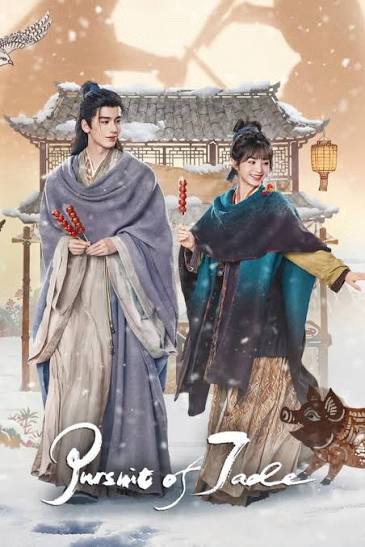
Pretty good! It’s a Cinderella story in which Cinderella is a preternaturally strong pig butcher (Fan Changyu, played by a winning Tian Xiwei) and the Prince, a preternaturally pretty marquis in disguise (Yan Zheng/Xie Jiuheng, played by Zhang Linghe).
I really liked the reversed gender dynamic, which starts with the female lead literally carrying the male lead (after she digs him wounded out of a snow bank following a failed assassination attempt by his evil uncle) and keeps that vibe strong for the rest of the series. Changyu repeatedly saves Zheng’s butt and the day along with it, roundly rejecting any attempts to protect or shelter her. I also love how she protects her family and friends in her home village of Lin’an, a rough and wintery locale that’s nevertheless stuffed with so many charming characters and scenes that it made me want to move there.
The show’s strongest in its first act in Lin’an. It’s even pretty decent once it moves to the battlefield for the second act, as Changyu learns about Zheng’s true identity (which he had to hide but which still reasonably feels like a betrayal) and as the empire of Dayin fights for its independence from scheming neighbors and various exiled crown princes. Once the Court Intrigue really gins up in the third act, however, dragging the story back to the capital, it drags the action and energy of the drama down with it.
CAVEAT LECTOR: BEYOND HERE THERE BE SPOILERS Look: I do appreciate that “Pursuit of Jade” forewent the device of ridiculous misunderstandings between the leads that C-dramas (at least the romantic ones) tend to chuck into the third act to delay their inevitable Happily Ever After; that freaking drives me crazy. Here, the second-act misunderstandings between Changyu and Zheng all felt pretty organic and earned. However, since they were largely cleared up by Act Three, nothing made me truly worry about the fate of our leading lovebirds. So, the tension dropped, and the story started to grind its gears through revelations of the mystery behind the inciting incident 17 years prior (the Battle of Jinzhou that resulted in Zheng’s dad’s death and Changyu’s dad being branded a traitor and exiled), the machinations of various contenders for the throne of Dayin, and the resolution of various other side plots. Changyu and Zheng’s love story got a bit sidelined in all the Strategery.
That’s not to say some of those side plots and characters weren’t compelling. Stand-outs include Crown Prince Sui Yuanhuai/Qi Min’s toxic obsession with the mysterious and beautiful doyenne of Lin’an’s Yixiang Restaurant, Yu Qianqian; the gang of thugs led by Jin Yuanbao who become Changyu’s bodyguards after she defeats them in combat and then saves their families from starvation; and Changyu’s childless neighbors in Xigu Alley, the Zhaos, who care for her and her little sister after the death of their parents. There’s also a star-crossed romance between the Grand Princess and her Go tutor that’s fun to watch. Unfortunately, these supporting storylines are so strong that the main love story, lacking any driving drama at that point, can’t compete. Here I’ll also note that the Big Mystery of Jinzhou is never fully explained to my satisfaction. BUT, I did love the post-credit stinger in which the director filmed an alternate ending in a world in which Jinzhou never happened; it was actually a really satisfying way to wrap things up.
Additional savvy directorial choices helped buoy my interest through the boggy bits of the drama. First of all, it’s gorgeously shot—swirling snow and textured neutrals in the background, saturated colors and luminous pastels foregrounded in the costumes and set pieces. The midnight spearfishing scene in episode 27: I’ll remember that for years—hauntingly beautiful and moving. Legitimately ingenious camera angles—overhead views of gauzy robes swirling ying-yang in bathtubs or furious duels, scheming moments shot through steam and screens and bamboo—add further value to the action. I already mentioned the compelling supporting roles, and of course the leads are all stunning human beings—almost comically so. A lot of the discussion of this drama in China has centered around how unmussed and made-up the Marquis looks at every moment—even in battle; this thread of argument generated the hilarious nickname “The Foundation General” for Yan Zheng, along with tongue-in-cheek suggestions that he must have gotten up at 4 am every morning to get in the glam chair before his 6 am battle start. I have to say—it’s true (also, Zhang’s wooden acting doesn’t help, though in his defense, I’m not sure how much of his face is actually moveable anymore after all the fillers and Botox). And this kind of airbrushed idol/fairy vibe just has never been my jam. I prefer a darker and more realistic mood, like the one in “Rise of Phoenixes” (which I don’t think I ever reviewed here but which is FANfreakingTASTIC; if you haven’t watched it, go watch it instead of “Pursuit of Jade”). Hey, I can sometimes appreciate a fantasy epic like “Word of Honor” or “The Untamed” if I’m in the mood for wire-work and CGI versions of Heaven or Hell. “Pursuit of Jade” tries to walk the tightrope between those aesthetics with mixed results.
Here’s where I need to add a PS comparing “Pursuit of Jade” to “Story of Pearl Girl” because I thought about that other drama SO MUCH while watching POJ that I started calling it “Story of Pig Girl.” There are just so many similarities, from the Cinderella female leads to the grouchy male leads in black fur cloaks (what is it with those fur cloaks??), to the scheming uncles, Instagrammable teahouses, and girl-power vibes. In comparing the two dramas, I feel like Pearl Girl did a better job aesthetically of putting pretty actors in gritty situations: Pig Girl, of managing the romantic tension between the leads (even given the third-act slump; I mean, Pearl Girl was just awful on that front—careening between absurd misunderstandings and cotton-candy makeout sessions with no logic or warning).

