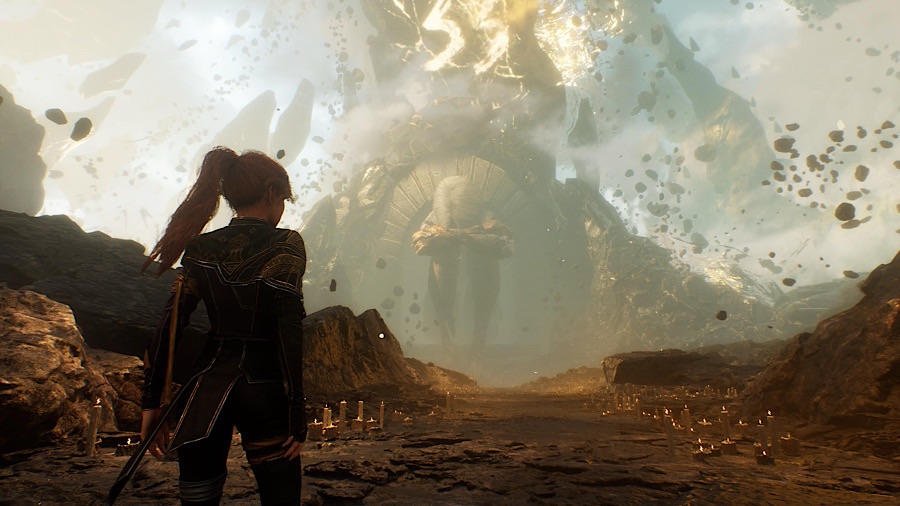
For those who come after….
This is the French-est game ever: that’s pretty much everything you need to know about Clair Obscur: Expedition 33. It’s a game of contrasts just as its title suggests—operatic and understated, carnivalesque and dark, austere and decadent, goofy and sexy. Until I got used to the visual style, I frequently found myself blinking and thinking, “Aaah, too much!” But when my eyes finally adjusted, I found myself fully immersed in the world of Lumière, happy to spend 100+ hours there. In the final accounting, I think E33 fully deserved all the Game of the Year accolades it got, even if a few quibbles with its story and leveling system linger.
Game Style and Play
At its core, this is a third-person Japanese-style role playing game, but it mixes in healthy doses of open-world exploration, a QTE (quick time event) system that livens up the turn-based combat, and a few minor puzzles.
Honestly, the game design is just about perfect. It’s complex, as all JRPGs are, but never to the point where frustration overwhelms intrigue and challenge. The main developer, Guillaume Broche, spent years at Ubisoft before leaving to start Sandfall Interactive, and he took lots of notes about what worked and didn’t work from the player’s perspective, and it shows. It also helps that E33 wears its heart on its sleeve, enticing the player through the gameplay and levels with emotionally engaging characters and storytelling.
Broche certainly doesn’t hide his influences: he names weapons after characters in Xenoblade Chronicles 3; the combat array for each character looks like a steampunk version of the array from Persona 5; certain boss fights (e.g., Dualiste) look like they were ripped straight from the world of Dark Souls…. But E33 wears these influences lightly and improves on most of them in substantial ways. I’ll come back to details of the combat system and other gameplay elements in a minute because they’re a *lot*, and I think you’ll want to hear about the story and world first.
Story and World
You start off playing Gustave, a French dude who lives in the city of Lumière. The costumes and melted Eiffel Tower in the background clue you in that Lumière is some kind of post-apocalyptic alternative Belle Époque Paris—shattered by a pre-game event called the Fracture. Gustave and his adopted little sister Maelle are soon racing through the jumbled streets and across the tilted rooftops of the city to its harbor for an annual event ominously called the Gommage. MINOR SPOILERS here, as these happen within the first 5 minutes of the game: during the Gommage (French for Erasure) a monumental figure named The Paintress rouses herself from slumber at the base of a monolith visible across the ocean and decreases the count on a glowing clock—currently set to 34. When she does, everyone that age dissolves into rose petals—which is exactly what happens to Gustave’s ex-girlfriend Sophie after he gives her a flower and wishes her…well, I guess?
Shiver. But Gustave and Maelle’s society has adapted to this bizarre cosmology. Everyone gets married young so they can have kids before they turn into rose petals; and, they throw a big party every year for both the Gommagees and the Expedition, in which a group of volunteers who are due to be Gommaged the following year set off across the sea that broke Lumière off from the rest of the world during the Fracture (the event that started the Paintress’s countdown clock at year 100) to try to kill the Paintress and stop her clock. You might have already done the math, but that means that 67 expeditions have tried and failed when Gustave joins Expedition 33.
Maelle joins, too, as she doesn’t want to be left behind without her only family. However (MORE SPOILERS, still very early on), out of the mists of the first island E33 lands on, a mysterious gray-haired man appears and slaughters most of the expedition, scattering the few survivors. The gray hair is significant b/c that means that whoever this is has survived the Gommage: how? That becomes one of the driving mysteries of the game, in addition to figuring out who the Paintress is and how to stop her.
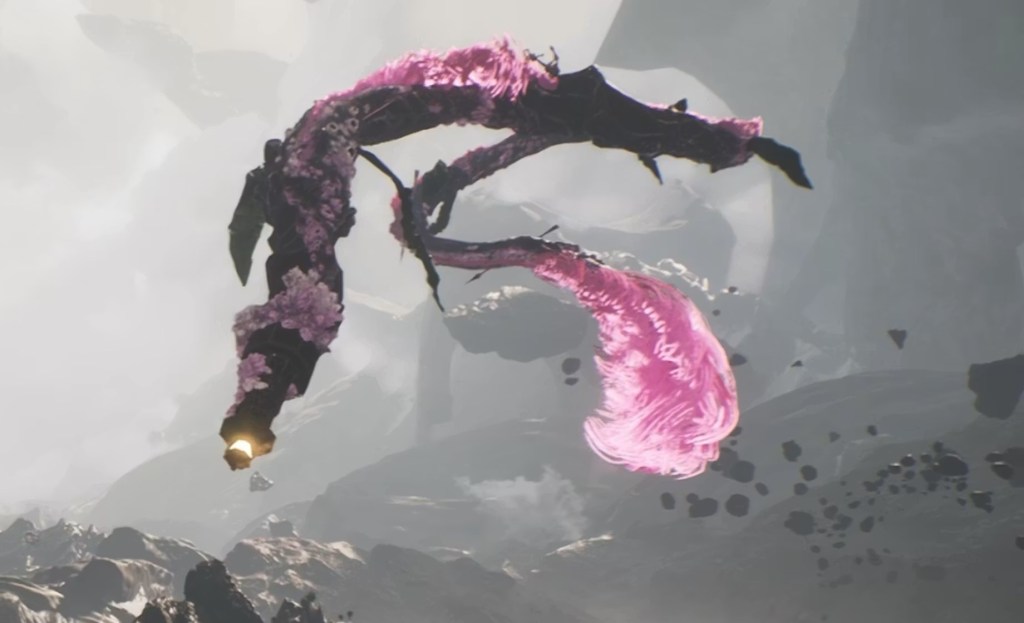
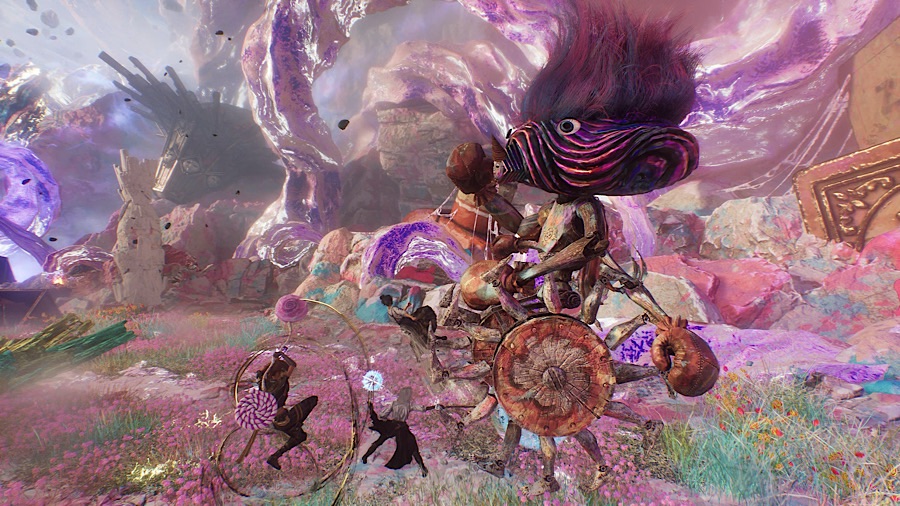
In trying to get his bearings, Gustave bumps into Luné first, a wizard who manipulates Chroma (the life-energy and currency in the game) to generate healing and other elemental effects. While she tries to convince him to head on toward the Monolith, he won’t leave the island without finding Maelle, so they head off in search. And almost immediately, they encounter the game’s monsters—nevrons who seek to steal the expeditioners’ chroma. I can’t overstate the originality of these monsters: they’re like Lewis Carroll’s linguistic portmanteaus in visual form. Exhibit A: the Serpenphare, a flying beta-fish eel-snake (serpent) with a lighthouse (phare) for a head that shoots beams of light at you. I’ve never seen more creative grotesquery in a video game.
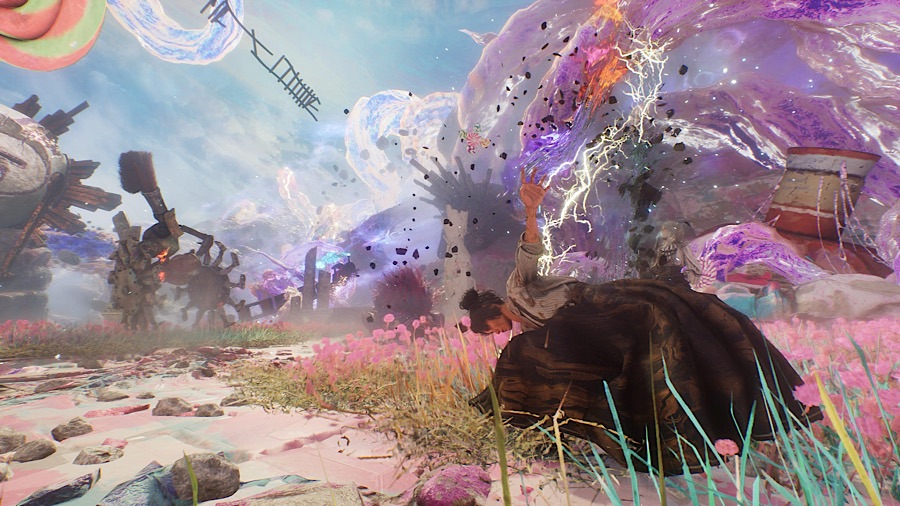
Before I talk about how you fight these guys, I should talk about the incredible game world they inhabit. It’s visually dense and baroque, all warped black rock formations with gold veins, high-chroma foliage, and shattered remains of Parisian architecture, down to the chandeliers and Louis XIV chairs strewn poignantly about. When you’re in the open world, it takes on a dioramic perspective, the foreground flattened so you can see where you’re going while the background of shredded mountains, floating islands, and chromatic clouds takes on an epic stature. Out here you can Camp at any time to rest, buff your party, and increase your relationship levels by spending time with party members: after Maelle, you add a few more for a total of 5 at any time that can be divided into 2 parties.
When you enter an “area” or dungeon, the camera pulls in tight behind whoever your lead character is (you can toggle this), and you see things from a more immersive perspective; here you can save and do some limited party functions at Flags, each chillingly marked with the number of the doomed expedition that planted it; you’ll also encounter their voice journals in crystalline recordings hidden in the dungeons (collecting them provides some signficant perks, so don’t miss them).
I shouldn’t go any further without talking about the sound design because it’s likely been what you’ve heard about with this game if you’ve heard nothing else. The OST (original soundtrack) by Lorien Testard is unlike anything else in video games: orchestral and operatic, almost entirely analog. Like it or hate it, you can’t help but admire the achievement, and I predict you will remember the music in this game as much as or more than any character—because it really *is* a NPC (non-player character) in the game. You can and should listen to it even if you have no intention of playing E33: you’ll be amazed. But if you do listen while you play and pay attention to what you’re hearing, the soundtrack will give you important clues about the story and its mysteries—even if you don’t understand the French lyrics. More broadly, the sound design in the game is excellent with effects that not only enhance big moves in combat but give you important cues for QTE.
Combat System and Game Mechanics
Look: this is a JRPG, so it ain’t easy. I’m not going to go into detail here because it might scare you off a system that’s actually pretty elegant and usable. I strongly recommend Arktix’s videos for details and tutorials. But basically in combat you have Action Points you can spend during each member of your party’s turn (you have a main and reserve party, max 3 characters each). With AP you can free-shoot with your weapon, often necessary for certain effects or enemies, or use a Skill. If you’re out of AP, you can always Attack, which builds up AP for your next turn.
The other primary way you build up AP is by Parrying enemy attacks. I mentioned that E33 has a QTE system that enlivens the turn-based combat framework. When an enemy attacks you can almost always Dodge it within a pretty generous QTE window. If you Parry the attack within a tighter window, you’ll not only stop the attack, you’ll earn AP. If you Parry all the hits an enemy dishes out during its turn, you’ll get a chance to Counterattack, which can give you AP and do some pretty healthy bonus damage. Developing the ability to Parry is critical for all difficulty modes above Story (easy). See Hot Tips below for some pointers on that. There are also powerful Gradient Attacks you pick up as you develop relationships within your party; they don’t cost AP but charge up on their own schedule—the game has a pretty good tutorial on these.
The combat system I just described relies on a multifaceted and interlocking ability system—involving Weapons, Attributes, Pictos, and Lumina. It’s complex but well-designed and reasonably learnable; again, Arktix’s tutorials can help with details and tips if you’re struggling.
You do do other things than fight in this game, though precious few: there are some collections you can make that are worth your while (journals in particular, also records you can play in Camp) and some platforming puzzles in fun Gestral Camps: Gestrals are friendly brush-headed creatures you encounter in your travels, and they serve as merchants who can sell you weapons, pictos, outfits for your party, and more. As in other open-world games, it pays to hunt around in dead-ends, nooks, and crannies to find merchants as well as Items that will increase your resources and abilities.
BEYOND HERE THERE BE DRAGON-SIZE SPOILERS
What I Loved:
Pretty much everything. The French aesthetic was a lot, but the game was so well-built that the over-ripeness of the design didn’t ruin it for me. I didn’t get as swept away emotionally by the story as a lot of players have: for instance, when Gustave was killed off at the end of Act I and replaced with Verso, I was like, shrug, the new guy is hotter. However, I especially loved…
- Esquie’s flying ability: when that unlocked and I could soar above and around the vertiginous landscape, I think I gasped out loud.
- The music, of course: not my jam genre-wise, but just so well done.
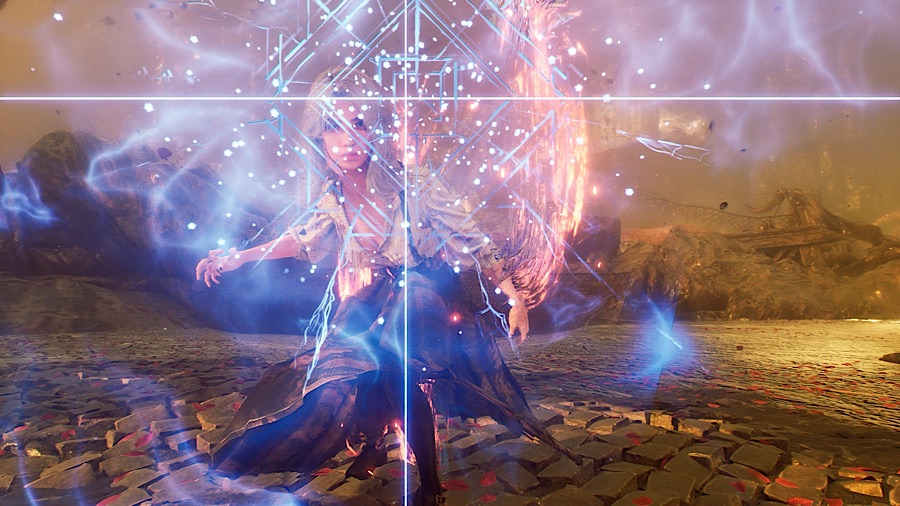
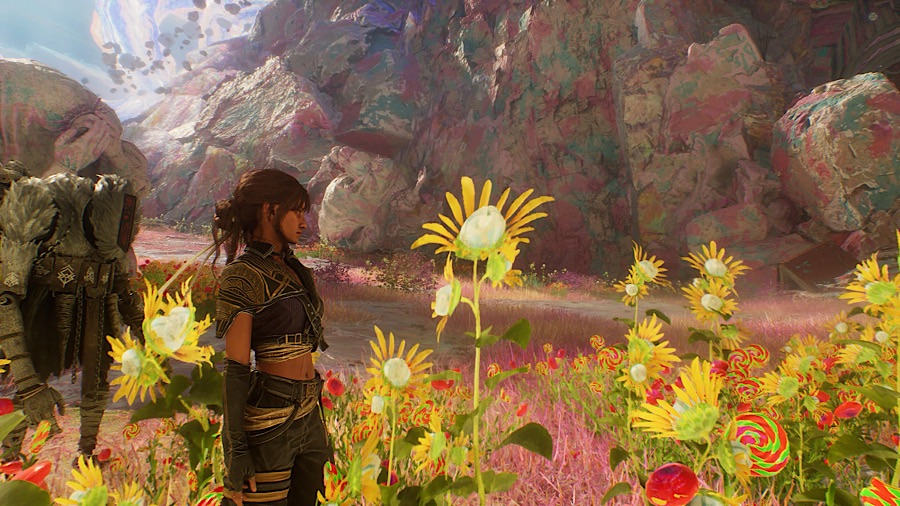
- The thank-you update, particularly Verso’s Drafts: loved the fun dance music, the candy-coated reprieve from the darkness of the world, the redemptive trip back to Verso’s childhood. Love, love, love. I did the whole thing twice including the boss fight. Also loved the improvements to the Photo Mode, as you’ll see in the gallery—I took a LOT of action photos in Verso’s Drafts.
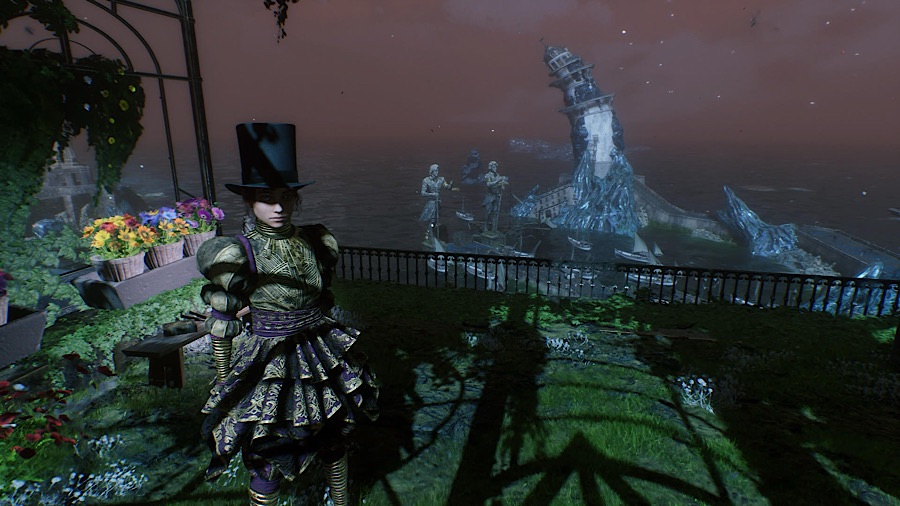
- The baguette outfits were hilarious and very French.
- The double endings—it felt right that there wasn’t a canon ending; it emphasized the ambiguous nature of grief and recovery and the fact that every decision we make, in this world or any other, has a downside. You have to live with that and find joy in spite of it.
- The Clea boss-fight. It was IMPOSSIBLE for me to parry all her ridiculous attacks, but I figured out how to stun-lock her with Verso’s Overload and End-Bringer abilities, buffed by Sciel’s Intervention. I was super-proud of myself for figuring that out without resorting to Reddit.
- I ❤ Stalacts. If I could make a plushie out of them, I would.
- My favorite dungeons: Frozen Hearts, Flying Manor, the Reacher. Verso’s Drafts, of course, and also the Endless Tower actually—it was super-handy for improving my Parrying skills, filling in gaps in Monoco’s skills, and leveling up.
- Monoco: “What lovely feet you have….” Loved his theme music, his nevron-based skill-set and the Wheel mechanic. And he hits *hard*: that Lampmaster Light skill saved me so many times. Also loved Sciel—she’s a badass and kind-hearted–the emotional glue of the party.
- I loved that you could make it through the main story without having to be a sys-admin—but if you wanted to engage the optional bosses (like Clea and Simon), you needed to get down with the Parry and figure out how to stack damage with luminas, weapons, and skills. That was a nice balance between challenge and story progression, I thought.
- I loved the checkpoints being flags planted by previous expeditions, and all the platforming infrastructure and camps they left behind “for those who come after”—such a cool game/story mechanic!
What I Didn’t Love
I’ll get the easy ones out of the way first: I had a minor issue with the leveling system toward the end of the game. For most of the game, it was great—you just had to fight all the monsters and clear all the areas, and you got a lot of good practice in the process. But the leveling got annoying after the main story ended, in spite of the really great Thank-You Update additions of Renoir’s and Verso’s Drafts. Specifically, getting above Level 90 was *a grind*—not only in terms of getting XP but also in terms of farming needed lumina; I ended up having to mindlessly farm areas I’d already cleared, repeatedly one-shotting mobs of enemies. Yawn. I get that devs can’t program infinite new areas; and, they could legitimately argue that if you want to go after optional post-main-story bosses, the grind is on you. But I think a relatively easy fix would have been to make the 4 optional bosses in the Endless Tower update a *skosh* easier. I mean, I was getting plastered by them *after* defeating Simon. If they had helped me get from level 90 to 95+ instead, it would have been both fun and profitable.
Also, have to say it: hated the platforming. The jump mechanic was wildly hard to control and really frustrating. Fortunately this mostly matters in the mini-games and optional areas that can be avoided.
Here’s my bigger issue, and this is not going to be a popular take: I didn’t love the story. Look, I loved the overarching fable about losing yourself in grief and the ironic damage it does to those loved ones still around you. I loved the Canvas being Verso’s creation from his experiences and childhood memories, and Aline losing herself in it in an attempt to keep her son with her; and, Renoir becoming increasingly desperate in his attempts to bring her back. That’s all first-rate. And the dual endings, as I said above, were just the right way to handle an essentially insoluable problem. But for most of the game the emotional impact of what was happening got lost for me in unexplained complexities and technicalities. In other words, I couldn’t lose myself in the characters’ perspectives and problems because they seemed fabricated and incompletely thought through, rather than organic. Maybe that’s my issue, not being able to suspend disbelief, but there it is.
Bottom line is I never really understood what the Dessendres were doing as Painters or how they were interacting with the Canvas (Verso’s Canvas? Or all of theirs?) Like, there were 3 versions of each of the 5 family members (real, painted, soul-echo), but the soul-echo versions were never explained and just added confusion for me (like, where was soul-echo Alicia? Did she not have one b/c she never Painted anything? What was the point of them anyway?) I quickly got frustrated trying to figure out who each new character/version was when they showed up and keep track of them, and in my defense, when there’s 14 of these versions, it’s kind of hard to care about them anymore.
Also, I never understood the cosmology of the Canvas: is there just one for all of them, and they each have areas in it? Or are there multiple canvases and they overlap? Don’t overlap? Everyone keeps referring to the Canvas as Verso’s, but Aline’s the one who painted the Dessendre family portrait, supposedly the source of the painted family members running around the Canvas (for instance, we find out Clea doesn’t like how Aline painted her and painted over it). Maybe the devs cut some scenes in the real world that showed the Painters painting themselves, stepping into the canvas, leaving soul-echoes as they traveled in the Canvas—that would have at least made it make more sense, if it didn’t make me care about them.
There was the problem of the Chroma as well: It’s the in-game currency, and the life-force of all painted characters in the Canvas (it’s basically magic paint), but what’s its source? Clea supposedly crafts nevrons explicitly to “steal” chroma from Aline (by sucking it out of expeditioners) and thus force her out of the painting because she’s run out of paint. OK, then that strategy would imply that Chroma is a closed, finite pool within the Canvas. But wouldn’t that mean Aline also has to harvest expeditioners to get more paint, which would render her supposed mission to protect Verso’s creations sadistically moot? If instead Chroma comes from outside the Canvas in the “real” world, why can’t Aline simply draw more from there whenever she wants to rebuild/maintain the Canvas? In short, the Chroma economy just doesn’t balance.
Neither does the idea that the tragedy that sparks the action of the story—real Verso’s death in a house fire—is the fault of Writers who are somehow at war with the Painters: besides it not making any sense, it’s honestly an off-putting political statement to make at this moment in history when the arts are under attack; was it some weird commentary on the Screen Actors Guild strike a couple years ago? I just didn’t get it, and there was no motivation behind the enmity. But it’s also likely the most logical direction a sequel will track—Clea’s revenge against the Writers–so perhaps Sandfall will have a chance to fill in those gaps in the future.
I’ll tell you what *I* thought the story was going to be about before the revelations at the end of Act 2. I thought it was going to be a fable about Alzheimer’s and memory loss. After all, the Paintress was an older woman, the monsters were named nevrons (neurons) and axons (which are key parts of neurons), and the NPCs were being erased in reverse, from older to younger, just as folks with degenerative memory loss lose more recent memories while hanging on to childhood memories. I thought this was going to be a story about the Paintress’s memories, as crucial parts of her personality, fighting hard to survive and finding out in the process that she wasn’t their enemy, that a degenerative monster/disease was. Cool, huh? But apparently totally wrong.
Anyway, TL;DR: I liked the overarching idea of the story of E33, and Jen Svedberg-Yen’s dialogue was first-rate, but ultimately I lost the emotional forest in the technicality trees. Fortunately, the game play was so challenging and fulfilling that I could ignore the trees for the most part.
Hot Tips
- pay attention to the color of the swirling portal to any area/dungeon you encounter: pale yellow means your party is leveled reasonably to handle it; red means your party’s under-leveled at the moment. Cleared areas turn blue-green.
- You can’t recoat weapons, so choose wisely: for sure you’re going to want to get Medalum for Maelle (have her take the final fight at the Gestral Arena) and keep it leveled as you go; it lets you start in Virtuose stance, which becomes crucial for winning late-game and optional boss fights. You’ll want at least one fire-based weapon leveled up pretty high for each of your characters as stacking Burn becomes an important way to do passive damage late-game. Joyaro is clutch for Monoco b/c it starts him in Almighty (just like Virtuose stance for Maelle—multiplies damage).
- If you need to farm Grandiose Chroma Catalysts late-game to level up some left-behind weapons, Dark Shores is your jam. You can get 5 pretty quickly, rest and repeat. Also, don’t miss the Flying Manor—you fight a range of difficult enemies who will level up their associated weapons when you defeat them.
- Parrying: The best way to work up to Parrying is to Dodge an enemy’s attacks until you’re getting Perfect Dodge consistently; Perfect Dodge has the same timing window as the Parry, so you’re ready to switch over at that point to Parrying. To perfect that timing, there are a couple of cues that Arktix and others point out: one is visual; the screen will zoom out and then suddenly zoom in to the enemy’s attack; at the max zoom-out point is when you want to Perfect Dodge/Parry. The other cue is aural and was actually easier for me especially with visually busy attacks; there will be a “shing!” type sound like a sword being drawn—that’s when you want to hit Parry.
- For farming lumina, make sure you don’t kill any of the white nevrons after you’ve done their quests, and go see Blanche at the Fountain; you’ll get 100 lumina for your mercy. You can also pick up a chunk of lumina for finding journals and bringing them back to the gestral who’s collecting them in the marketplace in the Gestral Village. The Endless Tower is good for farming both lumina and chroma catalysts. But by far the best way to farm hella Lumina, per Reddit (and I tried it—it works) is to leave the Chromatic Danseuse in Old Lumière (down off the beaten track by the Train Station Flag) alive until late-game. Then, when you fight her, *don’t* attack her directly (that means letting her Gradient Fall you and taking the hit without R2-ing her, so fight your instincts there). Wait for her to spawn clones and kill *them* on repeat; you get 5 lumina per clone and can rack up a ton of lumina very quickly this way once your characters do enough damage to one-hit the clones (level 85+). Just be careful not to get too greedy: once you’re above 1000 lumina, a lot of players report the game crashing and losing your rewards—something about the GPU struggling to map all the light flecks left swirling after each clone bites the dust. Cash out after killing 200 clones or fewer, and you should be OK.
- OK, Simon…. Look, this is going to be a horrendously tough fight no matter what. There are lots of different strategies out there: I’ll tell you how I beat him since I couldn’t parry anything after Phase One and I’m not smart enough to make a one-shot build. I got my party up to level 95 and my lumina points up around 350 per character. In terms of specific Luminas, I made sure I had Cheater, Second Chance, and Clea’s Life on everyone so I didn’t have to waste turns healing and could double my actions per turn. Breaking Death was *critical* b/c Simon can OTK even your highest-level character, and you need to Break him to interrupt his ridiculous speed bursts. The rest of my points went on Rush and Burn luminas to take away even more of his turns and stack passive Burn damage on him; I also put Inverted Affinity on everybody to boost damage since Simon drops everyone to 1 HP anyway (and Clea’s Life heals you to full HP on your extra Cheater turn in spite of the Inversion). In my initial party I had Sciel, Verso, and Maelle: I used Sciel to Rush everyone, buff Maelle for damage (Fortune’s Fury and Marking Card), and stun-lock Simon using the same combo as for Clea (Intervention by Sciel and then Verso’s Overload and End-Bringer). Oh, and I’d recommend putting on some Luminas that charge Gradient Attacks quicker, too, since that’s the way you’re really going to burst Simon down (Gommage in Virtuose stance with Fortune’s Fury, Marking Card, and Powerful did like 10M damage for me—which is not record-breaking by any means but was obviously enough since I won). That strat kept my main party up until Phase 3 when Simon wiped them off the canvas. Then, I used Luné and Monoco to Slow him again (Crustal Crush and Chevalier Ice, I think) and burst the rest of his HP (Elemental Trick/Genesis and Lampmaster Light, I think).
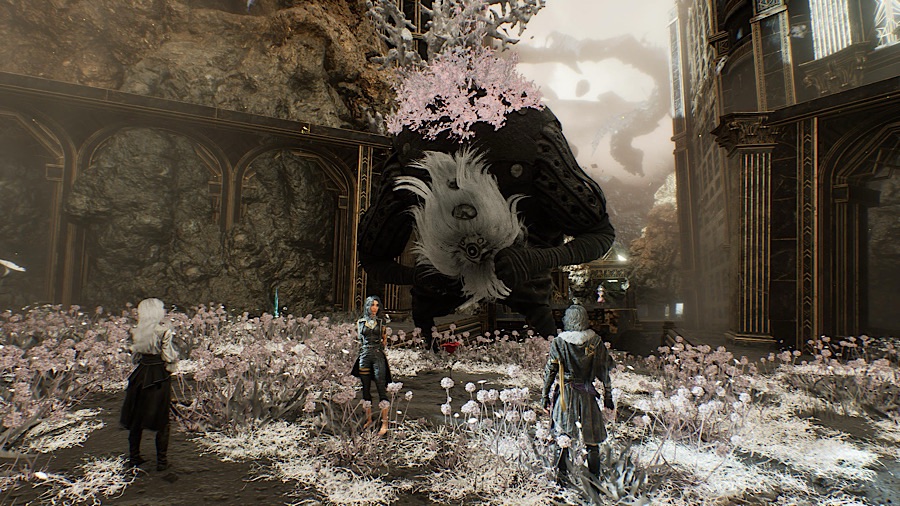
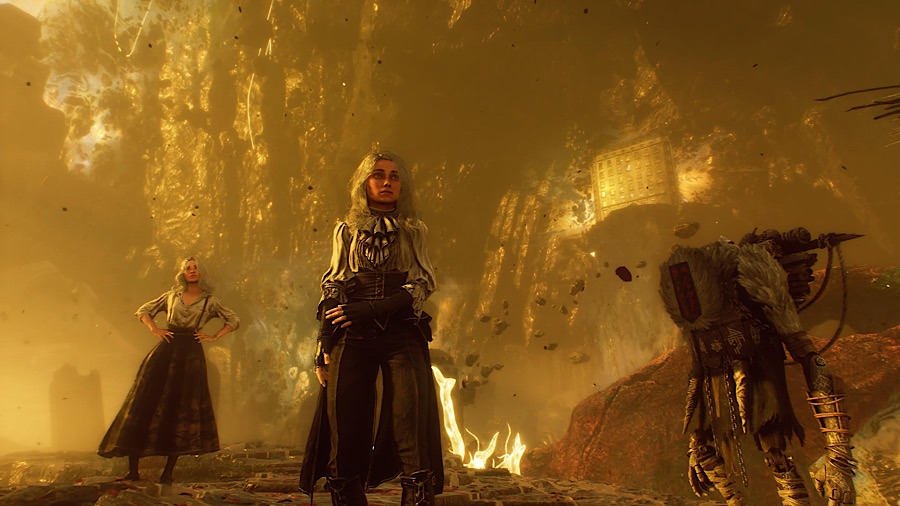
Pretty Picture Time!


One thought on “Loading…Clair Obscur: Expedition 33”