I had kinda given up on ever being able to make the “linguine ricci di mare” recipe from my Try file because it involves fresh sea-urchin roe (most commonly known by its Japanese name, uni). When its fresh, uni is one of the best things you can put in your mouth on the planet: it tastes like the sea air made into a custard with a sprinkling of sugar. But the problem with uni is that it degrades in quality exponentially with every minute it’s outside of the urchin, and so I was unwilling to pay an arm and a leg to have Japanese uni airmailed to me that I wasn’t excited about eating anyway. But this is not a story with a sad ending….
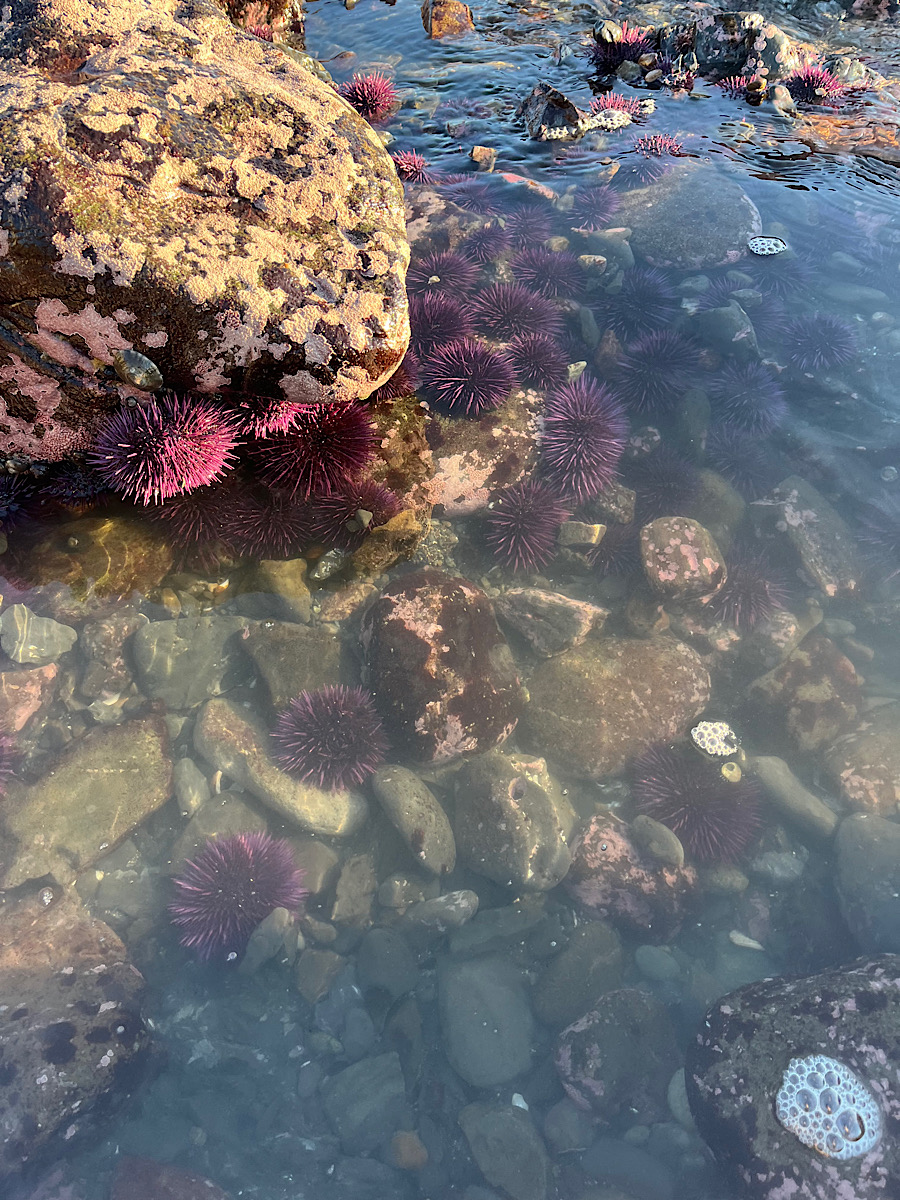
A bit ago, I was reading an article about “urchin barrens,” the eery swaths of bare seafloor and spiky purple balls that are all that are left after purple sea urchins mow down kelp forests, I remembered seeing purple urchins above water in tidepools on the CA coast, and a light bulb went on. I thought, I can help the environment and have my ricci di mare too! Even better, my research quickly turned up the factoid that there was going to be a big negative low tide at the easiest tidepooling spot for me to get to–Fort Ross–on my birthday weekend. And so I said, in the immortal words of Hannibal from the “A-Team”

Harvesting was not at all difficult: you just need your tide tables, a good pair of wellies, gloves, a knife (even a table knife will pop an urchin off its rock), a bucket, and a valid CA fishing license. There is an exemption for purple sea urchins both from the normal bag limit of 35 urchins per person per day (the “limit” on purple urchins is 40 *gallons* per person per day; basically CDFW is saying, Extinct these for us please!) and from the prohibition on harvesting intertidal invertebrates from tidepools. Basically the policy is Have At It where purple sea urchins are concerned b/c they’re committing ecocide on that stretch of coast: the short history there is that we wiped sea otters out for the fur trade in the 19th century (“we” in this case being the Russians and the Aleutian hunters they hired); the sea urchins the otters snacked on multiplied as a result and moved out farther into the kelp with warming and acidifying seas; and then, in an ironic and slightly meanspirited loop, they mowed down the kelp forests that the otters needed for habitat. So, in conclusion, go get ’em.
Where the trick lies is getting enough roe from your purple urchins. Red urchins are bigger and have nicer lobes of uni. Purple urchin uni is about half the volume, so start by doubling your recipe. Then, I’d apply an additional factor of at least 4x to your harvest quota because only 1 in 4 urchins I harvested had decent uni. Since uni are the urchin’s gonads, they wax and wane with annual reproduction cycles. I had read that fall was the best time to harvest bc they’re fattening up to make it through a stormy winter when there’s not as much food available. But I might have pushed it a bit too late into the fall. Of the 3 I cracked open immediately in camp to check, 2 had nice uni, so I was somewhat mislead on that point. But next time if I were feeding 8 people I’d bring in a minimum of 36 urchins.
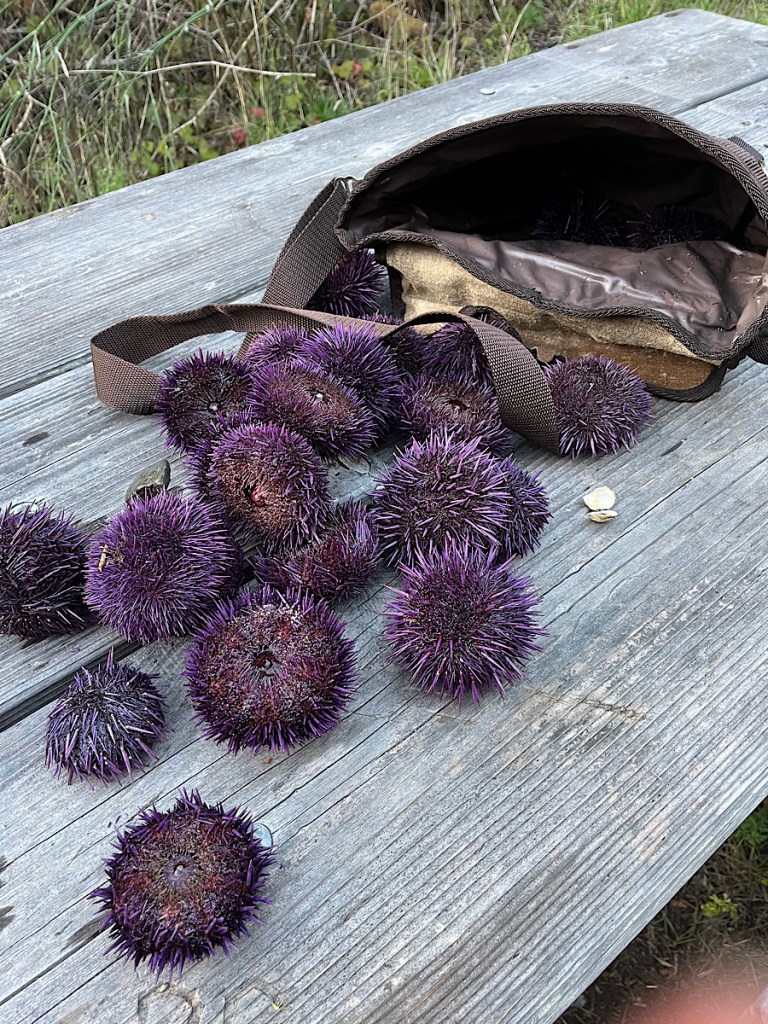
To store them: don’t do it long, but they’ll live a day or two on ice or in cold ocean water. Mine made in home fine in 24 hours on ice.
To process them: first, make sure they’re alive. They should be sticking to each other and the sides of your container; their spines should wave slowly once they warm up on the counter, and the mouth part on the bottom (they’re like little spiky purple roombas) should still be intact and springy. If they’re dead, throw them out, just like clams. Put on gloves, pry out the mouth and teeth with the tip of a knife, then crack open the shell with your thumbs or a knife you don’t care about. I used a pair of garden clippers to snip the shell on both sides of the mouth hole and then cracked it in half with my hands. Gently rinse and coax out the organs and dark, slimy digested kelp, and what you’ll have left if you’re lucky is five or six beautiful orange lobes of uni stuck to the shell. Gently coax these off with your knife tip into a container (or onto a cracker, or straight into your mouth–who am I to judge?) They’ll keep in the fridge for an hour or two but like I said before, time really is of the essence. They oxidize and lose flavor almost as fast as a cut apple does.
We didn’t end up with enough uni to make linguine ricci di mare for everyone, but it turned out that everyone wasn’t as into uni as I am. So, almost everyone tried a lobe on a cracker with some champagne and then just had garlic pasta. Ian and I mixed the rest of the uni into our pasta. And it was *ridiculously* good. Worth every bit of the effort.
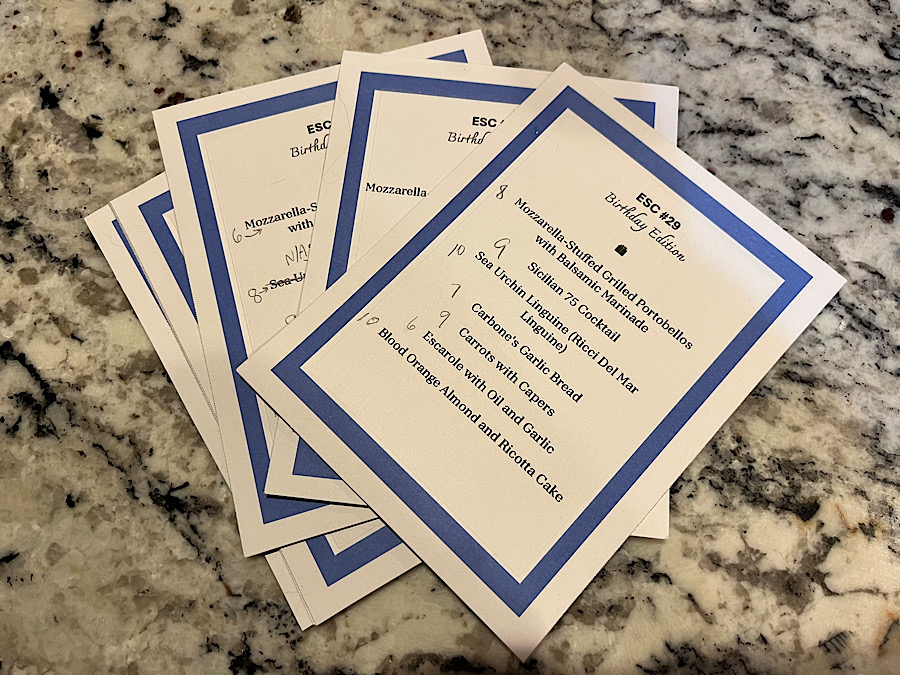
The rest of the dinner was very nice: the carrots and escarole are from Giovanna Bellia La Marca’s Sicilian feasts, the Sicilian 75 was delicious with the grilled stuffed portobellos, and Carbone’s garlic bread was a hit. The blood orange ricotta and almond cake from Smitten Kitchen was the perfect tart and creamy finish to a very Experimental Supper Club.
 The Rookery