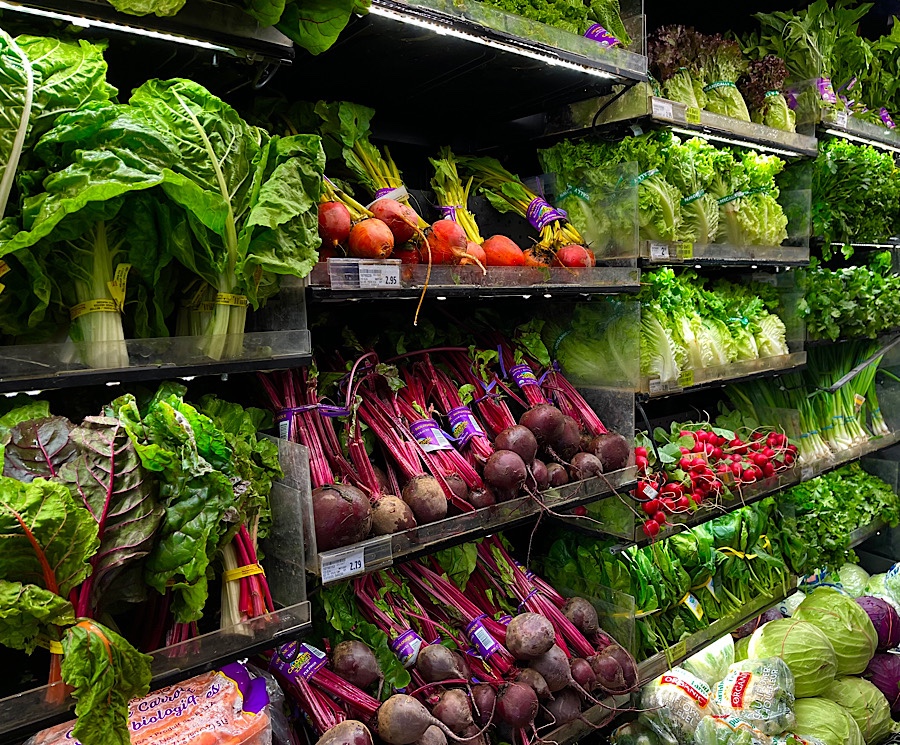
I realized last week that one of the most significant and long-standing relationships of my life hasn’t been with a person but with a place: the grocery store. Naturally, there have been many grocery stores over the years, but if taken together they make this sort of Ur-space where I have worked out some of my biggest issues. To put it in perspective: I’ve definitely spent more time in a grocery store than in a therapist’s office, and more money, and it’s hard to argue I haven’t gotten just as much out of that investment. So, I thought I’d write a bit about what I’ve learned in those climate-controlled, fluorescent-lit aisles.
Let’s get this fact out of the way first: if you’re an American woman, whether you like it or not, you are in a long-term, committed, potentially toxic relationship with a grocery store (or multiple grocery stores; hey, I’m not here to judge). Culturally we’re conditioned and expected to spend a lot of time there, and the stakes are quite high—our family’s happiness and healthiness, our BMI, which is assessed quite harshly…. Depending on where we live, there may be social expectations as well, which mean we can’t just roll in there in our pajamas with a coat on top–like I used to until I started shopping at the Raley’s by the university where my students also shop.
I’ll talk about that Raley’s since it’s a good synecdoche for my total life experience with grocery stores. Also, I’m trauma-bonded to it, which I am not joking about. I realized that this spring when Raley’s shut down for 6 months for renovation (hilarious, by the way; they put down some Luxury Vinyl Plank flooring and added some live mushrooms under glass domes in the produce section [which almost immediately died from lack of care] and called it a day). I actually had an anxiety reaction: Where was I going to shop? I didn’t have a car at the time, and the only other grocery store in a 2-mile radius from my house involved a bike ride so risky I wouldn’t do it (NB: food deserts don’t just happen in poor neighborhoods—they also happen in neighborhoods where city planners assume everyone has a car and so it doesn’t matter how far away basic necessities are). I teared up just thinking about the dilemma. And that reaction is what started me thinking about my relationship to Raley’s. I’ll try to break it down as succinctly as I can (spoiler alert: not very succinctly):
- Raley’s is a lever that society pushes on to get me to conform to gender norms. Of course, it’s a feminized space—you can tell that from the flowers by the front and the bath bomb bar by the pharmacy. But that’s not what I’m not talking about—I’m talking about the way that grocery shopping operates in the household economy. Women are still expected to do it in spite of the fact that most now have non-domestic jobs on top of their domestic jobs. Even when they don’t do the grocery shopping for their household, it’s somehow still their responsibility. Toward the end of my marriage, my ex-husband mostly did the grocery shopping because we only had one car and he drove it to work. But I noticed the grocery store lever didn’t push on him the same way it pushed on me. If he forgot to get something or didn’t get enough for the week and we had to go back, it was no big deal. If *I* made one of those errors, however, it was instantly interpreted as evidence that I didn’t care about my husband’s needs and wasn’t holding up my end of the marriage partnership. After multiple iterations of this lopsided dynamic, the following dawned on me: if a man grocery shops, it’s a charitable act, for which he can be praised but never criticized, because in the final accounting he’s viewed as shouldering a woman’s responsibility.
- Raley’s reminds me of how tricky it is to be a good capitalist subject. Thirty brands of power bars? Seventy kinds of cereal? Some days I’m reminded of when I got back from a literacy project in Mali in the 1990s and stood shivering under the air conditioning and blinking at all those boxes of cereal under the harsh fluroescent lights thinking, “I know I’m supposed to be overjoyed right now at all this affluence and all these choices, but I just kinda feel gross.” But then when I go to our local Co-op that (mostly) only carries things from our regional food shed, and they don’t have limes, I get seriously annoyed. So, Raley’s makes it clear to me that I’m part of the problem.
- Because it’s so economically and culturally freighted, who goes to Raley’s is also a good indicator of the health of an intimate relationship: who determines the list, who chooses Raley’s or Trader Joe’s or WinCo or all three, who does the shopping—how these tasks are divided up are a good key to how power is divided, and how intimacy is functioning, in the relationship. When my ex-husband started emotionally divesting from our marriage, one of the first things he did was quit grocery shopping, which in addition to pushing that responsibility back onto me generated more opportunities for me to fail his expectations, which in turn generated further evidence the marriage wasn’t working, etc. etc. I saw the trap but didn’t know how to get out of it. So, in a small act of defiance, I started going to Raley’s without a list; it made me feel better and made him apoplectic.
- While Raley’s may be a lever to make me behave as a certain sort of woman, it has also afforded me a space where I could reforge my identity as a woman. During most of my marriage, because of the dynamics described above, I hated going to the grocery store. My heart would pound as I walked through the door with the anxiety that I would forget something and be judged a bad wife. But toward the end of my marriage and throughout the discard and divorce, Raley’s became a space of rebellion, a haven for me. I would wander up and down the aisles just to see what they had, and they had all sorts of interesting things: Yuba noodles, stick blenders, Korean ramyeon, lavender Epsom salts, cedar coathangers made in the US (sadly discontinued). I made grocery trips into mini-vacations when I was off everybody’s clock, free to follow my own whims. And, I got to know the cashiers: Lisa, who always asked me what I was doing with some exotic ingredient that came down her conveyor belt; Pam, who admired my blanket coat and got me unstuck at the self check-out; the bagger who always said, “You have a great rest of your day.” During the disorientation of my divorce, I would sometimes go to Raley’s even when I didn’t need anything, just to be in a space where I knew where I was and everyone was nice to me.
- Menopause mostly sucks, but not in the grocery store: I was talking to my colleague Jen recently, and we both noted that we now tend to go to the grocery stores in completely non-productive ways–without lists and, thanks to perimenopause, without being able to keep a list in our heads. But that’s the whole point: we’re not productive anymore, as far as society is concerned; we can’t reproduce. And so we’re finally left to our own devices, in the grocery store and elsewhere. It’s kinda awesome. And if we remember what we came for in the parking lot on the way out, oh well. There will always be another day at the grocery store for us.
 The Rookery
That produce section is even more uniform and attractive than Whole Foods, which has a similar structure. Congratulations to your Raley’s.
LikeLike