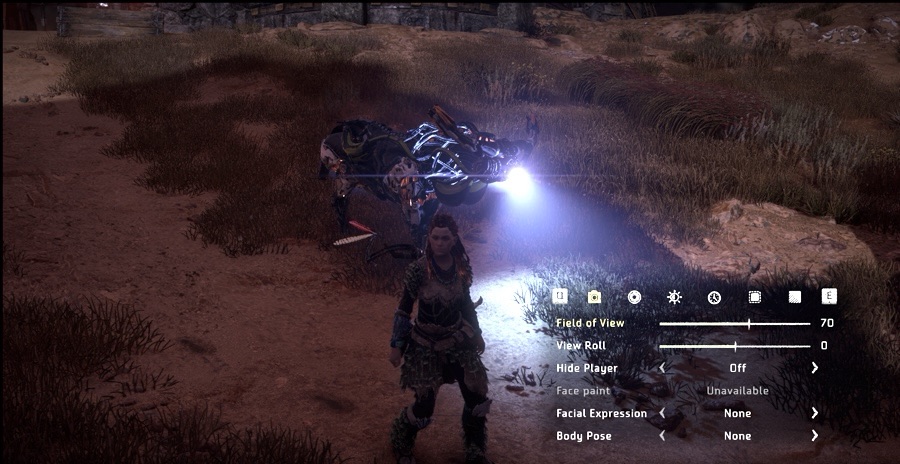
I realized the other day when I saw one of our cute little campus food-delivery robots trundling its way down the sidewalk, and my first thought was, “Where’s my bow?” that I had perhaps been playing too much Horizon: Zero Dawn. Because in this game, you kill robot dinosaurs like the rent is due. As a matter of fact, I seriously considered printing a t-shirt for myself with that slogan on it and a picture of a little Watcher; they were absolutely terrifying at first, but now I think they’re totes adorbs—observe:
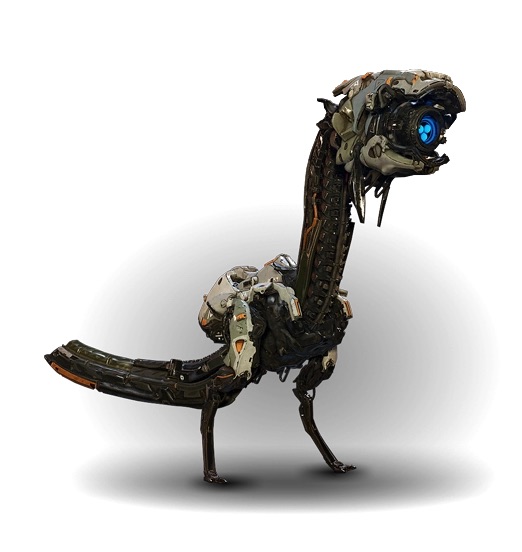
I mean, if that doesn’t make you go awwww….. No? Yeah, OK, I’ve definitely been playing this game too much.
I think I first saw gameplay from the Horizon series when I was starting to look for other open-world games to play after Breath of the Wild back in 2022. It would have been footage from Horizon: Forbidden West because that game had just come out. I remember thinking: Whoa, the character design is so cool! So was the player-character’s moveset: fluid rolls, runs, and leaps punctuated with stylish in-air shots from a tricked-out bow. And, she (Aloy, pronounced “Ay-loy”) wasn’t doing it with her boobs and butt hanging out. Which BTW has always made zero sense to me: fantasy/anime/videogame women characters fighting in “armor” that’s essentially a metal bikini. Um, my boobs are just fat and water—they are not the parts of me whose protection I would prioritize in mortal combat over, say, my heart, spleen, or head.
Anyhoo, props to Guerrilla Games there. Not to mention that the machine-monsters that Aloy was busy turning into expensive pincushions were intricate and beautiful—also intimidating, which is why it took me a while to get up the nerve to play this game. Well, that and platform issues: the Horizon series was only available for PlayStation or PC, and at the time, I was only playing on the Nintendo Switch. But after I broke the PC seal with Ghost of Tsushima, the World of 2010s PC Games was my oyster, baby, and I decided to try the Horizon Series.
I picked Zero Dawn because Reddit said to: kinda but not entirely kidding. Posters on several forums and on YouTube said that the story and game design in Zero Dawn was tighter and made a better introduction to the series, even if the combat system and graphics were more refined in Forbidden West. Plus, the older game was cheaper on Steam.
I’m going to try to be a little more organized with these reviews, so here goes:
Setting/World
Zero Dawn is set in a post-apocalyptic Western U.S. (roughly Colorado and Utah) in which our civilization has been wiped out by a mysterious cataclysm, and relatively primitive tribes of surviving humans battle a harsh climate populated by hostile machines. Some of these look and act a lot like Western wildlife—antelope, bison, and mountain lions—whereas others are bizarre new mechanical life forms. Even more troubling, there has been an event called the Derangement in which strange new machines called Corruptors are going around infecting the native machines with a sort of red goopy light that and causes them to attack humans unprovoked. What’s behind the Derangement, as well as the secrets of the ruins of the Old Ones (namely, us) that litter the landscape are the main question marks punctuating the world when the story begins.
Story
Aloy is an orphan Outcast of the Nora tribe—machine hunters who live in the mountains and dress a lot like Vikings—being raised by another Outcast, Rost. This basically means that she grows up learning how to kill machines and platform impressively, but she’s shunned by the rest of her tribe for reasons that are unpacked as the game progresses. The silver lining of this harsh fate is that she does a lot of exploring on her own, during one episode of which she falls into a sinkhole that leads to some kind of Bunker full of Old Ones tech. She picks up a little Bluetooth-like Focus device that lets her see and hear uncanny info about her surroundings, such as the strengths and weaknesses of machines, their paths, identities of strange humans, valuable items in the landscape, etc. Though Rost calls the Focus junk, Aloy keeps it anyway and uses it to give her advantages in hunting and foraging. When she turns 18, she’s allowed to participate in a test of strength and skill called the Proving that grants the winner full tribal status as a Brave of the Nora. CAVEAT LECTOR: SPOILERS FROM HERE ON. Except…the Proving goes horribly sideways when a cult called the Eclipse shows up, points at Aloy and calls her the Entity, and proceeds to try to kill her. It’s probably *not* a spoiler to say they fail, otherwise you would have no one to play for the rest of the game. But they do manage to kill Rost, ensuring that Aloy will go after them for revenge and to solve the mystery of why they were hunting her in the first place—at whose behest? And what is the Entity?
The journey to find answers to these questions takes Aloy beyond the boundaries of the Nora’s Sacred Land and into the territories of other tribes—the sun-worshipping Carja, the tech-minded Oseram, the Banuk with their snowy fortresses and affinity with machines. It also obliges her to delve into the ruins of the Old Ones, where she recovers powerful ancient tech, learns to override machines to make them do her bidding, and learns she may have an intimate connection to the Old Ones—-in particular, their head scientist, Elisabet Sobeck, who is responsible for the survival of humanity and also, indirectly, for the Derangement.
Gameplay
I would describe Horizon: Zero Dawn as a combat-centric open-world action–adventure game. You’re encouraged to explore the world by the main story, side-quests, and various sets of collectibles—all of which yield decent XP/levelling gains. But this is no Breath of the Wild: I could count the times the “relaxing background music” kicked in on two hands for the entire 60+ hours I played. The rest of the time I was either getting attacked by machines or was being warned I was about to be attacked by a series of effective musical/sonic queues: suspenseful riffs and low, metallic purrs. (The sound design is really nice—more on that point in a moment).
The combat system is well-designed: it’s multifeatured, with a spear, various bows, traps and tripwires, and a couple of gun-type weapons at your disposal as the game progresses. But it eases you into this full armory, which becomes relatively efficient with practice—as long as you develop your own mnemonic for assigning weapons to the quadrants of your Weapons wheel, which you can open and cycle through via the Tab key mid-combat: bows on the sides, trip and rope casters top and bottom, for example. If you don’t, you’ll get plastered by a Stalker while you’re trying to remember where the heck you stuck your shock arrows. The game does grant a slight slow-down of the action while you’re spinning the Wheel of Weapons; and, you can always pause the action completely by bouncing out to the main menu. Machines have somewhat forgiving attack patterns and will give you a breather between attacks, even on harder modes. You’ve got a Concentration mechanic that slows time so you can aim your shots, as well as slow-motion modes that automatically trigger while you’re aiming and jumping, sliding, or mounted on a machine. But all that being said, combat is the focus of this game, and it’s intense.
There’s a whole Stealth skill tree to exploit, too, and you are definitely rewarded for sneaking around in the ubiquitous tall red-flowered grass, either to Override a machine and get it to do your wet-work for you, or to lay a well-placed ambush for a larger machine once you’ve figured out their patrol pattern with your Focus. You’re offered Bandit Camps to clear out as well, where stealth is definitely your friend. Not being great at combat myself (I eventually decided to ramp down to Easy mode because killing robot dinosaurs just wasn’t motivating me to finish the game; I needed to shift the balance toward story progression), I definitely leaned Stealth.
What I Loved
- Character design: It’s drop-dead gorgeous, incredibly ingenious, and inclusive. The Female Gaze has a nice rundown. I really like how Guerrilla designers chose a theme like “sun-worship” to synthesize the Carja tribe’s aesthetic from Egyptian, Aztec, and Berber sources. The diversity of each tribe is lovely and feels organic, once you learn the backstory of how humanity survived the machine apocalypse and rebuilt.
- Riding Machines: That’s me and Bevo up there, my Broadhead override mount I named after the mascot at my graduate alma mater. It’s a big world with a lot of required travel, and mounts make short(er) work of it, at least until you can get your Golden Travel Pack that allows unlimited fast travel between unlocked campfire checkpoints. You can call your mount within a generous time/space range, and if you level them up you can repair them and fight while mounted, which is pretty effective.
- The world: I didn’t take as many screencaps as I did in Ghost of Tsushima, but I think that’s because the world is so immersive and realistic. There aren’t that many “views”: you’re mostly embedded in whatever ecosystem you’re in—mountain, desert, or jungle—and it feels very scaled and organic. And you can’t interact with your surroundings as freely as in Breath of the Wild, for instance, where you can climb any vertical surface or cut anything cuttable with your sword. But I think that’s because it’s a more linear game than BOTW. And anyway, the countryside is chock-full of robot dinosaurs, so there go your picnic plans.
- The NPCs: I did a healthy helping of side-quests early on and really enjoyed them—all the non-player-characters you meet have compelling stories and ways of living in the post-apocalyptic world. I especially ❤ the Groundskeeper at the Nora Hunting Grounds; major crush. I wish I’d had more patience for side-quests and errands toward the end of the game, but by then I was tired of killing machines (which most of the side-quests involve) and was focused on just finishing the story. I’m super-glad I paused to do Petra’s quest on the way to the Bitter Climb, however, because when she showed up with her Oseram cannon at the final battle, I was genuinely overjoyed to see her, and she remembered me (she doesn’t if you haven’t done her quest, which is a cool detail). Several of the other major side-quest NPCs you engage with also show up at the end to help you or wish you well, and that feels really satisfying as well. One of the many ways in which this game reminded me of Ghost of Tsushima, which makes sense as the Sucker Punch guys acknowledge it as a source in several ways (like the cool Nora Brave armor set you can pick up in the Iki Island DLC).
- Dialogue options: Speaking of NPCs, you’re sometimes given options about how you reply to a character, and each option leads you to a (minorly) different outcome. The options are Force, Wit, or Compassion. It was fun playing with those options and, as in Persona 5, is a good example of how a videogame can encourage players to rethink how they interact with people in their real lives.
- The Datapoints: You can scan all sorts of journals and documents with your Focus that you find around the world, and they build out an archive that you can listen to and read to help you understand the lost world of the Old Ones, and the civilizations that are being built in its stead. As a researcher who has done a fair bit of work in archives, I loved piecing together these puzzle-pieces of information into a fuller picture. I especially loved the cryptic logs you’d pull from Tallnecks when you overrode them to get maps of new territories—haunting echoes of a broken system.
- The sound design: The OST is dramatic and beautiful—check it out. The environmental cues are also lovely, in addition to being informative: crackling campfires, squeaks and grunts for different kinds of animals you might want to hunt, rushing water, chirping birds, etc. Especially when you have the Focus on and everything is amplified, you can hear things walking around that want to unalive you, and that sure is useful.
What I Didn’t Love
- Robot Dinosaurs: Look, they’re gorgeous, intricate, and balanced in terms of how you can approach them—override them to make them your ally, farm parts off them without killing them, or take them down. Also, I genuinely appreciate a game that asks you to kill machines rather than people (well, you can kill people in HZD if you want—bandits and cultists; there’s even a creepy psychopathic character Nils who will be your hype man if that’s your jam; it’s not my jam). There are 26 machine species in the game (ish? You see a couple extra fossilized ones that you don’t have to fight, thank goodness, because they’re enormous and nasty); that’s a nice diversity, and they frequently come in organically mixed groups, with one type protecting another type. Further, each one is designed to evolve to cover key vulnerabilities after you’ve killed a few—which is a super-neat design choice. The Notebook helps you keep track of their vulnerabilities once you’ve scanned them with your Focus, and when you scan, their weak spots will stay lit up for a while so you can home in on them. So, I’m not saying the machine design is bad, I’m saying I just don’t care: I didn’t play with robots as a kid for a reason, and I don’t love combat enough as a play style that I’m going to stay motivated to find new ways to kill robots, or kill them in shorter periods of time, or kill them so that I can remove more valuable parts for crafting and trade, zzzzzzzz. Sorry, nodded off for a second there.
- NOT BEING ABLE TO TARGET ENEMIES DURING MELEE. Man, this killed me. I’m not great at combat, we all know that, but I can’t even *count* the number of swings I took fully at the air because I wasn’t pointed precisely enough at the enemy I was trying to hit. It was probably 20%, honestly. I started fighting almost exclusively at range because of this sloppy targeting mechanic. Ghost of Tsushima doesn’t let you lock on either by default (it’s an option you can turn on; I never did), but that game homed your attacks a lot more generously than HZD does.
- The Tutorials: They weren’t tutorials—they were just side-quests that made you practice with a new weapon without giving you any help or guidance on the aforementioned new weapon. And the blast sling tutorial was functionally impossible (not just my opinion: ask Reddit). The XP gains for completing tutorials were decent at the start, but I found they just weren’t worth the hassle after that. The Hunting Grounds are much more effective than the Tutorials for honing your skills with particular weapons IMHO.
Tips
- Watch Arktix’s videos: they’re an unusual and helpful combo of someone who plays the game obsessively and someone who can still put themselves in the shoes of a new player to the game.
- Stay on top of getting those power cells for the Shield Weaver armor. You’ll be glad you did, HINT HINT.
- As soon as you can, onboard the Disarm Traps and Tinker skills under the Forager Skill Tree so you can re-use expensive and rare weapons and modifications.
- Tear is not Damage. If a machine part says it’s weak to “Any,” that’s “any damage,” and it does not include Tear. Make sure the part is flagged for Tear specifically before going at it with Tearblast weapons. I died at least once in the final boss fight because I forgot this.
- Don’t go in hot on larger machines (unless you’re really good at melee and dodging, in which case, knock yourself out—perhaps literally): observe their patrol patterns from cover, lay traps and ambushes to stun and carve shields off them with high-tear ammo, and then hit them in their vulnerable spots with high-damage ammo to finish them.
- On the ropecaster, two tips, both of which I picked up from various folks on YouTube: 1. If you’ve got two decent-sized machines to deal with, say in a Cauldron, sequence them by tying one down to take it out of combat temporarily and focusing on the other; 2. The ropecaster does a ton of Tear, so after you’ve immobilized a big machine that has dangerous weapons on it, like a Behemoth or a Thunderjaw, go back around it and attach ropes specifically to those weapons before it gets up; when it does, they will likely tear off (I’m talking about the Heavy Ropecaster here, not the light).
- Do the Cauldrons, at least through Rho: 1. They’re very cool dungeons with awesome atmosphere, fun platforming, and good rewards (but make sure you have the Cauldron quest activated, or you’ll be wandering around lost in the dark getting stomped by Ravagers). 2. It’s good to be able to override the more common machines because as the game progresses, you’re more likely to encounter areas with mixed machine types in your various quests, and if you can sneak up and override a Ravager, for instance, he can take out a lot of his friends and maybe even soften up a bigger machine for you. I farmed machine hearts for Shadow weapons this way late-game without nocking a single arrow.
 The Rookery
One thought on “Loading…Horizon: Zero Dawn”