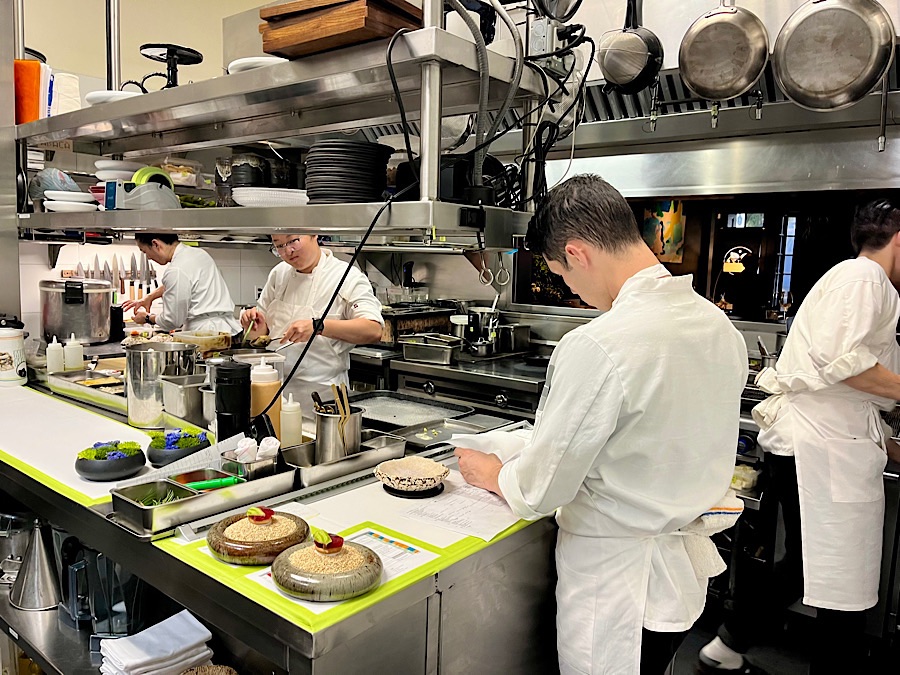
“So, you ready to run away and join the circus?” David Yoshimura asked me as we stood side-by-side in chef’s whites in the kitchen of his Michelin-starred restaurant, Nisei, watching our hard work that day come to fruition as the first plates went out to dinner guests. I just chuckled because the answer to that question would take time Chef David didn’t have in the middle of service.
But here’s the truth: if I were in my 20s again, I would totally do it. I love cooking (obvs). Plus, my ADHD means I can hyperfocus on stimulating tasks for 10 hours straight without flagging. There are of course reasons you might *not* want someone with ADHD around hot stoves and sharp knives all day…. But professional chef is definitely in my top 10 alternative careers, which are as follows:
- Food historian
- Ceramics expert/appraiser for a high-end auction house
- Destination hotel/restaurant owner (my dream is having a “secret” alpenhof that you can only walk or ride a horse to that weary backpackers discover by accident)
- Graphic novelist: I would have to take more art classes, for sure, but I think I could pull this one off with the “build” I was born with.
- Pop music producer. I’ve loved writing melodies since I was a kid and am not half-bad at it; with some training at a young age, I think I could have made this work.
- Dance choreographer: yeah, needed to have been born more flexible for this one, but I *did* choreograph floor routines for my friend Tammy in high school.
- Farmer: notice I didn’t say gardener. I think fruit mostly, but maybe also wheat since I seem to have a knack for it ;P
- Foley artist: ever since I was a kid and saw a documentary on how foley artists make sounds for films using things like cabbages, fishing rods, and toilet plungers, I thought it was the coolest job ever.
- Interior designer: I have a decent eye but would need some training for sure.
Curious what your alternate careers would be—put them in the comments if you feel like it!
Anyway, on to my Day in the Life Of experience at Nisei. I’ve never set foot in a professional kitchen, outside a cooking class on a cruise ship once. Imagine, then, if you will, the astronomical risks and sheer bravery involved in letting me tie on an apron in a Michelin-starred kitchen and help prepare dinner for paying guests. And yet, that’s exactly what Chef David did last weekend when he gave me the incredible opportunity to shadow him and his team for an entire day as they shopped, prepped, and cooked for dinner service. Almost equally incredibly, by the end of that day, I didn’t need stitches, and I hadn’t poisoned anyone. And it was one of the most memorable days of my life, no joke.
A little about Nisei, which means “second-generation” in Japanese and refers to children of Japanese immigrants to the U.S., which is what Chef David is—raised in Houston but a frequent visitor to his father’s family in Japan often, where he learned washoku—home cooking, built around the concept of ichiju sansai (one soup, three side dishes, with rice of course). After culinary school, he staged in Michelin-starred restaurants both in the U.S. and Tokyo (his bio is here if you want more details). He opened Nisei in 2021; in 2022, the restaurant received its first Michelin star and has held onto it every year since then. They’re currently gunning for two stars (and I have every expectation of success for them).
The menu at Nisei respects its foundations in washoku while minding the seasons in California, and making room for the chefs’ latest obsessions. The menu the night I cooked (and ate!) at Nisei is below.
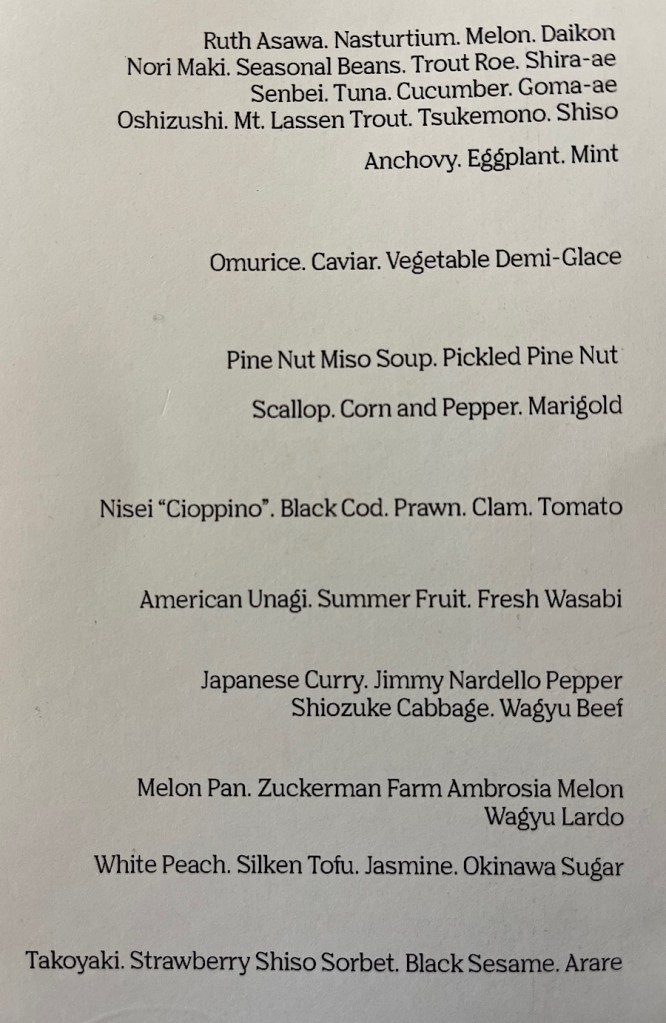
Here’s how the day went down:
9:00 am Chef David, his partner Anna, and I met up at the Ferry Terminal Farmer’s market to pick up seasonal produce. We shopped mostly for the next’s night’s meal, which was Nisei’s 4th anniversary dinner. It was interesting following David and Anna around to the various farmers and purveyors as they picked up orders, checked accounts, chatted with the farmers about family and friends, and tasted samples. The extensive social network it takes to run a Michelin-starred restaurant started to come into relief for me, especially when we bumped into the head chef at Californios, where Chef David used to work before he struck out on his own. We finished up with breakfast—some great Jamaican oxtail and rice from Peaches Patties in the terminal—and then loaded the contents of our cart into Chef David’s car and headed back to Nisei.
10:30 am After a tour of the restaurant and Bar Iris, and introductions to the rest of the Nisei team, it was time to tie on aprons and get prepping—after I learned basic food safely practices and the standard call-signs for moving around the tight quarters without injuring anyone or dumping a thousand dollars-worth of food on the floor, such as “Corner!” and “Behind!” with the very important modifiers “Hot!” and “Sharp!” Also, *everyone* who works in the kitchen is addressed as “chef,” which was a bit of a shock the first time one of the actual chefs addressed me that way—but it’s a vital part of the culture. Chef David and I were mostly working on the next day’s meals, stirring up a bolognese for family meal and deveining and curing miso-marinated foie for the anniversary service. The kitchen was humming, but the vibe was calm, focused, and friendly—pretty much the opposite of what I expected from reading Anthony Bourdain’s Kitchen Confidential, which made a professional kitchen sound like a pirate ship.
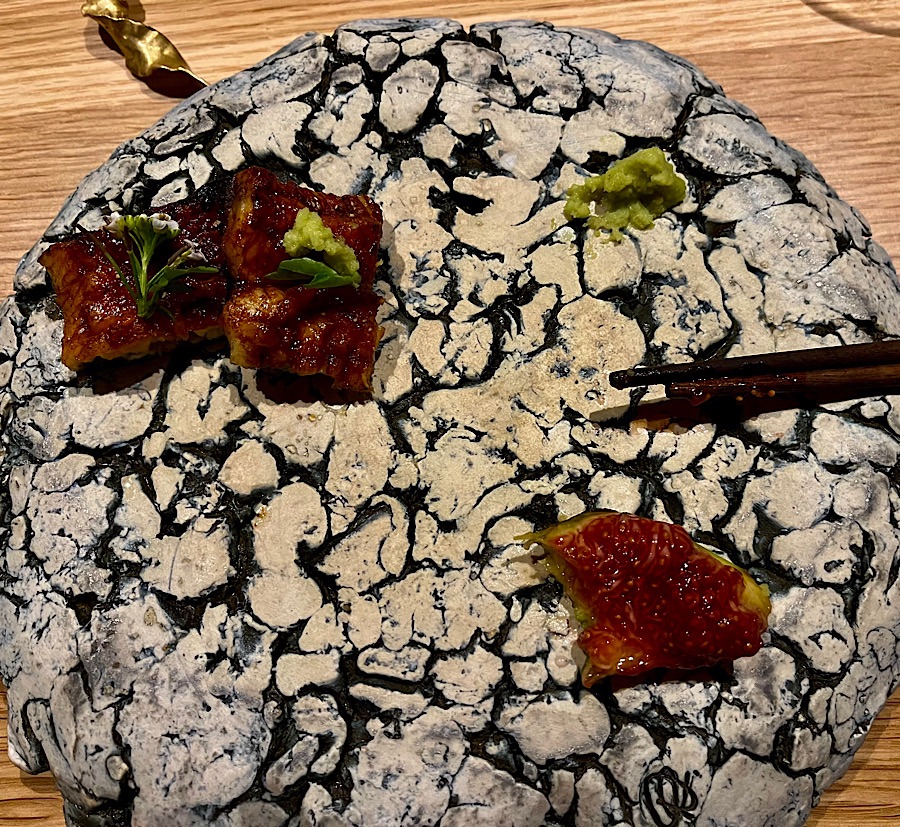
I absolutely loved woodshedding my assigned tasks: weighing balls of red-bean paste and stuffing them with dried cherries, snipping tiny, perfect herbs and flowers for garnish (so many! It was so hard to keep track of counts like 105 and 126 at a time—the chefs must have systems for remembering where they are in their counts, through all inevitable distractions). Chef David had me circulate through all the stations so I could see what each chef was doing. He asked me what I liked to listen to while I cooked, and after we bonded over our shared love of metal, we blasted Astronoid in the kitchen while I snipped tiny sprigs of some white-flowered herb into an ice bath (sorry, I don’t remember their name even though I’m 100% positive Chef Chonghai told me; I was at Herb Saturation at that point. However, those sprigs showed up on my unagi later: see below).
2:30 pm We stopped whatever we were doing and stepped out of the kitchen so the chefs could strip it and scrub it down from top to bottom: they do this every day before service (in addition to taking turns sweeping the floors during prep); Nisei’s kitchen is immaculate. Not wanting to just stand around while we waited to get back in the kitchen, I found Anna and asked her if there was anything I could do to help the front of the house. She set me to folding napkins, which at a Michelin-starred restaurant is no simple task: each clean napkin from the laundry service has to be inspected to make sure there aren’t any frays, stains, or wrinkles that can’t be smoothed out during folding; then, it has to be folded precisely so it will be uniform with the other napkins and can be deployed rapidly during service. One thing I learned from listening to Anna talk to the staff was the way that tiny imperfections can snowball in a Michelin situation where service is intricate and has to be synchronized not only with the kitchen but with the guests’ behavior.
3:00 pm Family meal; we filled our plates with the delicious chicken-and-rice, salad, and cookies that the chefs had ingeniously prepared from leftover ingredients in the cooler. I sat out in the cool sidewalk seating left over from COVID with the chefs and listened to them talk kitchen business. I asked just a few questions about how long they had been at Nisei, why they had been interested in working there, where they had been before: there’s really a diverse range of life experience at the restaurant, and I think it’s one of many reasons the food has gotten even better than when I ate there the first time in 2021. Chef David invites his team to contribute their ideas to the ever-changing menu, and their ideas come from all over the place, literally.
3:30 pm The kitchen had a staff meeting where they went over details for the anniversary dinner and made some last minute changes to dinner service due to a few things being unavailable from suppliers. Then, we went upstairs and changed into chef’s whites, and the chefs plated up samples of the evening’s dishes while the front of the house ate family meal.
3:45 pm The whole team gathered in the Kimono Room (the private dining room, named for a beautiful white-and-gold kimono belonging to Chef David’s mother that hangs on the wall) for an all-hands meeting. The guest list for the evening was gone over, the few alterations to the menu announced. Then, the wait staff studied the sample plates, took photos, and asked questions, making notes on the printouts they had received with details about each course: in anticipation of questions guests might have, they asked things like, “Why is the eel blanched before grilling?” and “Where did the figs come from?” and “What type of pickles are these?” (since Nisei has a pretty extensive tsukemono or traditional pickling/preserving program). After the meeting, we got back into the kitchen and finished up remaining prep tasks before service started: I helped dust cornstarch off mochi, snip more herbs, and place tiny little cutout pickled cherry-tree leaves on wagashi (Japanese tea sweets) with tweezers.
5:00 pm Service starts! I thought I would just stand out of the way and watch (there is literally only one place in the Nisei kitchen to be out of the way, a little one-person-sized triangle of space in a T intersection between the dishwashing station and the main kitchen); however, Chef David had me help the Garde Manger plate some of the courses and expedite. As I caught sight of guests taking their seats out of the corner of my eye, I thought back to all the times I had been on that side of the pass, craning my neck to peak into the kitchen and spy on what the chefs were up to; it was so bizarre and thrilling to be on the reverse side of that equation.
5:45 Anna Lee came to get me to change into civvies before my 6 pm reservation at Bar Iris, Nisei’s partner next door. Their cocktail program is really special, combining a deep knowledge of Japanese spirits with Nisei’s commitment to promoting amazing organic fruits, flowers, spices, and vegetables grown by Californian farmers, particularly Asian-American ones (Chef David told me a cute story about the feisty farmer of the heirloom short-grain rice he uses at Nisei chewing him out because she saw a photo of one of his rice dishes online in which her rice “looked overcooked!” He assured her it was not…). The bar manager, Andrey, welcomed me in warmly, and I had a lovely hour resting, people-watching, and sipping a fantastic cocktail made with the corn and marigolds I had helped pick up at the farmer’s market.
7:00 Dinner time. I got to enjoy all the courses I had helped (in a small way) prepare. Yep, those are my flowers on that eel! And I grated that fresh wasabi, too, FYI.
Chef David sent each of the chefs out with at least one course to say hi, so I got a chance to thank each of them for taking me under their wing that day. My favorite course was the Nori Maki, a tiny 2”x1” bite in which you nevertheless could taste every single ingredient in its finest expression. If someone were to ask me, “Why would I ever spend the money to eat at a Michelin-starred restaurant,” I would probably hold up this tiny nori maki as my answer. And then I’d say, You’ve likely never *really* tasted a green bean, or trout roe, until you’ve had a Michelin-caliber chef cook it for you. They know what they’re doing, and what they do is study and practice until they can make every ingredient they lay their hands on taste the best it possibly can, not only by preparing it perfectly on its own but also by putting it into conversation with other ingredients that can bring out its hidden virtues. It’s like C.S. Lewis used to say about friends: they bring out wonderful things in us that we didn’t even know about ourselves. The same is true of Michelin-caliber chefs like Chef Paul, who invented the nori maki, and the rest of the Nisei team.
Toward the end of the meal, Chef David came out to check on me. “How is everything?” he asked.
“Better than when I ate here last time,” I said, “and that’s saying something. How’s everything going back there?”
“We need you,” he said with a wink.
“Just give me a minute to get my clogs back on,” I said. And I meant it.
 The Rookery