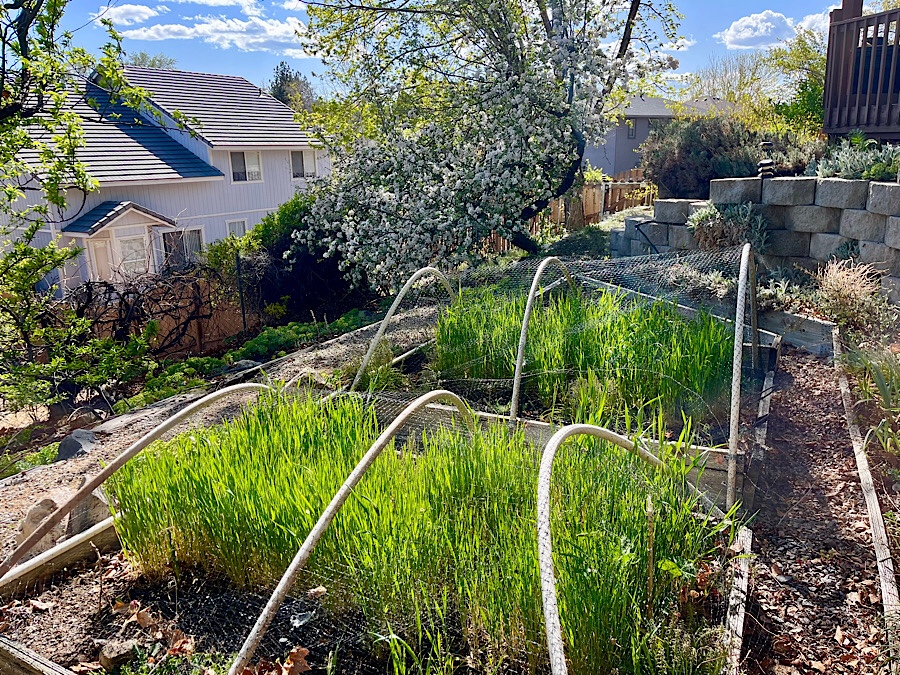
Last year, I think a bird must have pooped out a wheat berry in the path right *next* to my garden beds (not *in* them for some reason), and against all odds, like a Biblical parable, it sprang up and bore fruit. My mama raised me right enough that I know a head of wheat when I see one, so I harvested it, separated the wheatberries from the chaff, and ground them in my mortar into 1 TB of whole-wheat flour. Then, I stared at it and tried to figure out what to do with 1 TB of flour.
First, I thought: how amazing is it that 1 wheat berry turns into 15 wheat berries (on average)? Not amazing to wheat farmers, but I am not a wheat farmer. Or…I wasn’t until this year. Turns out you need at least 2 1/4 cups of flour to make a baguette, so I calculated I needed 36 wheat stalks. I went to Natural Grocers and bought a bag of hard red winter wheat, planted it this winter in 2 of my garden beds, and watered it every day till it came up. Spoiler alert: “winter wheat” doesn’t grow in the winter; nothing grows in the winter. You sow it in the winter and it comes up first thing in the spring). Oops. Like I said, not a wheat farmer. However, despite my ineptitude, look! Wheat! It’s getting little heads and everything. And there’s way more than 36 of them. So, I’ll keep you posted on Operation Baguette.
 The Rookery
Gorgeous.
In Michigan our farmers planted winter wheat in the fall to get an early start. It over-wintered with the short leaves and therefore had a headstart in the spring. Yours looks like it definitely has the headstart.
Yours are growing very closely together–a lot of competition. You might consult a wheat farmer there (probably online), and find how closely they plant their berries in rows, and how far between rows if you do this again. And beware of thrips–though tiny, they bite.
Wishing you an amazing baguette–and admiring your dedication.
LikeLike