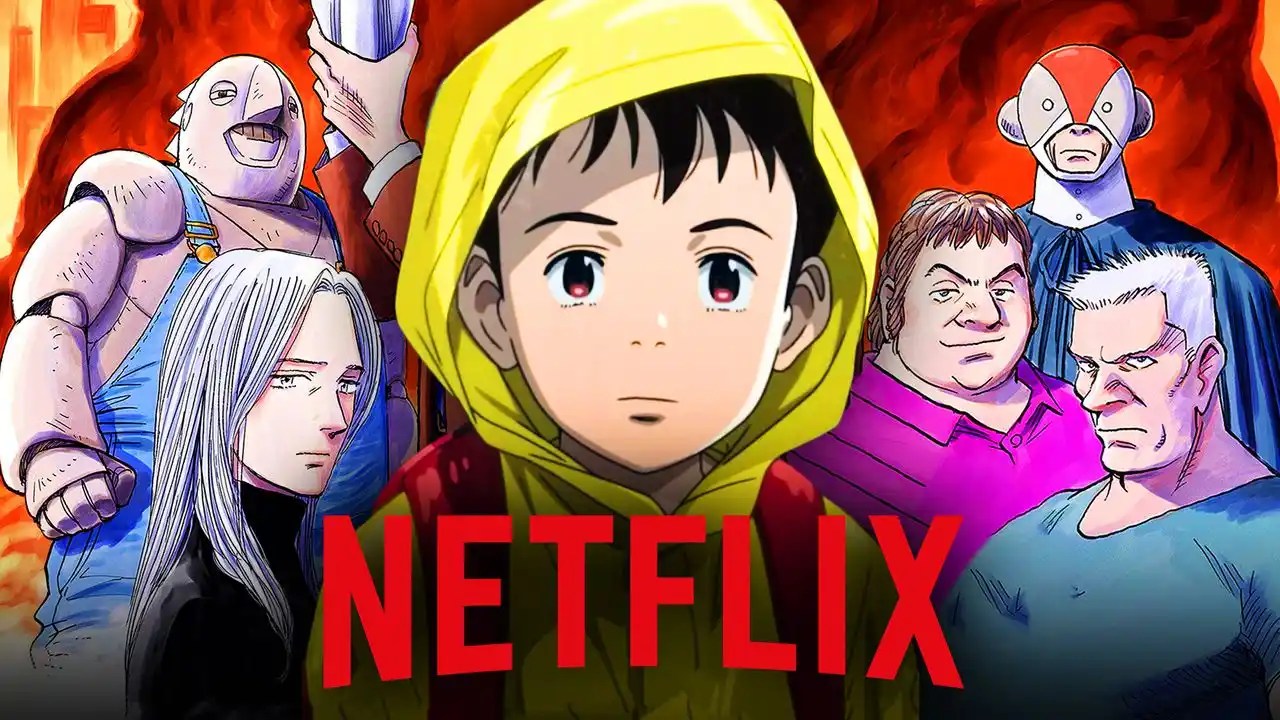
Possibly the most famous manga of all time is Astro Boy, written by Osamu Tezuka and serialized during the 1950s and 1960s in Japan during its harrowing post-WWII reconstruction period. While it reads today as hopelessly corn-cheesy (unless you grew up with it), at the time Astro Boy was a real shot in the arm for Japanese readers, offering the nation a narrative path to redemption on the global scene via innovation in robotics and electronics, one that turned out to be at least partially prophetic.
In the mid-00s, as another global war was unfolding with potentially nuclear consequences, an animator who had grown up with Astro Boy decided to re-tell one of its most cherished arcs, the Greatest Robot on Earth, a whodunit that staged a series of confrontations between Astro Boy and a pair of robots from the Kingdom of Persia. The parallels with the Iraq War were just too tempting for Naoki Urasawa not to draw out, and so he did in Pluto: Urasawa x Tezuka. Last year Netflix animated the Pluto arc over a mini-series of 8 episodes.
Structurally the show is a police procedural, with the twist that the detective in charge, Europol’s Gesicht, is a robot, and he’s trying to prevent the serial murder of the seven most advanced robots on the planet–one of which is he–as well as several human robot researchers and rights advocates. He’s got his hands full because there are a number of red herrings and crossing bunny trails. A International Robot Bill of Rights has just been ratified by the U.N., offering robots full civic and human rights, and the roboticides might have something to do with that. Or, they might not, because each victim is found with a pair of makeshift horns stuck in or near their head in a leitmotif that’s soon identified as belonging to Pluto, horned Roman god of death. Then again, the United States of Thracia is up to its usual global-imperialist machinations, so it might just be taking out the competition for its own (weaker) AI program. But! The victims are also all linked to the recent and devastating 39th Central Asian War against the Kingdom of Persia. In fact, several of them were part of the Bora Fact-finding Mission, sent to the Kingdom by the U.N. prior to the war to verify rumors of a particular violation of International Robot Law–namely, the creation of a Robot of Mass Destruction called Bora by a mad scientist named Goji. The Mission found neither the robot nor the scientist, but their nations invaded the Kingdom anyway and turned it into extended parking for Europe. (Sound familiar? What’s particularly creepy about this is that like 70% of it was original to the original Astro Boy manga from 1964. Little wonder Urasawa got a serious case of dejà-vu following Colin Powell’s fateful presentation at the U.N. four decades later.)
The show does a nice job slowly building the tension, menace, and mystery around the serial murder and its political fallout for the first half of the show. The issues it raises around robot and human rights are legitimately sticky; the second and fourth episodes are particularly good on this front. The characters are all well-developed (except the villains–more on that shortly), especially Gesicht’s; it becomes clear relatively early on that his memories from the war period have been erased and replaced, so he suddenly becomes an unreliable narrator–for himself as well as for us.
In terms of its technical elements, the show’s animation style–particularly the color work–is crisply consistent with the exception of one or two weird swerves off-piste into a trippy Studio 4°C vibe during action sequences. The different generations and types of robots are rendered with enough diversity and detail that their world seems real (the cheerful, well-heeled, Hannibal-Lecter-like mien of the only robot known to have killed a human, Brau1589, is particularly arresting in this respect). Everything’s going really well at the halfway mark, in other words. Then, the director seems to realize he’s got only 4 episodes left to wrap up the arc because the show suddenly turns on its foot rockets and blasts for the finish, cutting a bunch of narrative corners via improbable coincidences and exposition. Since I haven’t read the original Tezuka manga, or Urasawa’s reboot, I can’t say how much of this was the anime’s fault v. a problem with the source material. But there were enough intriguing bits and pieces of wreckage left lying around at the finish line to tempt me to try my hand at one more rebuild. So here goes.
***As usual, caveat lector: spoilers ahead***
What I would keep: Pretty much everything through the first 4 episodes. There are a lot of moving parts as described above with the overlapping and conflicting motivations for the robot murders, but I think they’re all reasonable and necessary at that point. There are a couple of mushy spots in the plot and dialogue, too, but they’re not worth quibbling over.
What I would change: the last 4 episodes, almost completely. At the 10,000-foot-level, it’s an easy swap–an evil mastermind for the collective suffering of all the robots killed in the 39th Central Asian War. On the ground level it gets a bit more complicated, as follows:
- The show literally puts a gun on the wall in the first act of the show, in the form of that discarded basement of Persian robots and their missing AI drives. We’re shown that, then we’re we’re told *repeatedly* that the only way to create a “perfect” AI capable of human-style evolution is to give it millions of personas to choose from and then inject it with a cocktail of negative emotions that shock it into choosing. We’re told Pluto the robot was named for Pluto the tulip, which kills all the other tulips around it so that it can live. And then…all of that goes nowhere. Let’s make that gun go off. Pluto can still be driven by the combustible combination of Abullah’s drive for revenge and Sahad’s self-loathing at being forced into Pluto’s body to carry it out, when all he wants to do is grow beautiful tulips and see his country bloom. But let’s have Bora be a total AI chain-reaction meltdown, catalyzed not only by the anguish contained in all those missing drives from all those Persian robots Tenma and Abullah sacrificed to wake Goji up–but also by the emotions of all the slain robots on the 39th Central Asian War battlefield. Bora can pick up their lingering pain, fear, betrayal, indignation, rage, and sorrow like Uran picks up Sahad’s sadness at a distance, or Atom, Epsilon’s. Then, Bora legit becomes a weapon capable of destroying the world–and a sobering reminder of the destructive energy generated when one group of people decides to subject another to oppression and genocide. And Pluto’s self-destructive victory over it becomes more poignant; Pluto’s dying for the hope that Atom’s ideal–finding a way for humans and robots to forgive each other and coexist–can become real.
- It’s OK to have the anti-robot faction as a red herring in the murder mystery, and its chump member Adolf trying (futilely) to kill Gesicht to avenge his brother’s death. But let’s swap out all the redundant monologuing Adolf does with some actual discussion of the problems with the new Robots Rights laws. For instance, Gesicht can’t quit his job because his human bosses “made him to be a detective”: Doesn’t sound like equal rights to me. If he’s going to let his boss gaslight him that bad, we need to have an explanation of why (too early in the rights movement? Gesicht is too old-school a model? It would be nice to have a younger robot like Atom or Uran chime in here…). There also need to be more discussion of the connection between the 39th Central Asian War and the International Robots Rights Act. It seems pretty clear that the rights act came about b/c of the abuses of robot soldiers during the war, but that’s never actually explained, and it’s important.
- Epsilon’s arc: The only real problem I have with it (other than I hate long drawn-out kidnapping sequences set up to lure targets into traps…) is that if Wassily is going to be such a linchpin, we at least have to know what he saw Bora do in the war. This remains a mystery: was Bora the one who annihilated all the troops to harvest their AIs, and were the allies blamed for it? If he’s a world-ending robot, why didn’t he wipe out the allies then? We need more answers, and Wassily can be the way we get them.
- We’ve gotta do something with the creepy UST teddy-bear AI. Right now it’s adding nothing but confusion. We at *least* need the President to gloat for a second that while everyone thinks the UST is falling behind in robotics, they have this killer (literally) AI. And it’s gotta do something more than sit in the dark and sound like a sociopath: maybe it could use its satellite hookups to send EM frequencies that destabilize Pluto and juice up Bora? I don’t know, but something, and the President has to tell us what the UST’s end game is. Also, Brau1589 showing up to murder-suicide the UST AI at the end makes zero sense on multiple levels. I’d rather Brau1589 stay alive and perplexed about Atom’s ability to forgive. He’s legit the most interesting robot in the series, and the tension between him and Atom reminds me of the tension between the Black Panther and Killmonger: in other words, what’s the right response to genocide and atrocity? *Is* there a right response? And who gets to say? It’s fascinating, and I say let’s keep Brau1589 around to see how it plays out. Maybe he and the teddy-bear AI are now running the UST? *That* would be interesting!
 The Rookery