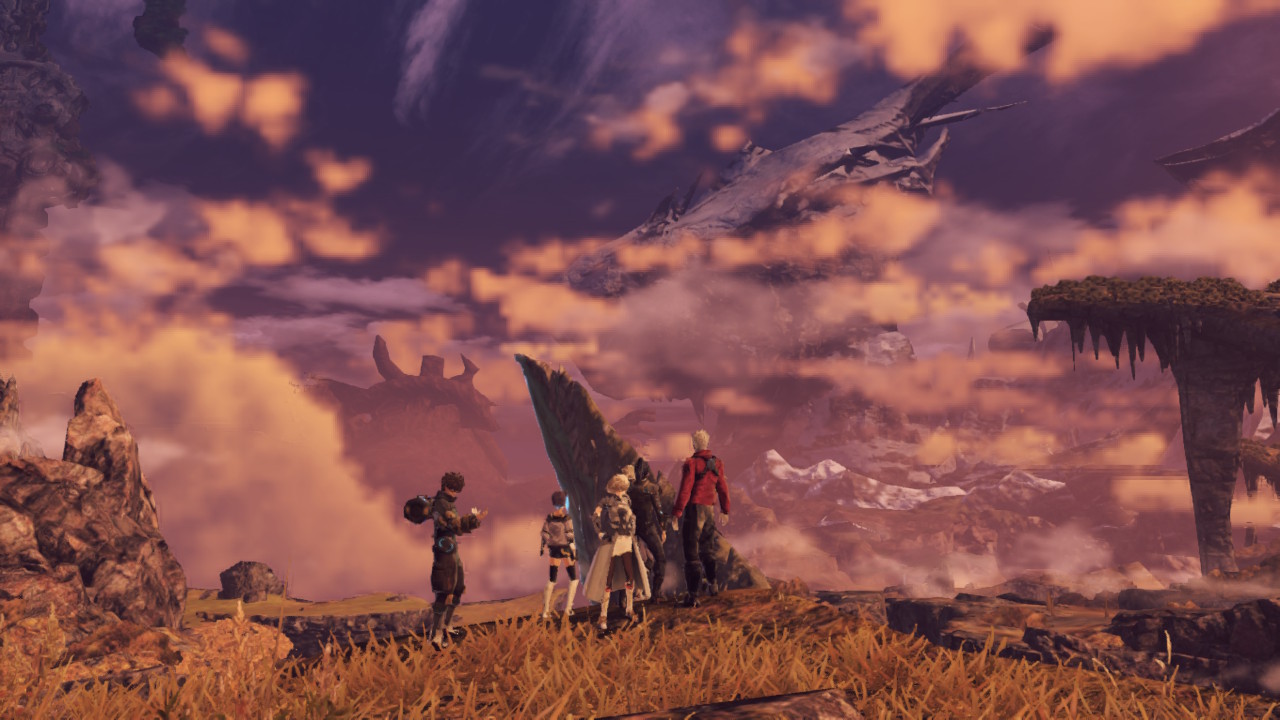
I’ll just get straight to it–the reasons to play this game are (1) the characters and their development (2) the design of the world and how it looks on the Switch (3) the combat dashboard, which manages to winnow a quite technical JRPG combat system down to something that’s not only playable but enjoyable. Reasons not to play the game: (1), (2), and (3) the dialogue, which will make you want to attempt the impossible task of stabbing your eyes out with your Switch. I’m not alone in being annoyed by that BTW: every review I read/watched mentioned the inane proliferation of speech bubbles. On average, by my estimation, the game uses 8 of these to communicate what most adults who are not high or otherwise impaired can get in 2. I swear I nearly sprained my thumb clicking “A” to speedrun my way through these windbaggy gauntlets.* Fortunately, the cut scenes are more tightly edited….
That was probably a mistake to start with the one con of XC3 as the pros added up to a game that I was more than happy to spend 127 hours playing and would have kept going if there had been more bosses to defeat (and there was a literal alphabet of bosses…). The biggest draws are the characters and story. I don’t have the story 100% worked out TBH, but…I’m not sure the writers did either as it involves the space/time collapse of two alternate realities and competing solutions for how to “save the world” in that scenario. I don’t want to spoil too much for folks who are interested in playing the game, but I think it’s safe to say the two alternate versions of the world of Aionios are called Keves and Agnus since, as the game opens, this is announced–as well as the fact that these two civilizations are bent on wiping each other off the planet. Kevesi and Agnian soldiers are birthed in pods created by their queens (much like bees), live for 10 “terms” or years, and spend that entire time trying to harvest as much of the opposing side’s life energy. This energy powers the “flame clocks” that earn the soldiers rewards from and, hopefully, a Homecoming to the queen, if they manage to make it to the ripe old age of 10.
This brutal business as usual is interrupted one day when 3 Kevesi soldiers–Noah, Eunie, and Lanz–are sent out on a mission from their colony to recon a mysterious third party and run into 3 Agnian solders on the same mission–Mio, Taion, and Sena. They find out the third party is from the City, a settlement of “free” humans who aren’t slaves to flame clocks and live longer than 10 years. Before they can pick their jaws up off the scorched ground at this revelation, a gnarly purple monster called Moebius appears to bury the secret and them with it. The captain of the City detachment, Guernica, is forced to use something he calls an Ouroboros stone to save them; the stone fuses the six young soldiers, in Kevesi/Agnian pairs, into Moebius-sized robots that can hold their own against the monster. From then on, whether they like it or not (and it’s definitely *not* at first) the Ouroboros kids are Public Enemies #1-6 and must race around the world to figure out what Moebius is up to and how it relates to the unending war they’re in before they get snuffed or their terms run out, whichever comes first.**
The most affecting of these characters, for me at least, was Mio–the only one of the six kids who’s in term 10 and thus can–and does, in her journal–literally number her remaining days. She vacillates among zen acceptance of her fate, blithe insouciance, and paralyzing anxiety, as anyone would in that situation. Sena idolizes Mio and partly as a result can’t seem to find her footing on her own path in life. Lanz and Sena bond over working out (they’re the tanks of the group). Along with Eunie, the saucy Kevesi healer (Note to Self; find a way to start working her idling catchphase, “Ugh! My plumage is everywhere!” into normal conversation), they provide the group’s forward momentum, dragging the more reticent members with them: these include Taion, the self-sabotaging Agnian strategist, and Noah, the group’s reluctant leader. Noah and Mio are both off-seers, flutists whose duty it is to release the life energy of those who fall outside battle back to the universe; when their respective Kevesi and Agnian melodies meld for the first time, they harmonize in a gripping refrain that serves as an important clue to what is really going on with the world. (I don’t want to go down too many rabbitholes here, but the sound design and orchestral scores are top-shelf. Much as in the Zelda games, a diverse array of musical themes helps orient you to familiar locations and familiar modes, such as combat, landmarks, rest spots, etc. Even the menu function has an upscale elevator-music theme that I found to be surprisingly calming at tense moments.)
If the above roster of characters already seems like a lot to keep up with, ho ho HO: those are only the six playable characters, my friend. And yes, you’re encouraged to switch among them by a number of game mechanics. One of them is triggered by the dozen-plus NPC “heroes” whom you meet on your journeys and who, when you complete various unlocking quests for them, can be selected one at a time to add various packages of skills and weapons, known as “classes” to your party.*** It’s a testament to the game designers that each of these heroes is unique and compelling in their own right, with quirky personalities and moving backstories that you get to explore through “ascension” quests that power up their abilities later in the game. I’ve never played a game with such a richly imagined dramatic cast, and I’d be lying if I said I didn’t tear up at pivotal moments in their arcs.
I can’t say a lot about the overall story arc without dropping spoilers, but it presents one of the most interesting philosophical conundrums that I’ve personally seen in a video game, revolving around a question exigent for all of us but most of all for the teenage demographic the game is aimed squarely at: is it better to try to keep everything the way it is right now, even if it’s not great, or to strike out for a future that may or not be worse? In other words, the devil you know (Moebius) or the devil you don’t (Ouroboros)?
If that sounds a bit too heady, it can be, especially given a couple of logical gaps in the story that are never convincingly bridged. But what kept the story grounded and interesting for me, other than the character development, was the design of the world. Keves, Agnus, and the City are all thoroughly and coherently built out: Keves is loosely patterned after Western European/Scandinavian design and architecture, rendered in gloomy, glowing steampunk blues and blacks; meanwhile, Agnus (my favorite!) layers a decidedly Japanese/samurai aesthetic on a woven origami-paper-white base and finishes it with splashes of jade green and lacquer red; and the City, appropriately, is jury-rigged, patched together from spare parts in rusty browns and greens with Bladerunner-like markets and taverns. And then there’s the outside world, the crazy, jaw-dropping landscape of Aionios. I quickly filled up my Switch’s photo album with screenshots, nearly getting snuffed in battle several times as a result. It’s gorgeously hyperrealistic, giving BOTW a real run for its money in that department. To wit, there’s a function where you can wash the team’s clothes–and you need to, because they really do get the sandy deserts, sooty battlefields, snowy slopes, thundering waterfalls, and viney forests all over them. Aionios resolves into a ring of stony landforms shaped like titan heads, swords, hands, and wings riddled with eery spherical holes from “annihilation” events caused by mysterious accumulations of glowing black fog. Apparently those titans are from an earlier bit of Xenoblade lore that I’m unfamiliar with; but in this game they’re atmospherically iced or grown over with a believably evolved landscape.
The monsters that populate this landscape are lovely, terrifying, and inventive. As in most JRPG’s, you need to fight and kill many of them to acquire materials needed for quests and equipment upgrades. Those fights (I’m looking at you, Bunnit wielding a club with your tail!) are your first real introduction to the combat system in XC3, which, I’m not going to lie, takes some getting used to. But I will say that the reviews I watched overly scared me about the system, to the point where I watched an hour or so of tutorials before even pressing “start” (this one and this one are the best ones for a total Xenoblade noob, IMHO). That turned out to be overkill (pun intended) because the game actually ramps you up reasonably slowly into handling the system. The in-game tips and tutorials are also quite good, with a special shout-out to the training drills that set up mock battles for you and don’t let you pass until you’ve mastered the particular skill at issue. I’m not even going to try to describe the combat system here other than to say that while the battles are visually overwhelming, quickly you’ll discover that you only need to monitor a handful of gauges on the dashboard to be able to fight competently. Also, for a mediocre combatant like myself, the Chain Attack mechanic is a godsend, allowing you to temporarily warp into a calmer, chess-game version of the battle you’re in for a few minutes to lower your heart rate and heal your party up.
It’s also very easy–perhaps too easy according to a few critics–to XP level in XC3, which means to increase your level by running around completing side quests and fighting lower-level monsters. For the first time in my JRPG history, I did so assiduously and thus was pretty OP when I got to the final boss fight; you really only need to be around a level 75 going into it on Normal mode, and I was closer to 85. What that experience told me was that it’s relatively easy to pick up needed levels if you follow the main story and pay a modicum of attention to side quests–particularly Hero quests. This was a particularly good piece of advice I got from one of the tutorials I linked above–not to spend time chasing supply drops, which usually have redundant items, but instead to chase question marks, which lead to quests unlocking new heroes and party skills. Besides, the main party Side Stories and Hero Ascension Quests are some of the most narratively moving facets of the game, so I highly recommend taking detours for these, on several counts.
Whoo, this is a long Letter of Recommendation. But that’s a JRPG for you…. Personally, I felt this was the best one I’ve played: I already miss the characters and am thinking about getting the DLC so I can spend more time with them. Overall I think Xenoblade Chronicles 3 is an excellent return on the learning curve and time investment. And it’s a hospitable port of entry to the JRPG genre for folks who like action-adventure games like BOTW and are looking to branch out.
*Also, the Nopon dialogue/speech. There’s no logic, linguistic or otherwise, behind them sounding that dumb. It’s Jar-Jar-Binks-level irritating. Also, the insipid, repeated catchphrases the main party would throw out on finishing a battle: I swore if I had to hear Eunie wheeze “Did you hear that, Noah? Lanz wants something meatier!” one more time I was going to break my Switch in half.
**A footnote on the intersection of language and political economy in XC3: I don’t know whether it was in the original Japanese or came in the English translation, but there’s some deft Bowdlerization of swearing here, with “snuffing” and “sparks!” standing in for some of our more common expletives, and “mudder” as a frequent epithet; these choices leads to some combinations like “snuffing sparks” that resonate nicely in the world system, in which the main metaphor for life energy is “flame.” The conceit of the “flame clock” is really queasy and gripping as a graphic gauge for how much life energy each colony or corporation harvests, with their own lives depending on keeping the gauge charged. XC3 is pretty ripe for a Marxist reading IMHO.
***I don’t think I’ve ever had to use this many footnotes for a video game review before…. Yep, it must be a JRPG! Anyway, what I was going to say is that you’ll need to swap out classes among your main party pretty regularly in order to maintain a good balance of attacking, defending, and healing roles; also, to rank up the classes so they become more powerful and available to more party members. You can further customize the main party by using arts, skills, gems, and accessories to tailor buffs and debuffs to particular kinds of enemies. I know this sounds totally overwhelming unless you’re a diehard JRPG fan, but there’s an “auto-build” button that will fill all the slots for you at first so you don’t have to sweat the multidimensional decision-making. I recommend doing that on the regular and then just swapping out one or two key accessories to give you an advantage against machines, for instance, or to counteract a Sleep debuff if you just got farmed by a boss who used it a lot. Here’s a couple technical tips: 1. remember you can use a gem on more than one party member, and keep a Decrease Bloodlust gem on your attackers and healers at all times, and an Ironclad gem on your defenders; 2. If you can, make sure you’ve got both combo flows available across your party members (after the introductory Break/Topple, the two flows go Launch/Smash or Daze/Burst); if you can’t get them both, prioritize Daze/Burst so you can debuff bosses’ Rage status, which is really damaging. Also, try to keep the flows out of the Talent Arts b/c those aren’t available for Chain Attacks; having said that, you’ll find that Burst and Smash are mostly on Talent Arts, so don’t sweat this one too much.
 The Rookery