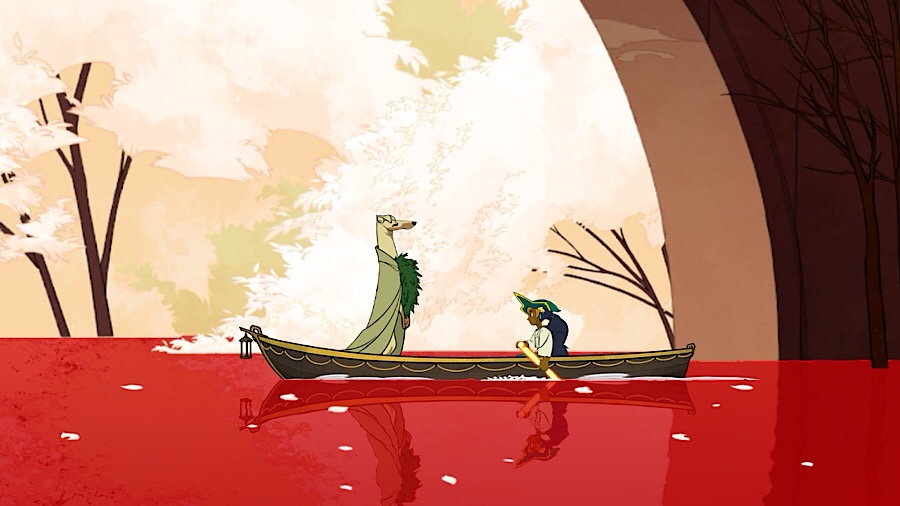
You know when you don’t want to say goodbye to a character in a video game that you’re having a special experience. That’s the main strength of Spiritfarer: the designers at Thunder Lotus have put so much effort into crafting the various spirits you pamper, cajole, and coax into the afterlife that it’s hard to tell them from people you only know through the Internet—in other words, from real people.
Spiritfarer is most commonly described in reviews as a “2D Metroidvania management game,” but I came to think of it as a cross between Legend of Zelda: Windwaker (leaning into the platform it bits) and Animal Crossing. You play Stella, who with her cat Daffodil is shanghaied into taking over for Charon—yep, that Charon from Greek mythology, the one who ferries spirits across the River Styx into the afterlife. After your precipitous onboarding (har har), you’re off and running, sailing across an ever-growing sea from island to island, collecting spirits who blossom into anthropomorphic animals when they step aboard your ever-growing boat. Stella serves as their concierge, catering to their whims and doubts, until they finally declare themselves ready to pass through the Everdoor into the afterlife.
That catering involves sailing around fishing, mining, buying, and growing raw ingredients that you transform—in kitchens, foundries, and other stations you build aboard your vessel—into furnishings and dishes that meet your passengers’ needs. As you interact with the spirits and learn more about their lives, their desires and fears, you get better and better at making them happy. In turn, they help you out with some of your tasks until they eventually shuffle off their mortal coils, leaving you with spirit coins and flowers that you can use to upgrade your boat and add to your abilities: double-jumping, gliding, dashing, etc. These upgrades open up new areas of the map, new spirits, and new resources to you. And the cycle continues.
If that all sounds like a lot of work, it can be. I will confess, there were times, as I fed my chickens and picked fruit from my floating orchard, that I had a fleeting moment of PTSD. But unlike in my real life, those chickens won’t die and those apples won’t rot if you don’t get to them in time. In fact, it’s entirely up to you whether and how quickly you respond to all of the various missions and requests you receive: one of my favorites was a multi-stage affair where you gradually renovate a rundown hospital on a dreary island; I felt a real satisfaction when I finally sailed away from the sunny, clean hospital and happy, well-fed patients. There are nearly limitless (and hilarious) other little spirits to interact with and do side quests for on the islands. And you’re free anytime you like to do a bit of fishing off the stern, to watch a gorgeous sunset from the bow of your boat, or to revel in a meteor swarm on the high seas.
The art of Spiritfarer is really beautiful, hitting that sweet spot between cartoon and realism. The colors in particular are dense and wonderful. And the character design is truly exceptional. All the spirits are amalgams of animals, people, and floral elements, and they are supremely expressive and compelling. Their dialogue (Stella just listens and communicates with gestures) is rich and realistic. And while they are rendered in 2D visually, emotionally they’re multidimensional. There’s Astrid the labor organizer with a preference for plain bread and rice; Gwen the diva deer who chainsmokes in between plates of french fries and bouts of fretting about her wealthy, toxic upbringing; Giovanni the charming narcissist; Gustav the prickly art dealer; Daria the dreamy, trippy fruit-bat poet; and my favorite, Buck the D&D nerd in the form of a little green basilisk who adorably flips his tail around your shoulders when he gives you a hug. Not all of the spirits are kind to Stella, but they all tell you enough about why they are the way they are that you’re at least partly sorry to see them all go when they finally do. Some of the spirits go with gusto, some in fear, some with the disorientation and exhaustion of dementia. Almost all of them, it turns out, have some connection to Stella’s life; without spoiling too much, I can say that bringing closure to the spirits brings her closure as well.
The sound design complements the visual design perfectly, with each character having sweet little telltale vocalizations that attend their dialogue bubbles; the music is always good and often gorgeous (you can play the various tunes on a jukebox in the Lounge, if you build it). Game play runs smoothly overall, but I had a couple of crashes on my Switch, and there are some glitches where items you need to interact with render behind ones you can’t, as well as a maddening single-button interaction mechanic that makes it nearly impossible to talk to a spirit if they’re standing in front of a door or other interactive element.
These are all minor quibbles; a more major one, for me at least, was Spiritfarer’s treatment of what lies beyond the Everdoor. Death, as I described above, the game handles well. The afterlife, on the other hand: weirdly, the 3D diversity of spirit life on the boat abruptly flattens out to a few New-Agey platitudes about peace and oneness with the universe as the spirits reach the threshold of the Everdoor. Not a single spirit talks about God, or heaven, or a reckoning of any kind; no one seriously wrestles with existential panic or despair. I get that the developers likely didn’t want to offend religious sensibilities and thus stuck to the safe argument that no one knows what lies on the other side of the door. But that choice also left them stranded between the Scylla of life’s scariest and saddest mystery on the one hand (poignantly visualized by the blood-red waters surrounding the Everdoor) and the Charybdis of a cozy Animal-Crossing-style management game on the other. That’s an insoluble dilemma, both in terms of philosophy and in terms of vibe. To spackle it over, they resorted to a couple of memorial mechanics that should keep the player suspended in the warm haze of the game play if they’re not in too critical a mood. Those memorials are genuinely moving, and they did remind me that if ultimately we leave nothing behind us but memories, that’s hardly nothing.
 The Rookery
One thought on “Loading…Review of Spiritfarer”