A lot of the anime I watch poses this question, probably because I tack toward sci-fi and cyberpunk shows. But it’s hard to think of recent shows that orbit around it more than these two–one of which is about a near-future monster-fighting task force (Kaiju No. 8) and the other, about Humanity’s attempts to reclaim Earth from the “machine lifeforms” that drove them from it by deploying remote armies of androids (NieR: Automata). Even more interestingly for two such diverse approaches to the question, the shows seem to arrive at similar answers.
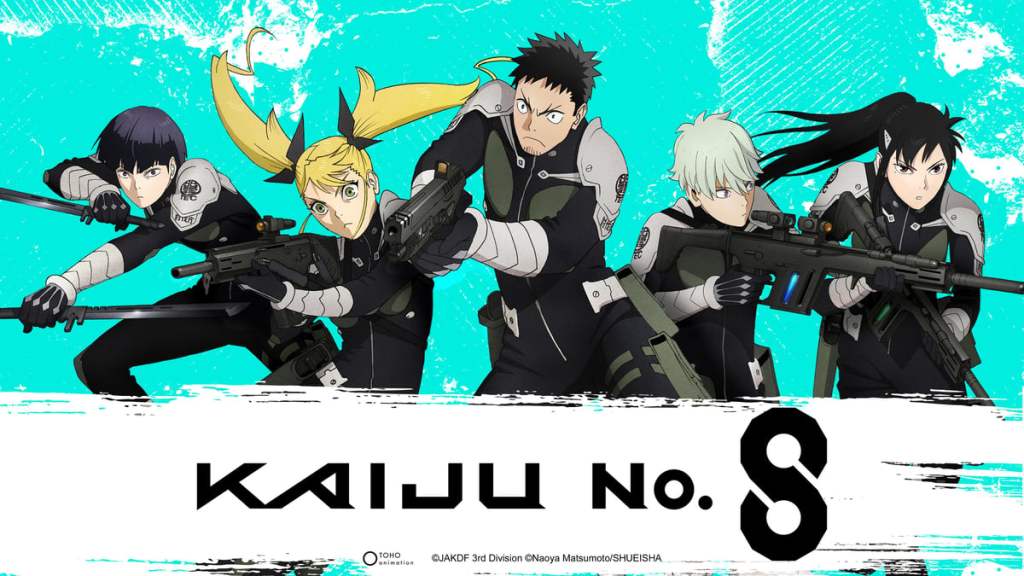
Kaiju No. 8 is set in a moody, neon-stabbed near-future Tokyo (thanks to a nice production design by Production I.G.) that finds itself under time-honored siege by kaiju. If you’re not familiar, think Godzilla–except these particular kaiju come in a variety pack: little car-sized yoju, their building-sized honju parents, and, rarely, gargantuan dai-kaiju so dangerous and destructive they’re assigned numbers, like names are assigned to hurricanes. The story follows Japan’s AKDF (Anti-Kaiju Defense Force), but instead of taking the expected perspective of the force’s badass captains who can take out a honju with a single cannon shot, it hilariously tracks Kafka Hibino, the guy the AKDF calls when they need to break down and dispose of that giant kaiju carcass they just splattered all over a playground–and the two buildings next door, and that freeway….
Kafka wasn’t talented enough to test into the AKDF, but he trains after hours to pass the next exam because he hasn’t given up his dream of standing beside his childhood friend Mina, the superstar of the AKDF, in the war against the kaiju (she’s the one with the cannon, not to mention a pet tiger). A monkey wrench gets thrown in Kafka’s plans, however, in the form of a kaiju parasite that jumps down his throat during a cleaning job and grants him the ability to transform, semi-at-will, into a human-sized dai-kaiju, one so powerful than when the AKDF first encounters him in that form, while he’s trying to save his friends from another kaiju, they assign him Number 8. The rest of the season follows Kafka as he tries to hide his kaiju side from the AKDF; meanwhile, the parasite gives him the power to pass the exam, so he’s finally on the team, making it ironically much tougher to hide what’s happening to him from his new comrades–some of whom have secrets of their own. It doesn’t make it any easier that Kafka’s finding it harder to control his transformations, and they’ve attracted the attention of another human-kaiju hybrid, a malevolent one…. The season ends on the cliffhanger of the discovery of Kafka’s secret by the AKDF and the debate about whether to kill him and turn his DNA into weapons, as has been done with other defeated dai-kaiju, or to believe his repeated protests–which catch his friend Mina squarely in the middle–that he’s human and still a loyal AKDF soldier. It will be interesting to see what happens next season: so far the kaiju have been presented as uniformly hostile and/or evil, but the parasite infecting Kafka seems different, and that makes me wonder if the show will go in the direction Knights of Sidonia did when the humans started being able to communicate with their monstrous Gauna antagonists and realized that if they had been able to do so earlier, things might have gone differently between the races.
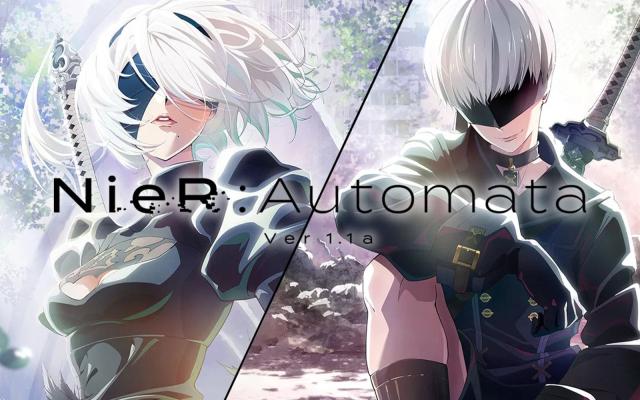
NieR: Automata definitely revels in that kind of irony and ethical ambiguity. Based on a video game, the anime nevertheless stands on its own as a gorgeously produced (by A-1 Pictures) and well-written cyberpunk series. Thousands of years after humans were supposedly driven off Earth by alien invaders and their hordes of “machine lifeforms,” the anime follows the adventures of a pair of soldiers from YoRHa, an elite android unit that is the latest of a apparently endless series of attempts by the moon-dwelling Council of Humanity to retake the planet. 2B is a combat model; her partner, 9S, a scanning and hacking model. They are dispatched from their Bunker in space, clad in ridiculous uniforms that might best be classified as Victorian Bondage (truly 2B must be made of metal to be able to fight in heels that high), to investigate an increasingly puzzling series of disappearances of their YoRHa comrades. In the process they discover that the situation on Earth is quite different than the Council of Humanity has led them to believe: machine lifeforms are evolving, sometimes into sentient, dangerous android-like forms, sometimes in peaceful communes trying to emulate the humans they’ve read about in books; earlier-generation androids have been abandoned by the Council to fend for themselves; and, glitchy rumors circulate that not only are the aliens who made the machine lifeforms dead and gone, so are the humans themselves….
While all those plot machinations are legitimately engaging, they pale in comparison to the uneasy magnetism of the developing relationship between 2B and 9S. Initially, it seems quite rote: the mature, gruff war veteran (2B) rebuffs the awkward and admiring attempts of the rookie recruit (9S) to strike up a friendship. But across multiple assignments and several glitchy reloads of their memories and personalities into new bodies (an occupational hazard of being an expendable android in a war zone) 9S starts to grow on 2B. Her palpable, almost savage sadness when that happens, in defiance of YoRHa’s strict prohibition of any kind of emotional display from its soldiers, clues us in that something else is going on–and so it is, big-time. The fact that when that plot twist is revealed, it’s a legitimate gut punch, is a testament to what a good show NieR: Automata is–that it makes you care more about its androids and AI robots than you do about their creators. And this is the point at which I think Kaiju No. 8 and NieR: Automata both stick the landing in their ambitious engagements of the question of what it means to be human–because I don’t think any of us would argue that the answer isn’t at least partly about loyalty, and partly about love.
Season 1 of NieR: Automata ends with the plot-thickening introduction of 2A, an abandoned earlier model of 2B. Gamers who have played NieR: Automata thus know at least some of what’s in store for Season 2. However, as the game is notorious for its multiple endings based on player choices (at which fun is repeatedly poked via adorable, sometimes macabre, little puppet shows at the close of each episode), it’s likely we all have a few surprises in store for us.
 The Rookery