Look, I’m not even going to try to argue that lard has been misunderstood and is somehow good for you…. This is quite obviously not true. But! I do think that, in the first place, it’s no worse for you than any other fat that’s solid at room temperature (provided you eat meat in the first place), and in the second place, how much lard are you realistically going to consume on a daily basis? So, let’s just set that whole discussion aside and get onto the good part, which is how amazing lard makes everything taste. This is largely because of 2 reasons: 1. It has flavorful fatty acids, which can vary delightfully depending on the diet of the piggies, and 2. Its fat crystals are larger than those of other baking fats, which creates flakier pastries by opening up bigger air pockets.
More importantly, there are some dishes that just aren’t going to taste authentic if you don’t use lard. Welsh cookies, for example. Or pretty much any dish from my Cuisine of Origin, New Mexican food. For a really long time, like 300 years, colonists in NM didn’t have ready access to fats other than the ones they could process at home from their livestock. So, that’s what they cooked with. Consequently, a tamale, or a bizcochito, or a sopaipilla just isn’t going to taste quite right to a New Mexican if it’s not cooked with lard, and as New Mexican food is generally very, very simple, the quality and flavor of its few ingredients really matter. I once got in a (mild) comment war on Serious Eats with Kenji Lopez-Alt because he doctored up a recipe for carne adovada with raisins, orange juice, and fish sauce ( you can see the recipe here though my comment, and Kenji’s response, got taken down for some reason). Unsurprisingly, he got pushback from several New Mexicans. For my part, I argued that when you tweak a recipe to fit a palate accustomed to international flavors, you lose the chance for it to teach you something about its specific culture of origin, about a way of eating, feeling, and being in the world that’s different than the one you’re familiar and comfortable with. Kenji argued back that he couldn’t get good NM chiles and that’s what he had to do to get his to taste like the original. He certainly has a good palate, so maybe he’s right about that. But he didn’t grow up in NM, so I suspect that it just didn’t taste like what he wanted it to taste like.
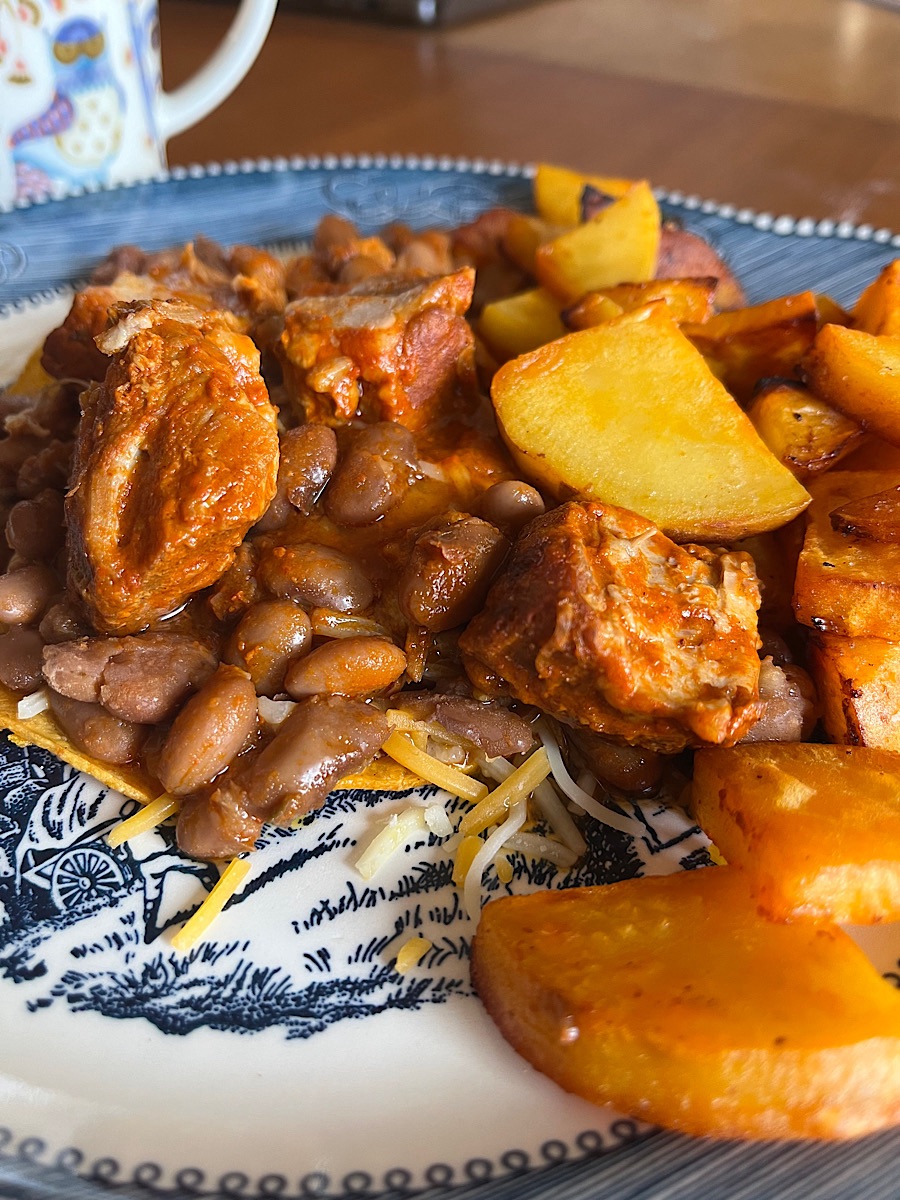
At any rate, my point is that lard is awesome. The picture above is of breakfast this morning: huevos rancheros with carne adovada and a side of sweet potatoes fried in the red-chile lard that I skimmed off the top of the refrigerated carne adovada (my sister taught me that trick!). It’s one of the best 10 things I’ve eaten this year so far, and I’ve eaten some good stuff. As with all recipes for huevos, it needs a little acidity, so if you don’t make your carne adovada with a little vinegar, you’ll want to add some to the sauce, or some tomatoes or tangy cheddar.
PS: Since it’s matanza season, you need a good recipe for carne adovada if you don’t have one. First, make a chile caribe sauce by toasting 12 NM hot red chile pods and soaking them in 2 cups hot broth or water for 20 minutes to soften, then blend that mixture to a silky sauce with a couple cloves of garlic, a teaspoon of oregano, way too much salt (b/c you’re basically brining the pork—I do at least 2 teaspoons, sometimes a tablespoon). Add a little apple-cider vinegar if you have a really fatty pork shoulder or your dried chiles weren’t nice and fruit-leathery to start—just 1-2 tablespoons. Cut up a 3-lb pork shoulder into 2-inch chunks and marinate in the chile caribe overnight, then bake the whole mess lightly covered with aluminum foil (for best flavor—the truly traditional way to make this is to braise it on a disco or in a dutch oven over an open fire) or pressure-cook it (the way I usually do it these days) or slow cook or simmer on the stovetop until it’s falling-apart tender; it’ll taste great no matter what, so don’t worry. Taste the finished braise and adjust salt. If your sauce is too watery, just fish out the meat and boil it down (my preference), or mix in a little flour/water roux and simmer to thicken to the consistency of a thick gravy. Put the leftovers in a container in the fridge, and when it’s cold, skim off the bright-orange chile lard on the top and save for frying potatoes!
 The Rookery