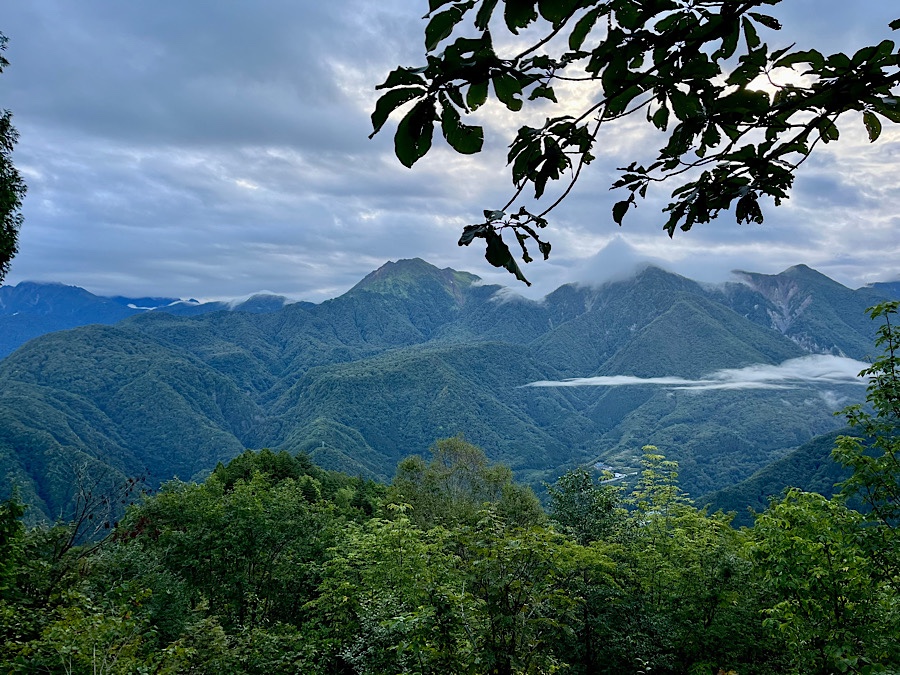
Really, I have no one to blame but myself. I’m the one who insisted on (me at least) catching the 10 am bus to Takayama so I could maximize my time in the traditional lacquerware town before we caught our train back to Tōkyō. True, Cheryl is the one who then suggested we get up at 5 to squeeze in the day’s optional hike before breakfast. But I could have said “See you at breakfast!” and relaxed in the onsen. Instead, I found myself slogging along with Cheryl and Steph in the semi-dark up a steep, switchbacked logging road littered with ankle-turning “babyhead” rocks, swatting away seemingly interminable spiderwebs.
It was the only truly unpleasant walk on our entire itinerary. After doing it, I have to wonder why anyone would enjoy it enough to recommend it to other human beings. But then, hiking is a very individual sport, and so if you like experiencing all the things I mentioned above, plus a scrambly root obstacle course, for 5 miles with no views except 2 brief, overgrown overlooks, then I’ll tell you what—the Oku-Hida loop to Fukuji Peak is for you. The only mercy was that it was relatively cool out (which didn’t mean that we weren’t still sweating so hard that Steph had to literally wring her shirt out at one point).
I can’t say enough kind things about the Ryokan Sansui folks though, who didn’t complain when we slid up to the delicious breakfast they had prepared for us 15 minutes late, drenched and filthy, and who helped us figure out the bus schedule on departure and even—bless them—gifted me with a beautiful yukata when they couldn’t find an extra to sell me as a souvenir. Although Fukuji Onsen the town isn’t anything special (the vaunted morning market had dwindled, at least on our visit, to a guy selling some vinyl and cheap tourist trinkets), Sansui certainly is worth an overnight if you’re passing through on your way down from Kamikochi.
We bid aufwiedersehen to the Germans before we boarded the bus as they didn’t have as tight an itinerary as we did and wanted to do the Oku-Hida hike (in spite of our one-star reviews). So, we hugged them and promised to do it again, maybe next time in the Black Forest? And we waved as they disappeared behind a green bend in the road.
We got to Takayama around 11 in the morning, and it was already pretty toasty in the valley. After dropping our bags and buying our train tickets, we fortified ourselves with iced coffees and headed into the old town to do some shopping and sightseeing.
I would love to return to Takayama and visit the whole Hida region to the north. The mountains are gorgeous, the food delectable, and it’s chock full of adorable villages like Shirakawa, famed for its traditional snow-shedding a-frame farmhouses. In spite of the roasting summers, the region does see pretty stout snowfalls; Japan as a whole is pretty far north, and Takayama is sandwiched between two serious mountain ranges.
The streets of old-town Takayama sometimes follow and sometimes shoot away from the Miyagawa river like a bunch of boisterous preschoolers on a field trip. Its narrow alleyways are crammed with traditional Japanese shops and houses, each one a study in contrast between white shoji screens and moody yakisugi siding (they char cypress to fireproof it—think about how hard it is to get a charred log of firewood to light again, and you’ll get the idea). Our first stop was the gallery of Norihito Yoshimoto, a kiri-e artist I had discovered while searching for Kyōko Yanagisawa online. He also follows regional themes, many preserving Hida’s traditional landscapes and architecture, but some of his more abstract pieces play with layered, colored paper in ingenious ways. We fell in love and bought 3 of his papercuts, having them shipped back to the States where they arrived in pristine condition with sweet handwritten thank-you cards. A gallery owner here in the States told me when he heard I was going to Japan, “Buy two of everything!” And I took his advice pretty literally since the yen was at a historic low during our trip. A few shops later, I picked up a beautiful little tea container made in Arita of polished cherry bark. It reminded me of how the branches of our enormous Bing cherry tree would look after we spent the summer climbing in it—picking cherries for our dad in cleaned-out paint cans tied to our waists with twine (one for the can, two for me…) and otherwise turning the tree into an orphanage, or a pirate ship, or a castle.
All that shopping in the heat wore us out, but as we weren’t hungry enough to sit down for a real lunch, we passed up the long line of folks waiting for Hida beef sashimi (looked fabulous) and ducked into the air-conditioned interior of Mitsuha Cafe. We split a towering bowl of kakigori shaved ice and washed it down with cappuccinos and, for Steph, an iced coffee with a giant ice cube shaped like a teddy bear.
Then, it was time to head back to the station and catch our train to Tōkyō. We caught a regional train to Nagoya and switched to the Shinkansen, which whisked us back to Shinagawa Station in about an hour and a half. Night fell as we went, so we didn’t get to see Mt Fuji, but we did enjoy views of fishermen casting along the banks of various rivers amid the pampas grass and against a sunset that Hiroshige himself might have stopped to sketch for a woodblock print.
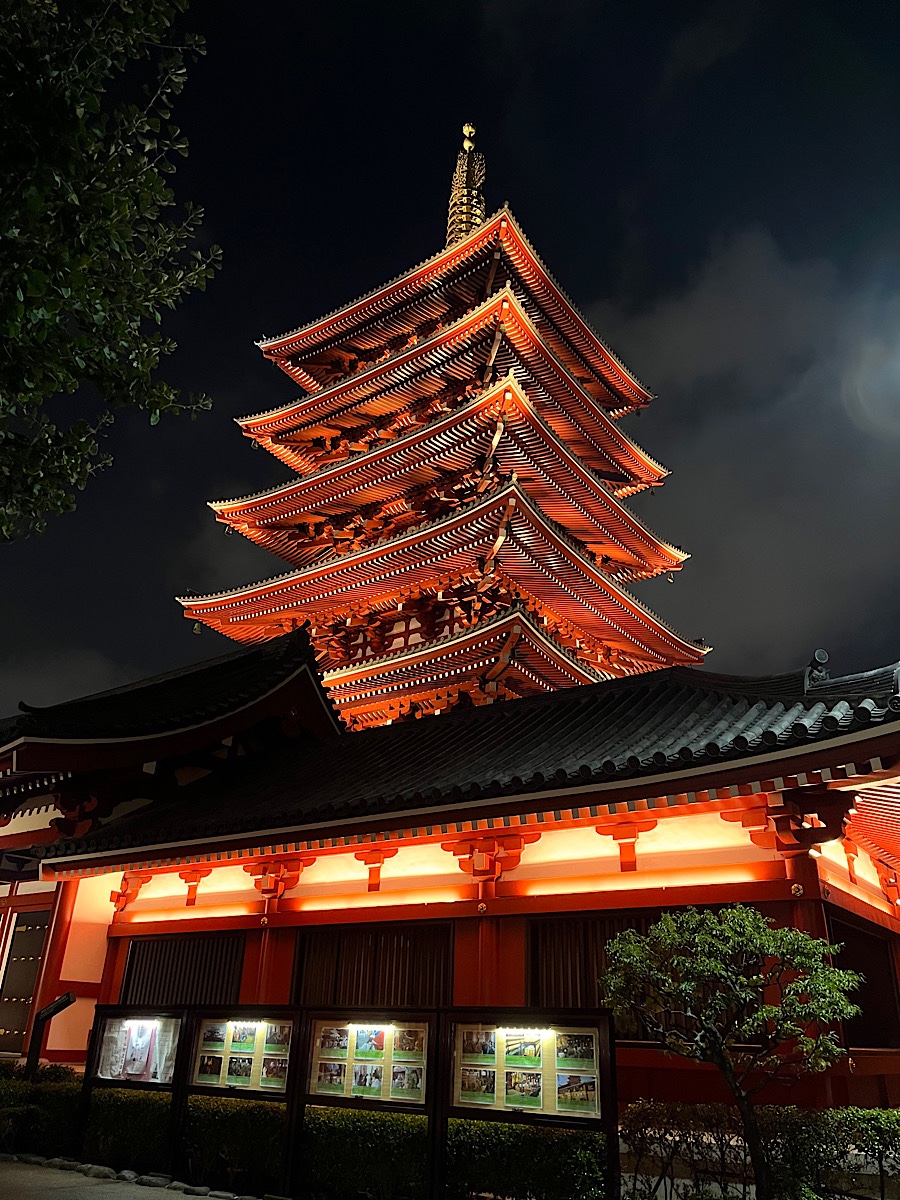
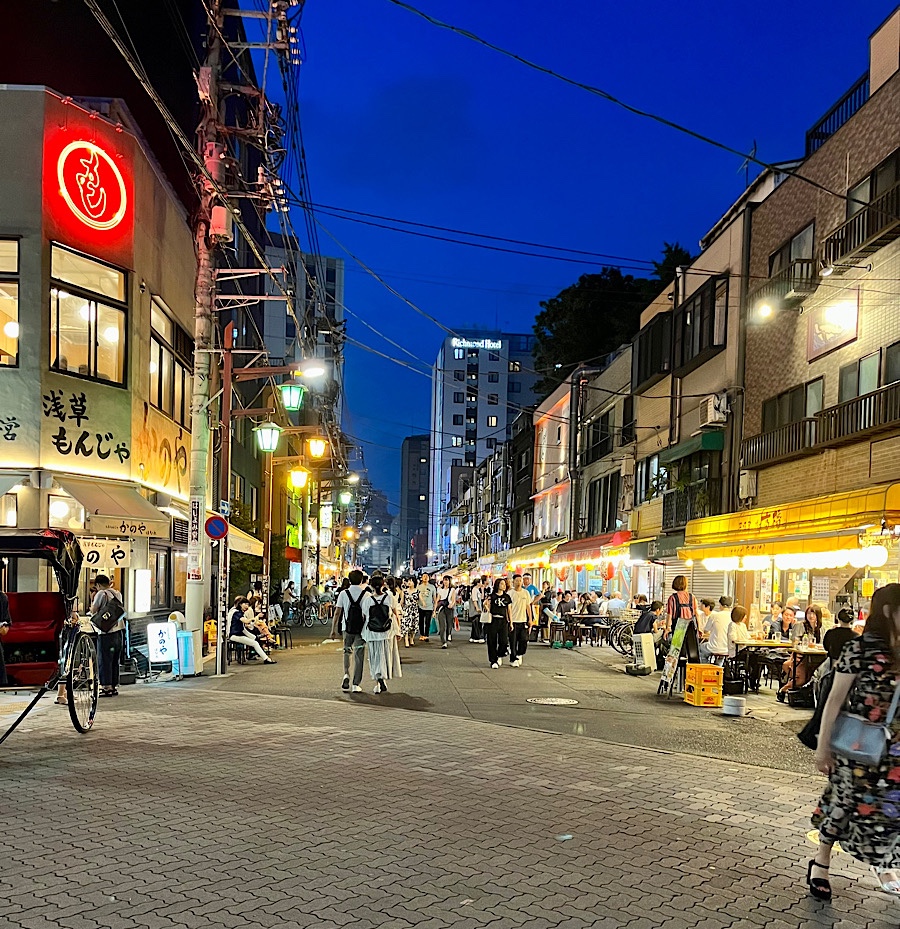
A couple more train changes, and we popped out at Asakusa Station with the Tokyo Skytree glowing above us, in and out of low clouds. The typhoon had passed through, but everything was still wet and steamy. Starving, we grabbed some döner kebab from a vendor on the corner (I swear it’s amazing all the places in the world that a good döner has saved my life) and checked into our cozy Airbnb apartment. After gobbling our sandwiches and cranking up the AC, we headed back out just a couple of blocks to Senso-ji and the traditional neighborhood around it. It had cooled down a bit, and flocks of girls were out giggling and eating ice cream in their rented yukata and sparkling hairpins. Most of the traditional shops were closed, but the eating streets were packed full of college kids enjoying the izakayas and the stores like Uniqlo that were still open. To these middle-aged ladies, bed was sounding better than yakitori and beer, so we headed home for showers and a good night’s sleep.
 The Rookery