
It all started with the Mushroom Fairy. I was hiking Three Lakes Trail up at Donner Summit with my dogs, maybe 10 years ago, and suddenly out of the woods stepped this beautiful girl—wearing a full peasant skirt, long dark hair braided back, carrying a basket full of mushrooms. At least that’s how I remember her. I also remember the basket having a red checkered liner, but that might just be fairytale embellishment. I blinked at her, she smiled sweetly at me, and then she was gone down the trail in the opposite direction. Immediately, I thought two things: “Was that a real person?” And, “Are there mushrooms I can eat up here? I want them.” But it was such a brief encounter, and so improbable, that I half-thought I hallucinated the Mushroom Fairy–until a friend reported encountering her in the same vicinity several years later. Having actually engaged her in conversation, my friend found her typically and frustratingly vague about where she had unearthed her haul of spring porcinis.
The Mushroom Fairy planted the seed; my time on fellowship at the Rachel Carson Center in Münich watered it. Europeans are mystified at how terrified Americans are of our fungi: they even call us “fungophobes.” If you meet 10 Europeans, odds are good that more than half have been foraging since they were kids and can identify at least a couple edible species as well as their poisonous doppelgangers, if they have any. It turns out, it’s really hard to kill yourself with a mushroom. The vast, vast majority of mistakes end in a bad stomach ache. It’s even harder when your local pharmacist is required as part of their licensing to be able to certify if a mushroom is an edible species, which French and German pharmacists (at least) are. Anyway, I went on a mushroom foraging trip in an oak forest in the suburbs of Münich led by a one of the RCC fellows, and I was hooked. I fried up the parasol mushroom we found as a delicious schnitzel and vowed when I got back to the States to sign up for a foraging course.
I finally found one in early 2020: Spring Fungi of the Sierra Nevada, taught at the San Francisco State University field campus near Sierra Buttes. If that timing rings a bell: yep, it was canceled that year due to the Pandemic, and the next as well. I was in Germany in 2022, but I set a reminder in my calendar to register for the 2023 course this June, and I talked my friend Gina into joining me for the week. And then I made us matching camp t-shirts (one of the veterans on the first night, when he saw our shirts, said, “But how did you know we call it Mushroom Camp?” I was like, um…what else were you gonna call it? “Mycological Jamboree?”)
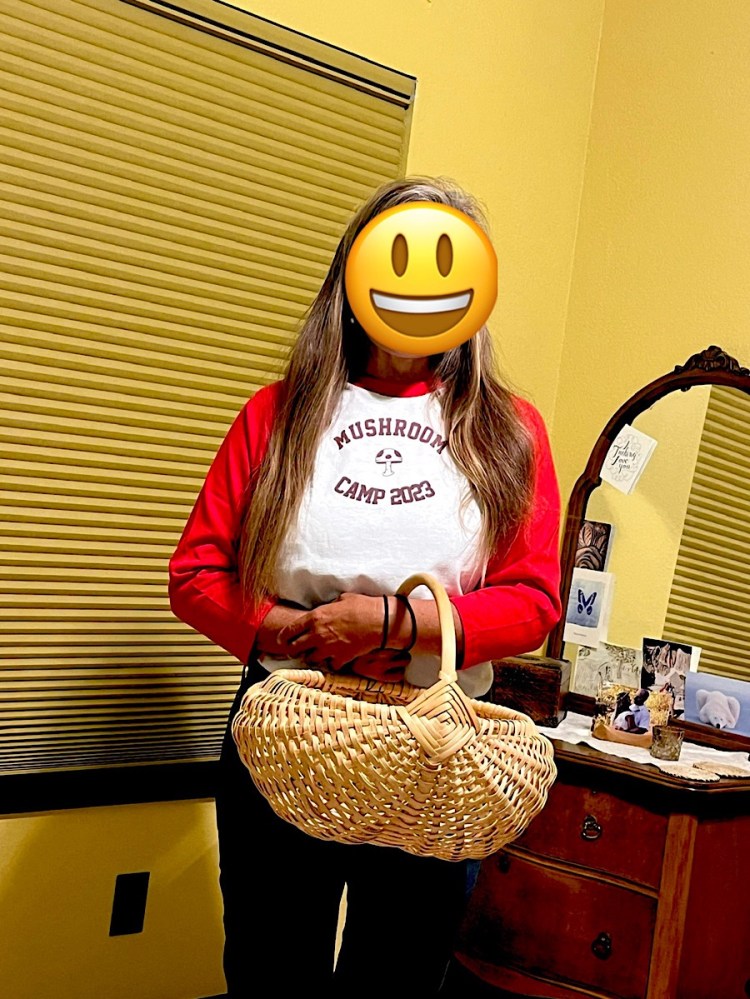
Mushroom Camp was one of those experiences you don’t at all get what you thought you were going to out of, but you still get something valuable. It’s a full-bore mycology course and so, with no biology background past high school, it was “tough sledding” for me, as my step-dad used to say. I found myself looking up words in the definitions of the words I didn’t know from “the Key”: the course text, a sort of demented choose-your-own-adventure book that would help you identify the mushroom you just found, sure thing, provided: (a) you know what “cheilocystidia” are; (b) you can identify said cheilocystidia under the first compound microscope you’ve touched since high school; and (c) you know to select “not associated with snowbanks” when you literally found your mushroom under a snowbank. Yep. Fortunately, a group of likeminded folks (namely, those of us whose primary interest in fungi is sautéing them, not admiring their basidiomes at 100x power) banded together and figured out that we needed to start with your field guide, find the picture of your mushroom there, then go to the name of that mushroom at the *end* of the key and work your way *backwards* to confirm that that’s what you found. If this all sounds terrifyingly uncertain, remember, the good news is it’s extraordinarily hard to poison yourself with a mushroom. If we needed help, of course we could ask one of the many Myco-Elites hanging around, but they were likely to just cock an eyebrow and say, “Nice find! Key it out.”
Just like band camp, Mushroom Camp had distinct cliques. Only about half the folks there that week were actually students; the rest were alums or friends of theirs in the mushroom industry (think, hallucinogenic mushrooms for therapy or recreation, the adaptogen craze, and increasingly, the meat substitute industry—there’s a lot of $$ in [and under] them there hills!). These Myco-Elites come back to Mushroom Camp every year for a sort of Old Home Week. And man, can they drink: they started in at 5 pm after they knocked off the microscopes with gin and tonics, went on to wine with dinner, whiskey after, and beers around the fire to finish. They were apparently as committed to alcohol diversity as fungal diversity…. Mind you, I only got to watch these shenanigans from afar for the most part, as I was part of the clique of folks who were there to eat mushrooms, not sell them or study them. And then there was a clique of actual college-age mycology students who participated in some of the nerding out over microsopy and some of the drinking. Like I said, Gina and I were pretty much on the outside of the action until Gina found one of the few morels that were fruiting that week: that earned us a seat at the big-kids’ table at least the last night. Gina is extraordinarily great at finding mushrooms, BTW. I kept making jokes about how they’d be so much easier to find if they had sparkling dots over them like in Zelda. I can pretty reliably find mushrooms if they’re attached to a tree or are a different color than the ground. The unfortunate thing there is most mushrooms you want to eat are ground-colored. For that, you’re going to want Gina….
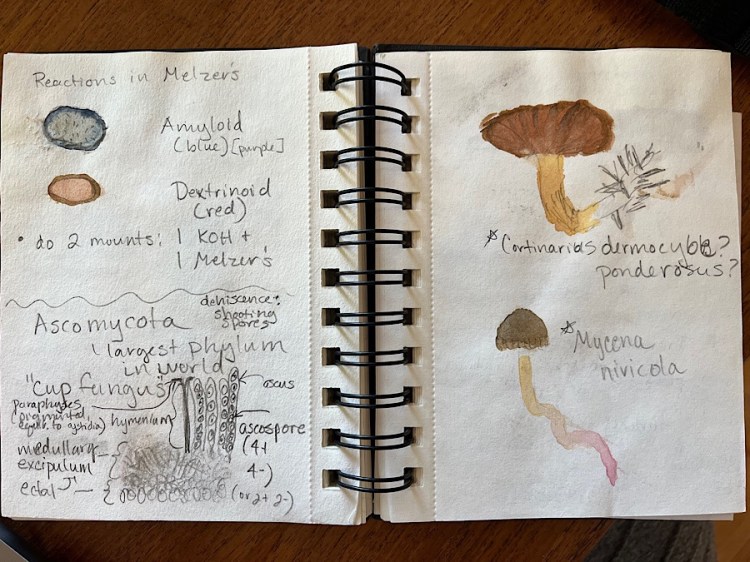
What did I get out of Mushroom Camp, in the end? A reintroduction to biology and microsopy, for one thing: it’s pretty cool, and I’m thinking about getting my own dissecting scope, at least…. I learned how to make spore prints, too (like the one in the header image), which are really pretty and important for ID-ing mushrooms. Here’s another page from my lab notebook:
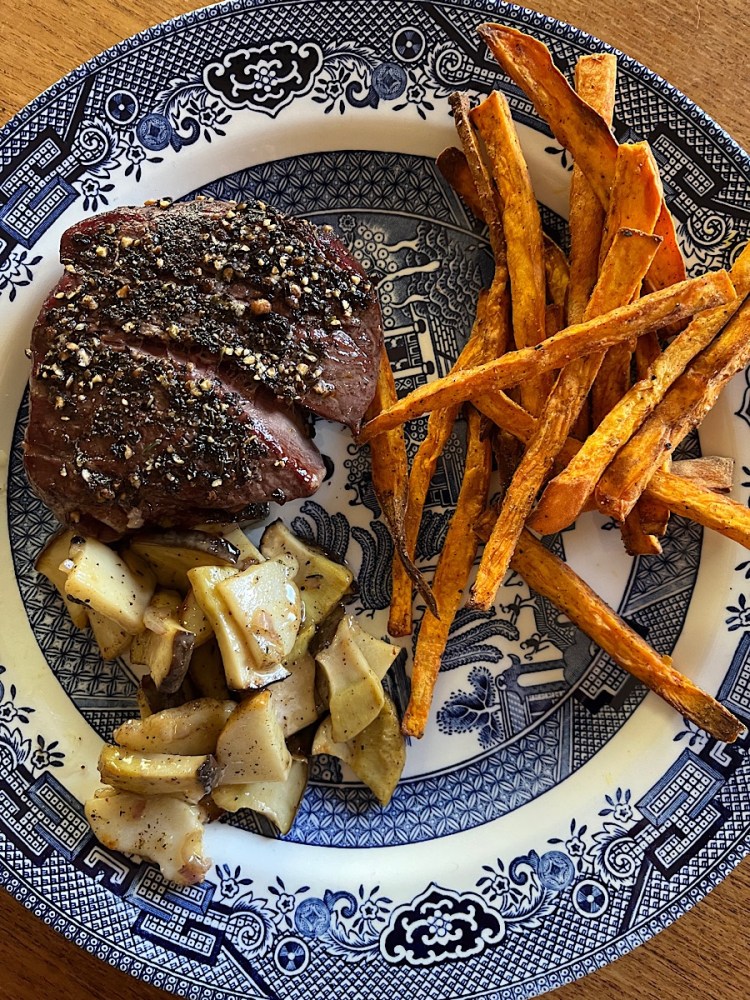
I got to meet some really neat people whom I think I’ll stay in touch with. I found out about another Mushroom Camp, SOMA camp, that sounds like it’s more my speed (not that I don’t love looking at pleurocystidia mounted in Congo Red at 100x under oil as much as the next girl…). And, if you’re wondering, yes, I did come home with at least one edible mushroom, in spite of it being really slim pickings due to the late snowpack. Turns out, there are only 3 species really worth eating in the spring in the Sierras, and none of them is a doppelganger for something that is going to kill you. Good news! I found a humongous Alpine White Waxy Cap (hygrophora subalpinus–not ground-colored!), from which I breaded and fried up medallions of the stipe (stem); it had the consistency of flavor of scallops. Oh, and here’s a porcini (fried up with brandy and served with filet au poivre and sweet-potato fries) I found the next weekend up at Gina’s cabin: she and her husband, Tim, know where all the good spots are.
Now, the next time it rains, I feel at least somewhat ready to light out for the hills with my basket and knife. Maybe I’ll run into the Mushroom Fairy. We can trade some shop talk and then be equally evasive with each other about where we filled up our red-checkered baskets before we head our separate ways down the trail.
 The Rookery