I’m semi-retroactively christening a new series on the blog because I realized I have written a lot of posts about Asian dramatic series and movies, and I might as well round them up (rounding things up makes my inner Border Collie happy).

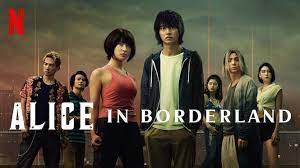
Alice in Borderland is a 2-season Japanese dramatic series on Netflix based on the manga by Haro Aso. It fits squarely in the battle royale genre. Ryōhei Arisu is a loser who games all day to avoid dealing with the breakdown of his family following his mother’s death. One day he and two friends are messing around in Shibuya Crossing when they cause a fender bender. They run from the police into a subway station; when they emerge, they find that everyone has disappeared from the crossing–and from most of Tokyo, as it turns out. They wander around the abandoned city until they find a few other people going into the only building around that’s still lit up, and that’s how they end up in their first “game”: a version of the “Lady or the Tiger” puzzle in which the winners get a “visa” that grants them a certain number of days in the post-apocalyptic city without having to join another game, while the losers are killed instantly by a laser blast from a satellite overhead.
The obvious questions are what happened to Tokyo, who’s running this game, and why? And that’s exactly what Arisu sets out to learn after his friends sacrifice themselves to save him in a Seven of Hearts game. The games are coded like a deck of cards, with the suit telling you what genre of game it is (Spades=physical challenge; Clubs=teamwork; Diamonds=intellect; Hearts=trust/betrayal) and the number indicating the difficulty. At the top sit the face cards, which represent actual human bosses. Arisu quickly gets the idea that if he beats the games to face-card level, he might be able to find out what’s going on; and, if he wins all of the games, he might be able to get back to his life in the real world.
Of course it’s not as straightforward as that. And as Arisu progresses through the games, he meets groups of people who have very different attitudes and approaches to surviving them: there are ad-hoc religious cults who believe they’re in some kind of purgatory and are earning their way to heaven by playing the games; there are hedonistic groups who party like every day’s their last (because it probably is); there are scientists and investigators trying to get to the bottom of what happened….
If this is all starting to sound pretty allegorical, of course it is. I’m not spoiling anything by telling you that at some point–as you watch average folks try to survive a geothermal explosion in a soccer stadium, or decide which friend to betray because only one person can survive a game, or solve an impossible mathematical conundrum with a cauldron of hydrochloric acid dangling overhead–two things will occur to you in sequence. First, you will think, “Who could be so cruel and horrible as to make people do this?” And then, it will slowly dawn on you, “Wait, this is life.” Nobody chooses to be born in this world, or gets a say in what situation they’re born into. And the end result is death–odds are good, a painful one–no matter what choices we make along the way. Alice in Borderland is so good precisely because it presents these chilling truths to us in a fantasy milieu that disarms our usual coping mechanisms for bracketing out the brutality and futility of this mortal life in order to make it through another day. As the characters wrestle with the question of why to keep playing the game, and what’s on the other side, it’s easy to recognize in their discussions the various answers humans have come up with to the question, What is the meaning of life? Salvation, love, pleasure, power, freedom, self-actualization? It’s also frighteningly plain that no one knows the answer for certain.
In Alice in Borderland, you do get a kind of answer at the end of season 2, but it’s partial and open-ended (setting up a likely season 3). But if it’s not clear at this point in the review, the answer isn’t the point of the series: it’s what the characters learn about themselves and each other, and who they become as they play the games. The characters are well-written, the acting is first-rate, and the plotting and cinematography are, too. If you can’t tell from the foregoing discussion, caveat spectator: it’s not for the squeamish. I think a lot of folks are watching season 2 right now to fill the gap left by Squid Games, and I didn’t watch that drama because it was too gory for me. Alice in Borderland is gory at times as well–more often in the second season than the first. However, as I argued above, the brutality is the point, so I can’t exactly call it gratuitous. I just skipped the really yucky stuff; as it’s obvious from the set-up of each game what’s going to happen and when, it’s easy to do so. And I do think the series is worth it for the really big questions it raises in a novel, vivid, and inescapable way. This one will stay with me a long time.
 The Rookery