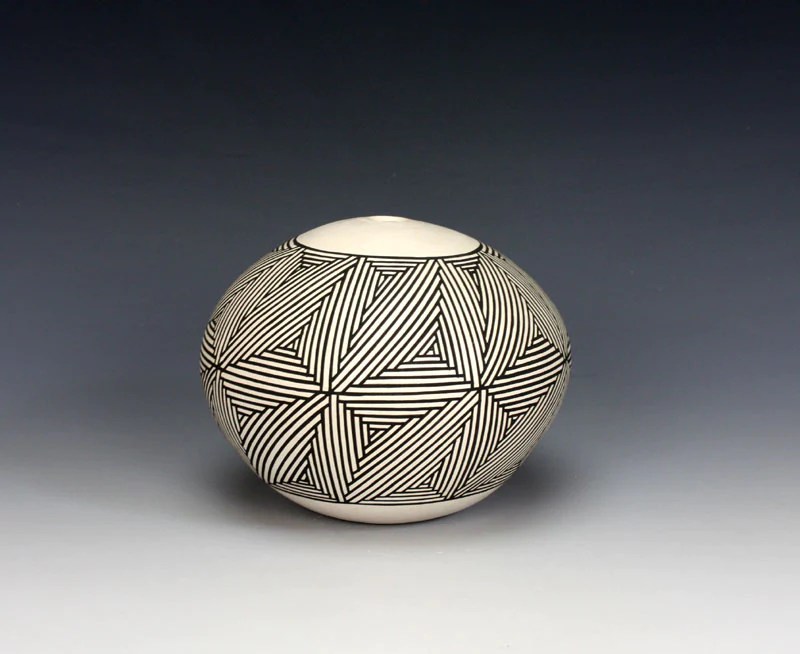
I’m starting a series on Pueblo pottery: while I won’t be able to do all 19 pueblos here, I’ll highlight my favorite styles, starting with Ácoma. I love the monochromatic color scheme and the geometric decorations. The rounded shapes also feel either very old (cf. Mimbres) or very modern to me as well.
Ácoma is a unique and beautiful pueblo that sits high on a defensible mesa in canyon country west of Albuquerque. It was the site of a famous revolt against Juan de Oñate in 1599 that resulted in brutal retribution against the tribe and heavy Spanish repression in following decades. However, the tribe has maintained its cultural traditions over the centuries of occupation, including the important art of pottery. Like other pueblo wares, Ácoma earthenwares are coil-built from local clays and low-fired in a wood-or-dung-burning horno. They’re glazed and decorated before firing with mineral-based slips, primarily from ground hematite or obsidian (black), copper or iron ores (red), and lead-bearing ores (white). The low firing temperatures tend to leave these glazes with a matte surface; however, potters sometimes burnish the slipped and decorated pots with a stone or potsherd before firing, which lends an eggshell patina.
Ácoma ware comes in all the traditional forms with a slant toward round ollas (water jars or jars for cooking stews) and seed pots (round jars, many hand-sized, with small holes that prevent rodent raids and serve as sowing vessels–see example above from Flo & Lee Vallo). The best pieces are very fine and light with “ringing” walls, owing to the high silica contents of the local cream-colored clay (and the artistry of the potters). The style is famous for its “fine line” work and other precise geometric decoration. In the polychrome wares, parrots, butterflies, and dragonflies are also common motifs, associated with the rare and precious resource of water in Ácoma country.
 The Rookery