This isn’t the same thing as mindful eating, though they’re related. I’m talking about something more specific and at the same time broader–a way of eating that engages me with the bigger picture of how and why I eat.
I think if you were brought up in relatively mainstream America, as I was, grateful eating is something you can’t really conceptualize until you’re around 50, for a few reasons. One is that when you’re younger, the correlation between how you eat and how you feel isn’t generally so clear (unless you were born with Type 1 diabetes or another condition that makes you acutely aware of that connection very early on). Two, it takes a long time–at least, it took me a long time–to learn about the global economy and how what I eat is produced. Three, I think it takes just as long if not longer to realize that eating is a fundamentally communal and not individual act.
In my case, I became aware of the first thing first because I started struggling with maintaining my weight and with some digestive issues in my 20s. I tried a number of dieting solutions, none too nuts (though raise your hand if you remember the fat-free Entenmann’s danishes from the 1990s–why did I ever think those were a good idea?) but also for the most part not sustainable because they didn’t address the “why” of eating. That part I became aware of in my 40s when I got serious about therapy for the second time. I realized the correlation between what I ate and how I felt was complex. On the one hand, I really enjoyed cooking and eating: I had a sensitive and adventurous palate, I was a good cook, and I loved nourishing the people I loved. On the other hand, because cooking and eating brought me so much pleasure, I sometimes used food as a drug–a stimulant if I was bored, a sedative if I was anxious. Like a friend of mine used to say about sex: food was my “get out of jail free” card. Whatever I was going through, I could count on eating to make me feel better.
But the secret for integrating my Jekyll/Hyde relationship to food turned out to be not leaning away from it but into it–at least the things I loved and that were healthy about it. One of the first diets I tried that actually stuck was Peter Kaminsky’s Culinary Intelligence. His argument was that if you really liked food, you should only eat the best: for him, that meant food produced so that the flavors really stood forward–so refined grains and sugars were out as well as most other mass-produced and processed foods. I immediately lost 10 pounds and had way more energy, and I’ve basically been able to keep Kaminsky’s principles over the last decade–with some off-roading during stressful or hectic periods, of course–because they addressed the “why” of eating for me.
The “how” piece took a while longer to fall into place. I have learned a lot more about the global economy in the last 10 years, thanks to colleagues and students who have educated me. In particular, I’ve become aware of how capitalism extracts energy from the earth and from workers and concentrates it in the bank accounts and bodies of a relatively small percentage of the population. In former times you could read the results of this process of profit concentration quite directly: i.e., the “fat cats” versus the undernourished working classes. But these days it’s flipped: the top 1% (or 5%, really) is thin and fit while obesity and its attendant health problems afflict the working classes. This ironic reversal made me suspect that the relationship between food production and consumption was more complicated than it first appeared, much like my own relationship to food.
To make a long story short(er), I learned the calorie is not the only way to capture the energy that circulates in the process of making and eating food. There’s at least one more kind of energy, and that’s what political economists call “affect.” If calories count the tangible benefits of the value circulating in the food economy (along with financial profits), then affect captures the intangible ones: feeling, aura, buzz, FOMO, satisfaction, happiness, etc. Since the way capitalism works is that it alienates workers from the value they put into goods with their labor (and creativity)–it strips it off as “profit” and hands it over to corporation owners–this makes workers miserable pretty quickly. So they search for various “opiates” (using Marx’s famous term) to dull the misery and make them feel good in the absence of what should actually be nourishing them–the fruits of their labor. These days, those opiates include the sugar rush and empty calories of cheap (because they’re monoculture soy-and-corn-based) mass-processed foods. Worse, since these foods are nutritionally deficient and affect-poor (because they’re produced in cold and abusive, largely automated industrial settings), they don’t satisfy, so you have to eat more and more of them just to feel OK. Meanwhile, the elite sectors of society are enjoying the affect-rich fruit of workers’ labor and have the time and energy to exercise their bodies in healthy and pleasurable ways.
I can’t fix this. I do what I can by growing as much as my own food as I can (though, I am a terrible gardener) and buying, as far as I can afford it, food that still has its affect attached to it–because the people and animals who made it work in good conditions and get to enjoy the fruits of their labor. But of course there’s a hard limit to how much those individual behaviors on my part can affect a broken system.
What I have started to do in the meantime is grateful eating. I learned this from a Buddhist nun in Korea, but the principle is a Christian one as well–realizing that “every good thing and every perfect gift comes from above” (James 1), that someone had to sacrifice something (or everything) of themselves to nourish you. It acknowledges and respects the community it takes to produce every bite I put in my mouth.
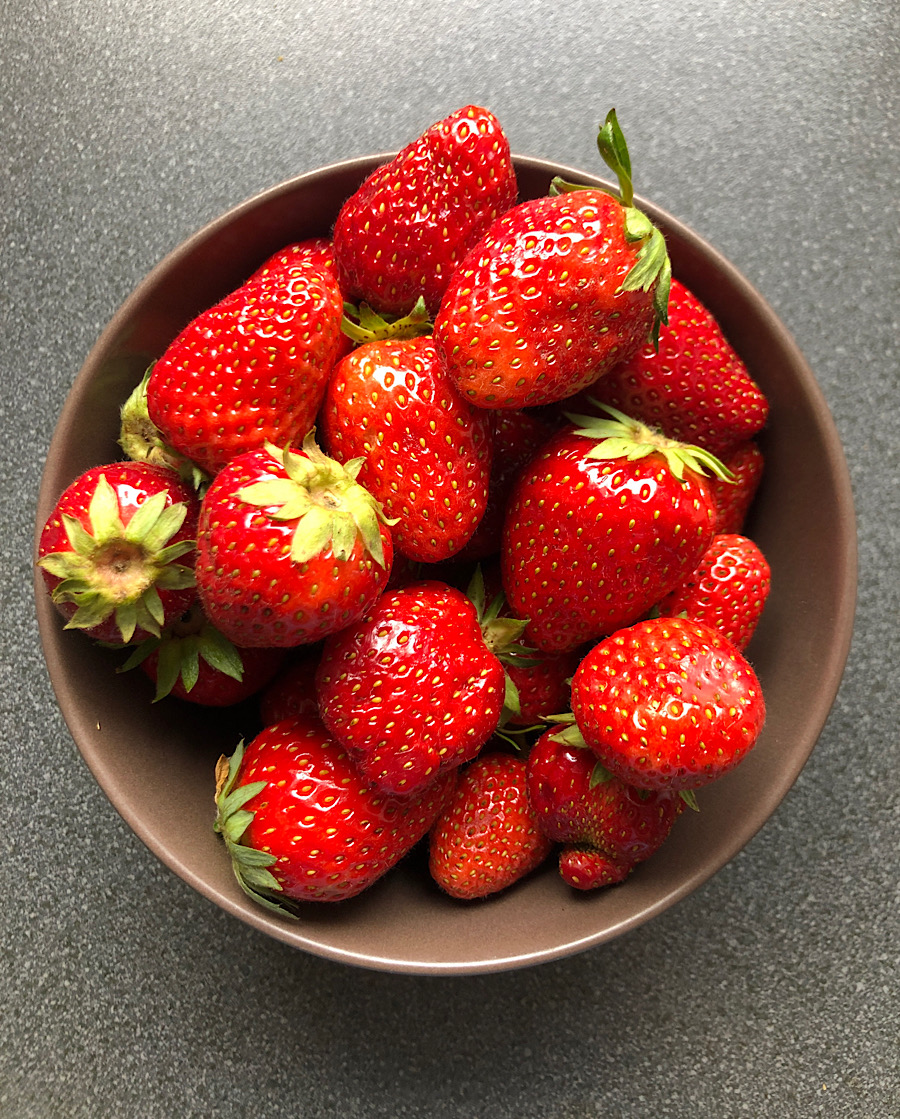
Putting grateful eating into practice is actually really simple: when I sit down to eat, I take a moment to look at the food in front of me and imaginatively reconstitute all of the energy and labor that went into it. For just a single strawberry, let’s say, it’s the seed and water and sunlight and all the millions of soil minerals and microorganisms and the pumps and lines that irrigated the plants and the farmers who sowed and tended the crop and the bees who fertilized the plants and the harvesters who picked the berry and the workers who washed and packaged it, and the electricity from coal or wind or sun that went into cooling the refrigerated truck, and the fossil fuels in its tank, and the driver who steered it to the market, and the workers who took their time to unpack it and be cheerful when they sold it to me (having worked retail myself, I know first hand how much effort being cheerful takes!)…. For a salad, its…. I’ll stop because you see how overwhelming it can get if you take the exercise seriously. All of that energy, all of that labor! It’s almost too much sometimes. When I eat in this way, though, even a small meal is intensely flavorful and satisfying. I feel profoundly cared for by God and all of these beings and energies He keeps circulating through His Creation. When I eat alone, I feel like I’m eating in community. My soul is being fed along with my body. And a nice side benefit is that I don’t tend to do as much mindless eating in-between meals. At least, I pause when I reach for the Cheez-its* or whatever because I sense the energy that’s in them and ask myself if I need that much and that kind of energy or if I need something else–to do some stretching or pet the dogs or call my sister or make some tea….
The prompt I use to spark grateful eating, when I’m by myself, is my own version of “saying grace.” I use the phrase I learned from Jeong Kwan, jal meok-ge-sseum-nida, which means being grateful to receive all of the life energy that was put into the food. The Japanese version is itadakimasu. Naturally, any expression that focuses your attention on the communal energy you’re receiving works as well.
Grateful eating isn’t a panacea. I still eat badly sometimes, and too much. I still live in (and contribute to) our messed-up global economy. But I can honestly say that grateful eating has profoundly changed my relationship to food, to myself, and all the folks–human and non–who sit down with me at the table every time I eat.
*Cheez-its are a terrible example because as far as I’m concerned it’s a law of physics that I need to eat Cheez-its. I am powerless to resist them if they are in my pantry. It would take an entirely different philosophical paradigm to get me to stop eating Cheez-its.
 The Rookery
One thought on “Grateful Eating”