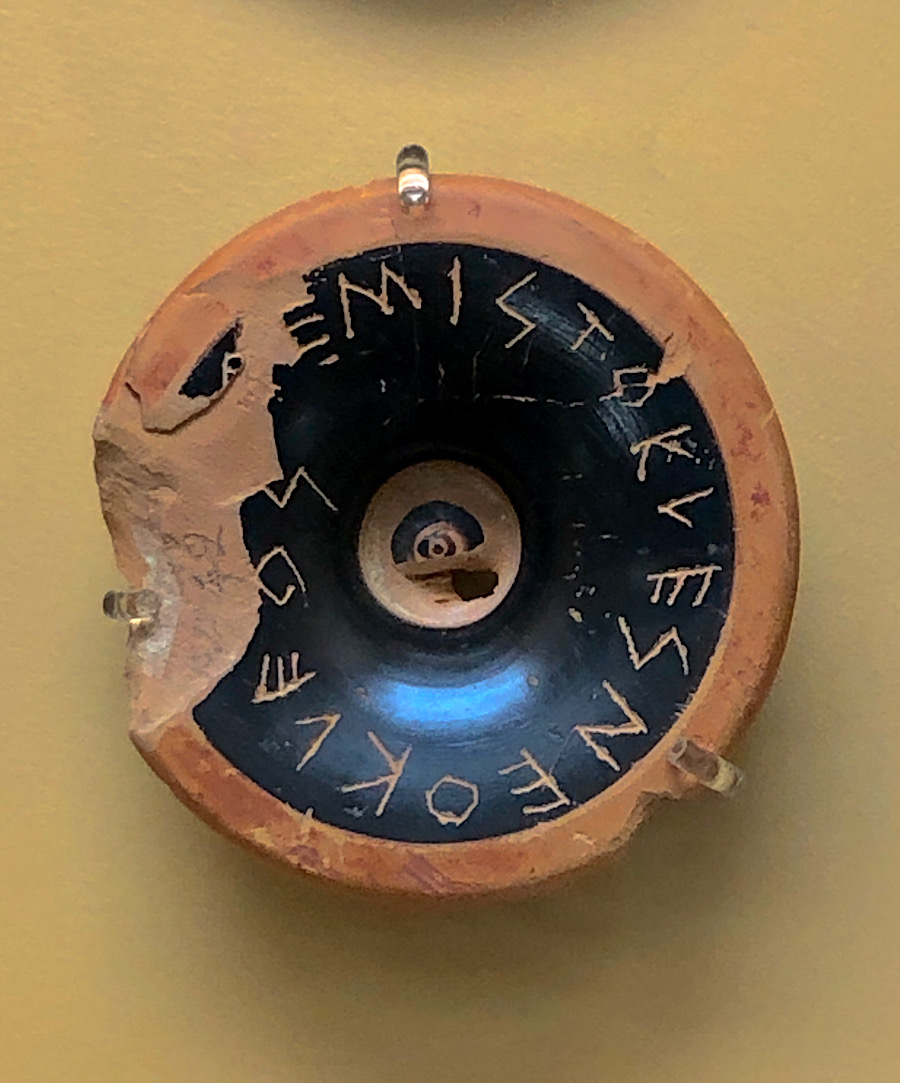
The Agora Museum in Athens is full of these funny little terracotta disks with a hole in the middle, partially glazed in black, with someone’s name scratched through the black glaze. They’re ostraka, and they were used in special elections called to banish certain citizens from Athens for 10 years. Ostracism was used in cases where there was no legal recourse–i.e., the person hadn’t necessarily committed a crime–and yet the Assembly wanted to punish them for excessive greed, a tyrant-like power grab, or, frequently, a military failure. This last was one of the most common reasons for ostracism, and sometimes those generals were recalled before the term of their ostracism was up–particularly if the Athenians were facing a worrying invasion and wanted to hedge their bets; for example, Pericles’s father, Xanthippus, was ostracized in 484 BC but recalled in 480 BC in advance of the Battle of Salamis.
Ostraka were usually just broken pieces of pots on which voters scratched the name of the person they wished to ostracize: these were everywhere in Athens, the equivalent of pieces of scratch paper (real paper, papyrus, was prohibitively expensive). After a preliminary vote of the Assembly on whether or not to hold an ostracism succeeded, then at least 6,000 ostraka (roughly 1/10 of the citizen population) needed to be counted for the ostracism to be effected. To speed up the process, it’s believed that some enterprising folks “preprinted” ostraka like the one pictured above, stringing them together for transport from the kilns at Kerameikos to the Athenian agora, where they were sold to citizens who couldn’t write or didn’t want to take the time to hunt up a stylus: a batch of nearly 200 such ostraka with Themistocles name on them were found dumped in a well in the agora after failing to sell, or perhaps after the failure of the preliminary vote; it’s impossible to say.
An ostracism vote could be taken symbolically as well: a few examples have been found of ostraka with the Greek terms for famine or disease scratched on them. In these rare cases, a pharmakos or scapegoat (usually a slave or other non-citizen of Athens) would be ostracized in hopes of appeasing the wrath of whichever god was causing the problem.
Ostracism was the Ancient Greek equivalent of modern-day “cancellation.” You don’t need ostracism when you live in a tyranny–whoever the tyrant doesn’t like is just exiled or killed. But in a democracy, if the body politic perceives a threat, you need a collective technology for excluding that threat from political life: enter ostracism, or cancellation. Naturally we can all think of modern examples where someone who has been cancelled has been invited back into public life before the expected term of their exile was up, just like Xanthippus: take, for example, Louis C.K.’s Grammy win last week after his very public cancellation during #MeToo a few years ago. I suppose the one conclusion we can safely draw from the ostrakon is that popular opinion isn’t any more or less fickle now than it was 2,500 years ago.
 The Rookery