
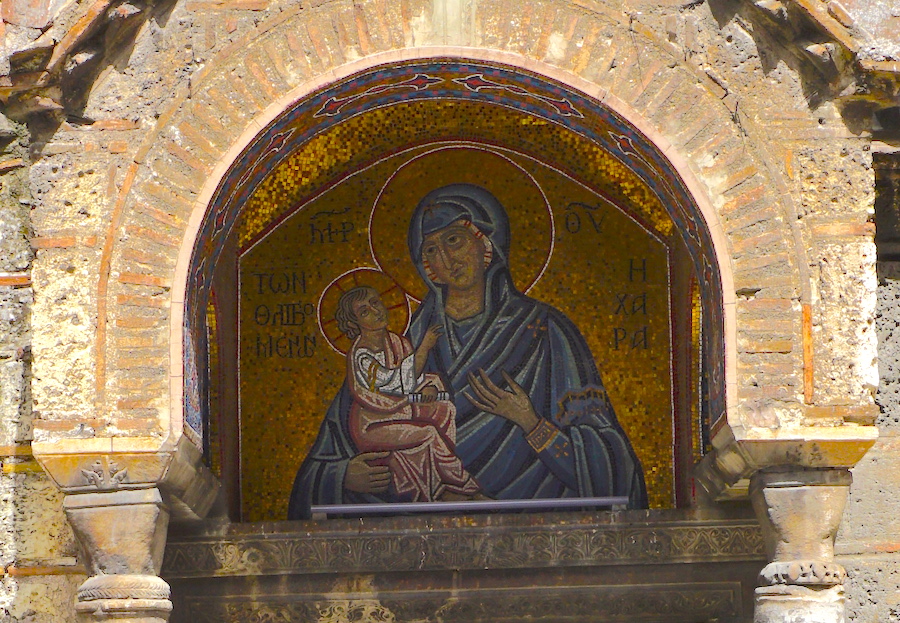
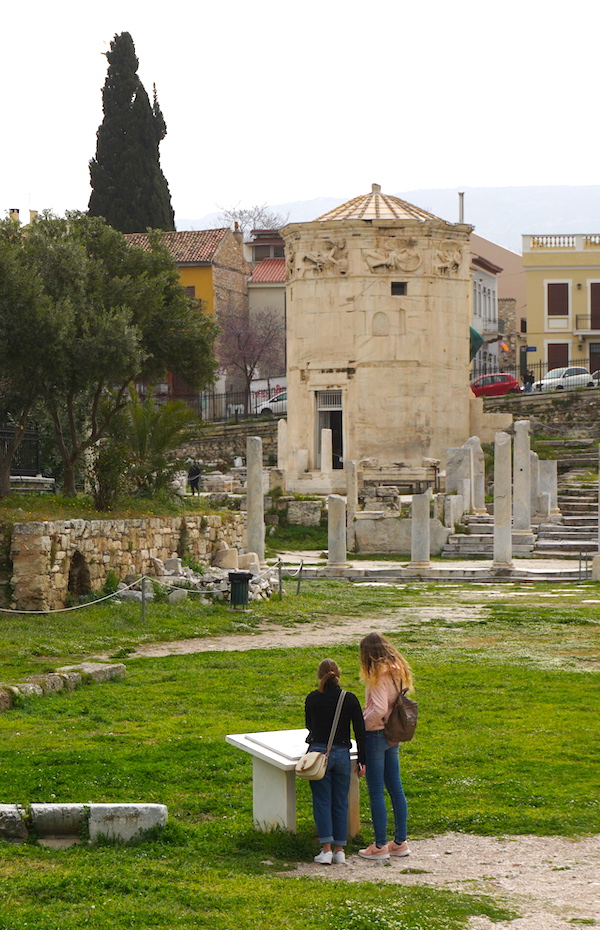
After a quick breakfast at our corner taverna, Taia, we hopped on the tram for a winding trip from Kassomouli to Syntagma through the National Botanical Garden. From there, we walked through Plaka–both really touristy and really beautiful, with jewel-box Byzantine chapels and crumbling villas tucked at the end of alleys–to the Roman Agora. We were there not to see the agora itself, which is just kind of a field, so much as the Tower of the Winds, an absolute marvel of Greek engineering built around 200 BC that stayed really well preserved thanks to being buried for much of the intervening time. It was an horologia, an astronomical water clock that kept track of both hours and days by means of hydrostatic pressure, a flow valve, a display cylinder or dial, and an ingenious ratcheting mechanism that advanced the system one day when the flow pressure reset every 24 hours. As a bonus, sundials on each of the 8 corners of the tower (it’s built like a compass rose) let passersby tell the time of day without going inside.
It took us a while to find the Greek agora, during which we got sucked into various tourist traps, the best of which was Dia Taūta (pronounced “Tafta”), purveyor of Greek cosmetics, oils, and liqueurs. I picked up an assortment of Santorini volcanic charcoal products, some olive-oil hand cream, and a tiny bottle of Mastiha, a digestif made from the sap of the mastic tree or shrub.
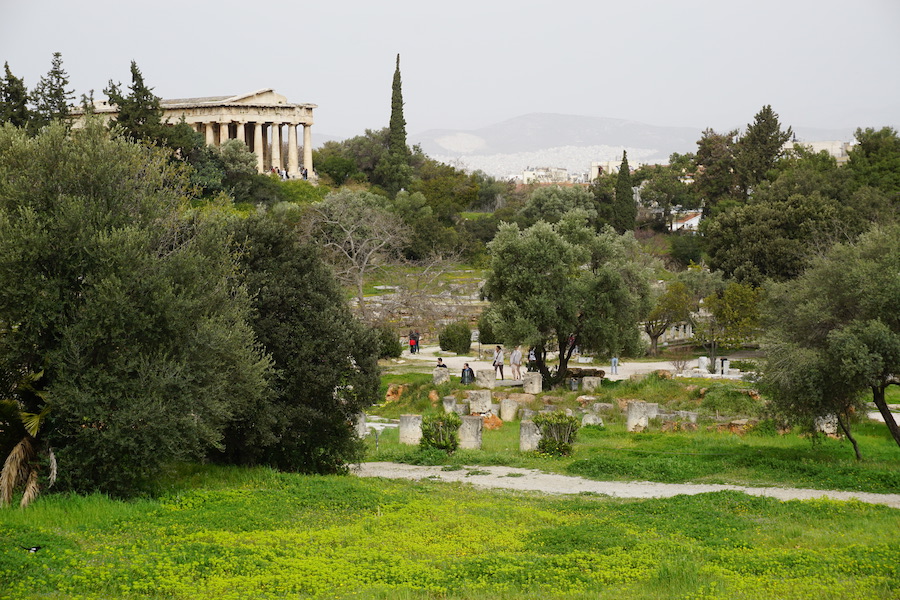
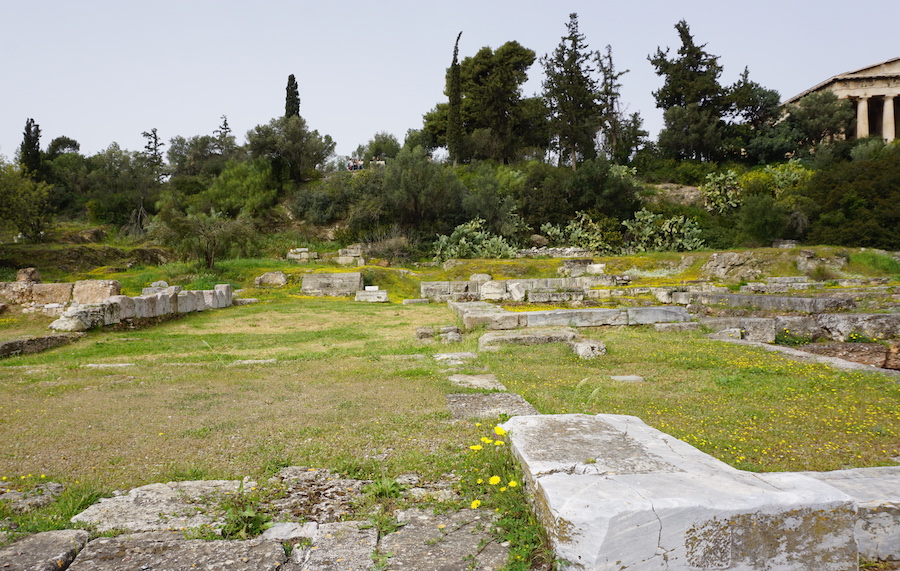
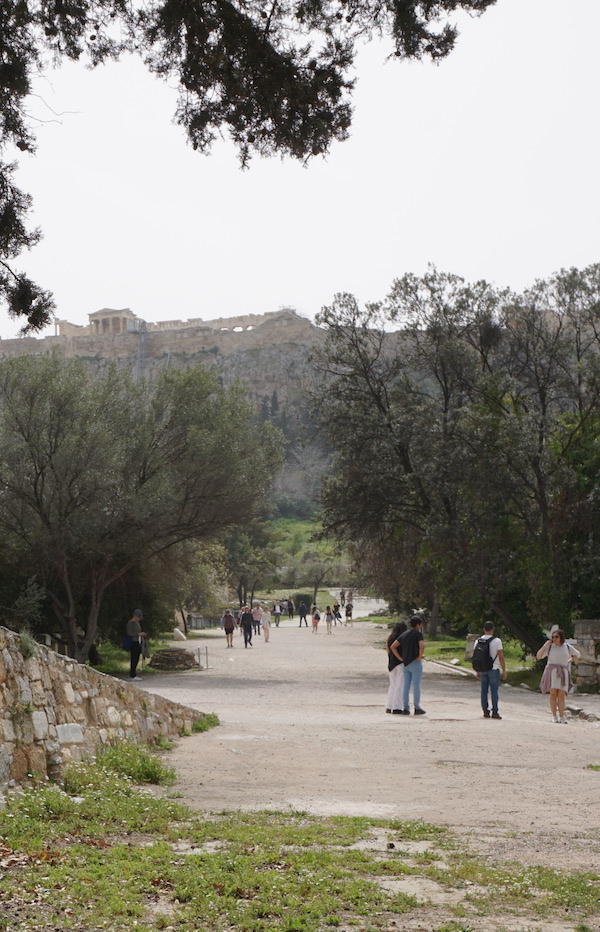
For rhetoricians, the ancient Greek agora is basically our Mecca–it’s where it all went down. Gorgias’s “Encomium of Helen” was declaimed here; Socrates’s trial took place at the bouleuterion; Plato and Isocrates and Aristotle all recruited students for their schools while perambulating the shady stoa or public arcades; the ekklesia voted here; oracles were interpreted in public here, and so on and so on.
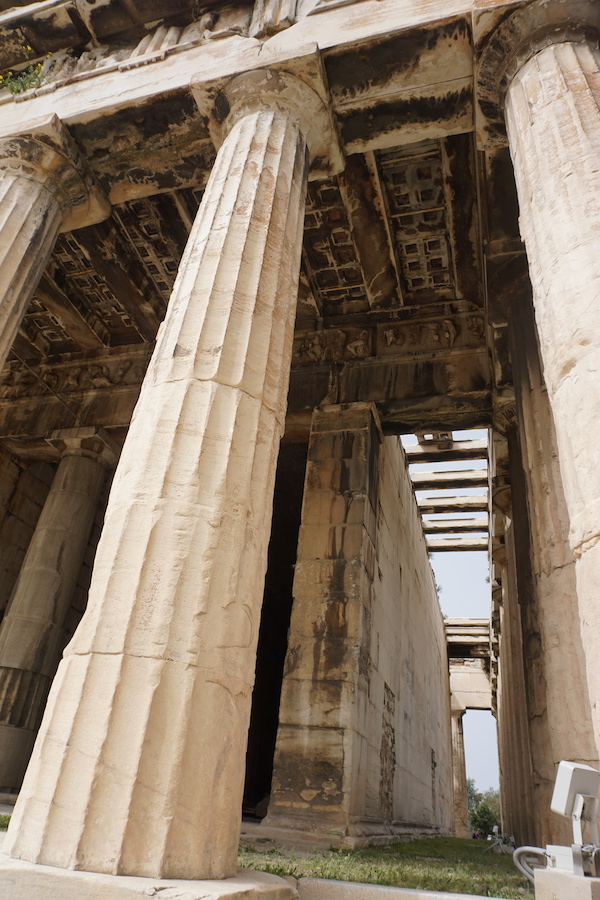
The Agora Museum presents a wonderful timeline showing how what was once private space became public space as Athens transformed from a tyranny into a democracy. The horos or boundary stones kept open the space of the agora as a space belonging equally to all citizens: anyone could do their business there with the right permits, but no individual laid claim to anything in that space. The buildings, of which there were more and more as time wore on from the 6th century BC, were all public ones: theaters, gymnasiums, temples, baths, arcades, civic offices, the Bouleuterion (Council building) as well as the Tholos (the dorm for the 30 or so members of the Council who were “on duty” at any given moment–this is also the building where standard weights and measures were kept for the purposes of customs, etc.)
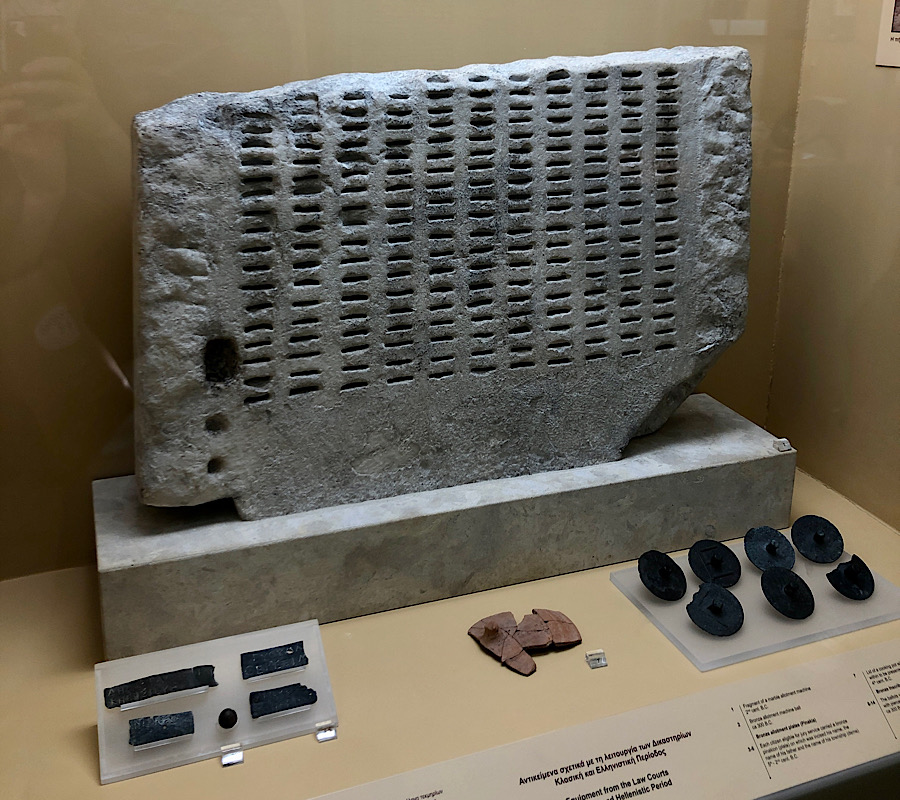
Every Athenian citizen (men from landholding families over the age of 18) belonged to the ekklesia and was expected to vote and be available for jury duty. The Agora Museum has examples of the special bronze voting tokens each man was assigned, as well as the remnants of an ingenious ancient jury-selection machine: citizens stuck bronze name-plates randomly into slots in a stone slab behind which ran a tube into which a number of bronze balls, painted black and white, equal to the number of filled rows was shaken up in a bag and loaded blind. Then, the balls were dispensed one by one, row by row; all rows with white balls were called for jury duty–Athenian juries could be as large as 500 citizens for important trials like Socrates’s. As Athens slid back toward tyranny, juries were called less often, and decisions that had been made by the ekklesia were increasingly made by the non-democratically elected boulé or related groups of oligarchs. I was impressed yet again with how much work it takes to maintain a democracy–even one as small as Athens’s had been (about 100,000 people at its peak)–and was reminded of Franklin’s famous quip when asked, on exiting Independence Hall, what kind of government had been ratified with the signing of the Constitution: “A republic, if you can keep it.”
As is probably obvious from the above, we spent a lot of time in the agora, so by the time we were done, we were thirsty and hungry. After a lunch of yet more fried fresh anchovies, pork souvlaki, and orange cake at Eūcharís, we stopped of course for another delicious Greek coffee at a coffee shop I tried to look up and failed to find because there is quite literally a coffee shop every 20 feet in Athens no matter which way you turn, and no directory can keep up. We walked up the Perikleos shopping street and on to the Museum of Ancient Greek Technology. This is a boutique project by Kostas Kotsanas, a Greek engineer who became deeply interested in the history of Greek technology and has now set up three museums dedicated to it around Greece with family foundation money. Despite being petite, it’s really nicely done–engaging and informative with a guided interactive format. Kotsanas has commissioned replicas of many inventions described in ancient Greek manuscripts–most made of bronze and either fire- or water-driven, ranging from telegraphic communication systems that could work across distances as great as 50 km to automatic door-openers to robot maids that served either water or wine or a mixture to your taste. It’s unclear how many of these, beyond the military inventions, were actually built or used in real life, but the concepts all work. Most impressive was a reconstruction of the Antikythera Mechanism, a portable computer created in roughly 200 BC for predicting eclipses and related astronomical phenomena: pieces of roughly half of the 37 projected gears were recovered in a shipwreck off the coast of the island, and scientists have been able to reconstruct from those roughly how the mechanism worked and looked. The actual bronze fragments are housed at the Archaeological Museum in Athens.
After the museum we came home to get ready for the opening ceremony for Weather Engines at Onassis Stegi and enjoyed an evening of multimedia talks and presentations about the exhibit. My favorite so far is Manifest Data Lab’s Carbon Topologies. But I also really liked the video installation 4 Waters and the terrazzo recreation of marine reef that was part of this installation.

 The Rookery