The purpose of training is to tighten up the slack, toughen the body, and polish the spirit.
Morihei Ueshiba, The Art of Peace
Hence it is incumbent on us to control the character of our activities, since on the quality of these depends the quality of our dispositions. It is therefore not of small moment whether we are trained from childhood in one set of habits or another; on the contrary it is of very great, or rather of supreme, importance.
Aristotle, Nicomachean Ethics, II.7-8
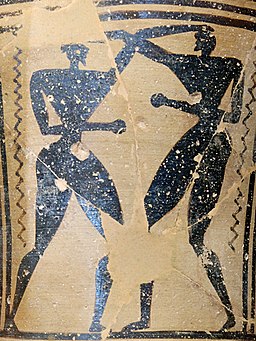
The image I chose for this series is not accidental: it is an image of two athletes training in a gymnasium from an ancient krater or urn. The gymnasium was not just where military and athletic training took place in Athens, it is also where Aristotle and other rhetoricians taught their students: they went straight from strigil-ing the sand and sweat of the wrestling ring off their bodies into the lecture hall; sometimes, teachers even held forth in the locker room. And so Aristotle would have immediately recognized O-Sensei’s words on the holistic nature of training because the Greeks saw the cultivation of ethos, of intellectual, moral, and physical excellence, as one harmonious project.
This is an important, lost teaching for all of us who grew up under the Western post-Enlightenment segregation of the physical from the spiritual, of the moral disciplines from the scientific ones. We learn things and then we do them…or not. Aristotle and O-Sensei were operating in a very different theater, one that recognized that the formation of character took hard, repetitive, integrated mental-and-physical work–training, in other words. The word ethos for Aristotle meant both character and habit: there was no way of separating the two. You have become who you are now through the accumulation of one tiny action after another; thus, you will only become a different version of yourself by the same process–laboriously removing those tiny pebbles of character, one at a time, from their current configuration and configuring them in another way; and, it will be a long time before the new pattern is recognizable to others.
This is why martial arts is such a helpful aid for training rhetorical excellence. We all instinctively understand that you don’t become a black belt just by tying one on. Yet, we persist in expecting to interact differently with the people around us simply by deciding to! What Aristotle and O-Sensei remind us is that we cannot tie on a different ethos. We stitch ourselves into it one answer, one silence, one reflection at a time, laboriously, patiently, over the course of years.
 The Rookery
2 thoughts on “Aikido and Rhetoric: The Gymnasium”