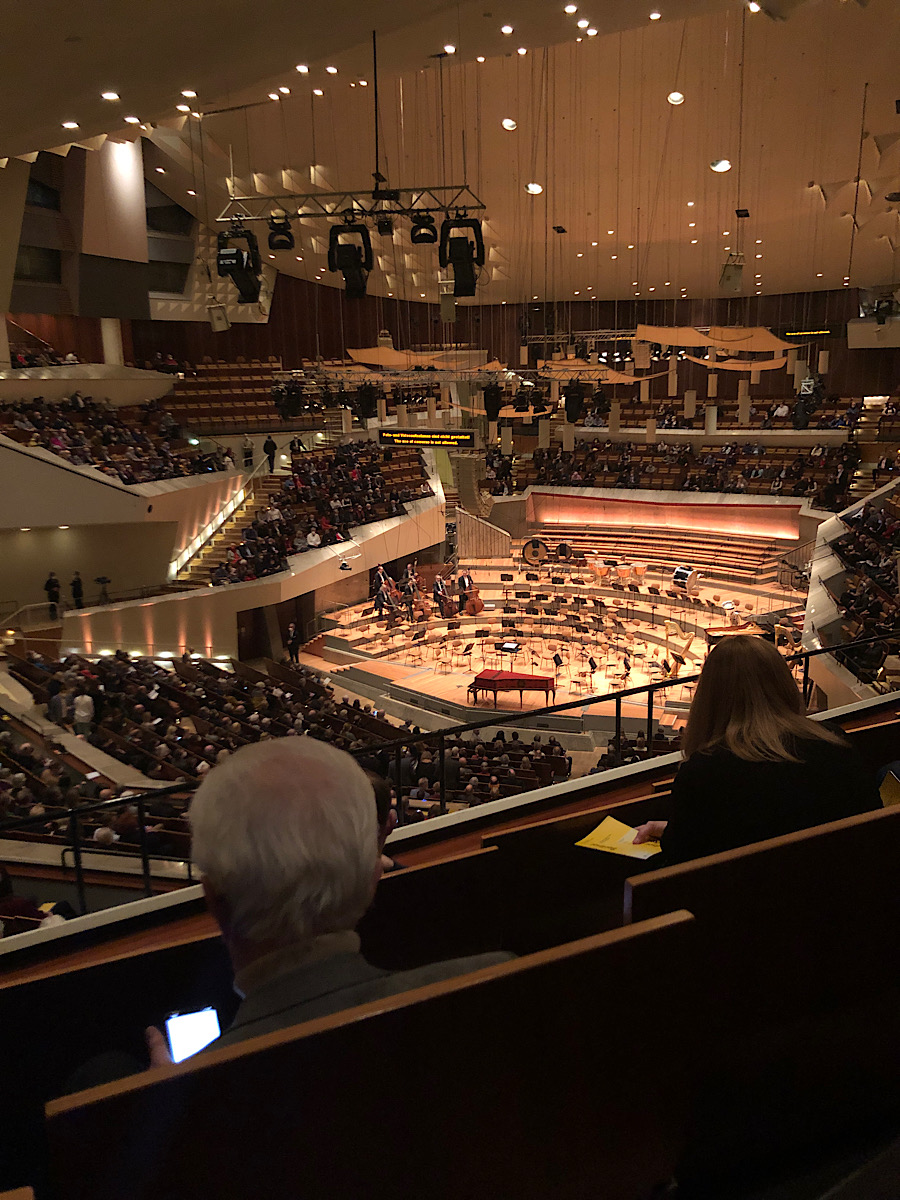
Last night I went with a group of friends to hear the Berlin Philharmonic play some ballet pieces by Stravinsky and a Bach concerto for oboe d’amore (Baroque oboe). First of all, the Philharmonic hall is a wonder in and of itself. Designed by Hans Scharoun and built in 1963, the hall was a bit shocking for its time, but many halls have copied it since due to its groundbreaking acoustics: there are no bad seats or sightlines in the house. The interior is…sliced up–there’s really no other word for it. It’s like someone made slits in a paper model and then stretched it out accordion style. But my friends were marveling that there was no awkward vantage point in the lobby or anywhere; the space flowed together even while cut into innumerable parts.
The program itself was excellent, of course. It was bold and interesting to combine Stravinsky with Baroque chamber music, but much like the sightlines in the hall, the various pieces were all harmonized by a common emotional angle, which I might best describe as wistfulness.
But the best bit was actually the result of an accident: the solo oboist (Albrecht Mayer) had a technical malfunction; the keys of his oboe d’amore stuck on him several times in the midst of the Bach concerto. He went offstage, cleaned the instrument, then came back and soldiered through the rest of the piece. But then, as a sort of apology, he played an encore: Handel’s Serse (HMV 40, arr. for oboe d’amore and orchestra). And it was magical: the musicians poured their heart into it, and it got a well-deserved standing ovation from the normally (I’ve been told) reserved Berlin Phil audience. If you want to get an idea of what the piece sounds like, you can listen to it here.
 The Rookery