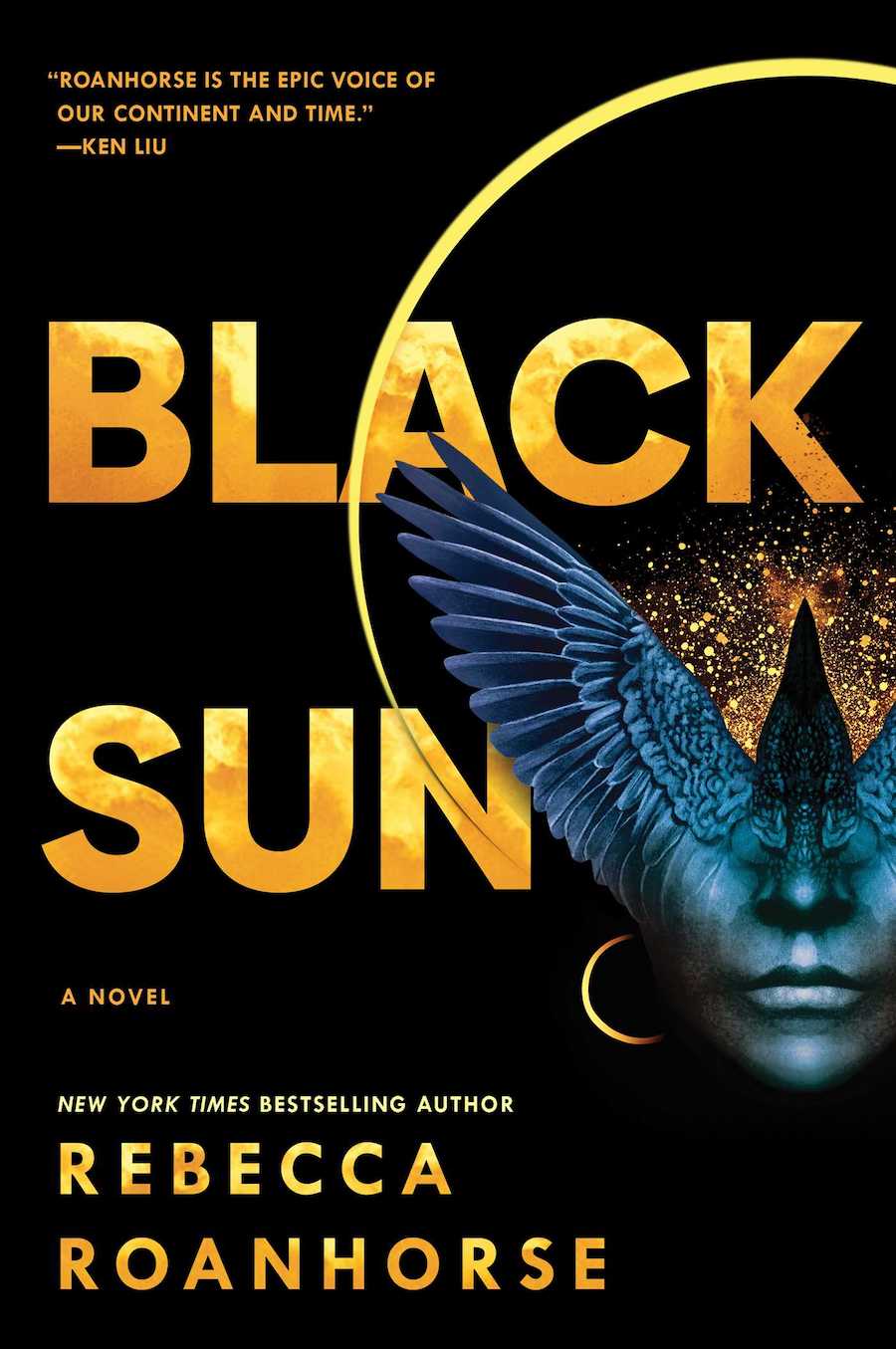
Rebecca Roanhorse is a fantasy writer who draws on her indigenous heritage and her experience living in the Navajo (Diné) Nation to create really unique speculative worlds. So far I’ve read two of her books: Trail of Lightning and Black Sun, and I recommend them both.
Trail of Lightning takes place in a speculative post-apocalyptic Southwest following the Big Water, a continental flood that submerges everything up to 4,500 ft. The Navajo Nation, sitting entirely above that level, has survived but has had to erect a magical wall around their lands to protect their people from disease, marauding, etc. The wall doesn’t protect them, however, from the resurgence of mythical monsters that draw their power from a long history of tribal trauma. Maggie Hoskie is a monster-slayer saved and trained by the demi-god, Neízghaní, who then suddenly abandons his charge for mysterious reasons. Grieving this loss and struggling to find her place among her own people, Maggie is hired to track down a golem-type monster who has been preying on young women. In the process, she uncovers a web of dark alliances that draws her inexorably back toward her old mentor and his unsettled business with the god Coyote.
Where Trail of Lightning takes place mostly in a world we recognize, Black Sun imagines an alternate history for the American continent, called Meridian in the novel, peopled by groups who draw their inspiration from the major pre-Columbian American civilizations: primarily Inca, Maya, Aztec, Anasazi, and Plains civilizations, with some recognizable influence also from Caribbean and Polynesian cultures. An old battle between pro-magic and pro-science factions ended years before the start of the novel in the ascendance of the scientific Sun cult and its genocidal suppression of Carrion Crow, followers of the Crow God–the Sun God’s ancient nemesis. As the story opens, a major solar eclipse is forecast by the Sun priests; at the same time, a long conspiracy by Carrion Crow to re-awaken the Crow God and exact vengeance against their oppressors is coming to fruition. This conspiracy revolves around a young man named Serapio who as a boy was blinded and made the avatar of the Crow God. He journeys to Tova, the sacred city of Meridian, to confront the Sun Priest at the eclipse and sacrifice himself to bring the Crow God back into power. Initially resigned to his fate, Serapio’s experiences traveling through Meridian and his growing friendship with a young sea-captain named Xiala–who herself hails from a magical tribe of siren women called the Teek–make him question his fate.
As should be clear even from these brief blurbs, both these novels are really special, building fantasy worlds that have almost nothing to do with the European mythologies that underpin The Lord of the Rings and nearly every fantasy and science-fiction book written thereafter (until Octavia Butler came along in the 1970s). It felt like such a privilege to be able to learn about indigenous cosmologies, particularly those so close to home for me. I lived most of my life in New Mexico and yet, of course, couldn’t access these traditions the way that Roanhorse has been able to.
I do have some quibbles with both books, more so with Black Sun than with Trail of Lightning, which did a better job working out the details of its Dinétah magical system. Many times in Black Sun, I found myself wondering how the Sun Priest made her star charts, and how that “science” was so terribly different from the magics of Carrion Crow and the other tribes. Perhaps it wasn’t; perhaps that was the point. But the reader should be given enough information that they can do that math on their own. The details provided were so sparse, in fact, I started to wonder if Roanhorse really fully understood her magic system herself (something I have been guilty of in my own speculative fiction at times, so I have a lot of empathy here). Black Sun is the first book in a projected trilogy, with Fevered Star, the next installment, due out this year–so perhaps many of my question marks will be resolved by the next book. That “out” isn’t available for my other quibbles with the books I’ve read so far, one of which is that the dialogue is stilted and expository much more often than it should be. The pacing is a bit herky-jerky as well: it takes pages to get Xiala out of her cabin and onto deck in the morning, for instance, and then suddenly the narrative skips over key days and events like a rock over ripples. Finally, and this is a personal preference, not a craft critique–I don’t particularly care for Roanhorse’s writing style, which often struck me as blunt and jointed. I do really like her dry sense of humor, though.
In the end, these minor quibbles are dwarfed by the major accomplishments of these books, which I’ve already described. So, I’ll just finish by saying that as I read Trail of Lightning and Black Sun, my primary feelings were joy and gratitude: it was such a pleasure to finally recognize the food, landscape, and traditions that I call home in a fantasy novel and to see them treated in such detail and with so much respect (there’s a whole passage in Trail of Lightning where Maggie makes her guests chile, beans, and frybread, and I almost cried, it made me so happy). Also, I came away from the books feeling deeply grateful for Roanhorse’s generosity in teaching readers about major, sophisticated indigenous cosmologies that almost never get taught in our educational systems in the U.S.–and also in taking the time to graciously educate readers about the traumas endured by Native American peoples, both large and small. Truly, these books felt like gifts.
 The Rookery