
So, Edmund de Waal covers this history at length in White Road, but during the 17th and 18th centuries in Europe, rich people collected Chinese and Japanese porcelain like crazy–like it was toilet paper during the pandemic; like there was a zombie apocalypse on, and the only things that could stop zombies were teacups. So nuts for this “white gold” were the European royalty that they bought thousands and thousands of pieces for personal use and plunged into a fevered race with each other to be the first on the Continent to figure out how to make porcelain domestically–no small feat as it requires mixing the right kind of petunse (a decomposed feldspar-rich igneous stone) with the right type of kaolin clay in the right proportions and firing it at the right temperature for the right amount of time….
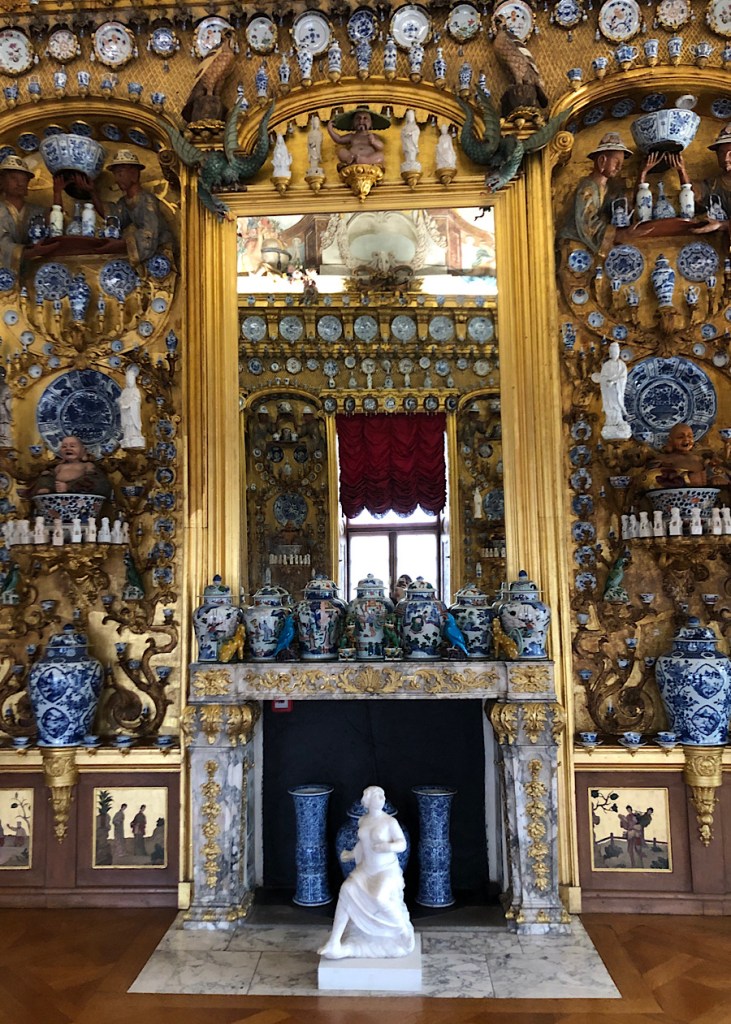
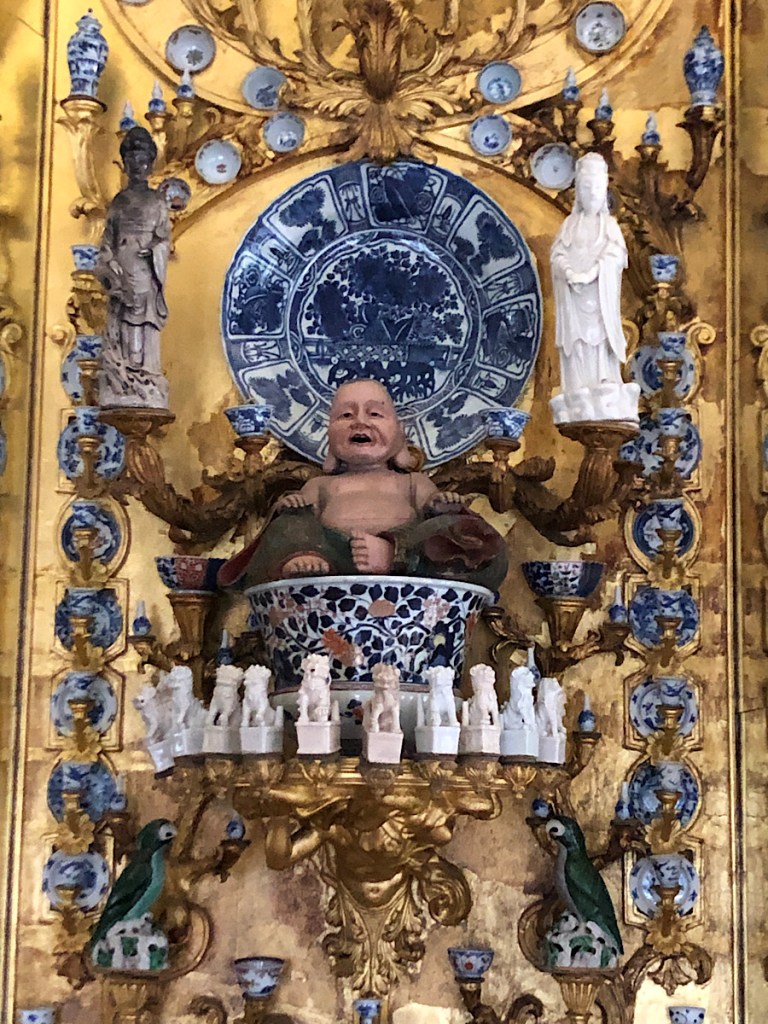
The Dutch had settled for glazing their Delft earthenwares in blue and white to mimic the Ming porcelains that became hard to get after the West-friendly Wanli emperor died in 1620. But their Polish and Prussian neighbors, with a wider variety of clays at their disposal, pressed on toward the goal of a true domestic porcelain. Augustus the Strong turned out to be the first to manufacture it at Meissen in 1709, thanks to a brilliant (and mad) alchemist named Böttger. Friedrich the Great opened his Royal Berlin Porcelain Factory in 1763. But pride of place in Friedrich’s Porcelain Cabinet at Charlottenburg was reserved for his collection of Ming wares: 2,700 pieces, to be precise (I did not slip a digit there). Tiny tea cups balance on candleholders, lions huddle to keep from tumbling off shelves, plates are stuffed into the light sconces, bowls are turned into hats for wooden figureheads because there is literally nowhere left to put them…. It’s impossible to appreciate any of the pieces as the work of art it is. But then again, that wasn’t the point. Friedrich would trawl visitors through the cabinet after dinner on their way to the salon for brandy and backgammon as a sort of colonial flex, a floor-to-ceiling mic drop. It was never about the porcelain; it was about power–the concrete demonstration of the technology, manpower, and connections it took to ship a teacup halfway around the world, and the money it took to buy that teacup in centuplicate.
After bombs blew many of those teacups to bits in WWII, conservators spent two decades painstakingly restoring broken pieces and hunting down replicas for pulverized ones based on photos and records. Even now if you hunt carefully through the glittering mess, you can spot a tiny jar or two missing a lid, but overall the conservators did an amazing job. The room looks just like it must have in the 18th century. I don’t know how it felt then, but I can tell you how it feels now: gaudy, and cold, like a tomb. The crypt of Empire perhaps, piled to the rafters with blue and white bones.
 The Rookery