I am a survivor of narcissistic abuse (NA), and so I wanted to put a brief handlist together of the resources I have found most helpful in my ongoing recovery. First, a few caveats based on my experience:
- There’s a lot of content on the Internet about narcissism, NA, and C-PTSD (complex post-traumatic stress disorder, a common result of narcissistic abuse) these days. Much of it is produced by people with no clinical training or experience in treating what is a very complex psychological disorder. Make sure to vet the credentials of any source you find before spending any time following their advice; it matters.
- It really helps to be in therapy as you process this information–with a therapist who has clinical training/experience with NPD (narcissistic personality disorder) or related “Cluster-B” personality disorders. I can’t emphasize this point enough. NA is by its nature self-concealing, as narcissists are extremely invested in and skilled at image management. Talking to people about your NA who don’t have experience with it generally just leads to further gaslighting (a form of victim-blaming involving insinuations or outright messages that *you* and not your abuser are the problem–that you’re somehow confused, off-base, or even the abusive one….) and thus stymies your recovery.
- That being said, if people you’re close to, especially those you knew before the NA started, try to tell you something isn’t right with your relationship, LISTEN. People who have suffered from NA liken it to being a frog in boiling water: the abuse ramps up slowly so you develop a tolerance for it and don’t get out. Only people who aren’t in the water are going to be able to take its temperature accurately. The pivotal moment for me was when I casually reported something to my sister that my husband had said to me, and she said, “That’s abusive.” Those two words shocked me into taking the temperature of my surroundings and started me on the road to recovery.
- Don’t spend hours trying to evaluate if your abuser is really a clinical narcissist or not. 1. You’re (probably) not a licensed clinical psychologist with training in Cluster B diagnostics; 2. Your abuser is unlikely ever to get a formal diagnosis b/c narcissists avoid those tests and are good at pulling the wool over the eyes of any therapist who hasn’t given them one; 3. Therefore, if you feel confident you’re experiencing NA after reading the sources on my list below, you probably are: as Margalis Fjelstad puts it, “If it walks like a duck and quacks like a duck, it’s probably a duck.”; 4. Who cares about the label? Is the abuse you’re experiencing acceptable to you?
- *Do* spend hours trying to figure out why you were so attracted to a narcissist, and why they were so attracted to you. This is time and money well spent because it will help you heal the attachment wounds, addictions, or other traumas that make you an easy target for NA, and it will help you develop the “narc-dar” that will protect you from NA in the future. Once your narc-dar is operational, you will be shocked at how many pings you get in your immediate social circle. That’s not because there are so many narcissists out there in society (estimates range from 1% to about 7% depending on your social circle), it’s because you’re a caring, giving person who puts others first for one reason or another. Narcissists are drawn to people like you like leeches are drawn to a warm leg in a lake–because they’re emotional energy vampires. Getting out of a NA marriage or relationship is often a precursor to shedding several other toxic relationships, if the survivor engages in the right therapy.
This is usually the spot where the blogger tells her story of NA: while I can’t get into the details of my experience for a number of reasons, nevertheless, there are *plenty* of stories in the sources I list below, and you will surely recognize yourself in them if you’re experiencing NA (I remember thinking when I read Fjelstad’s book: “How did she have a microphone in my bedroom?”) I can say these two things about my experience: first, my marriage ticked nearly every box for NA and yet it lasted for 18 years and was the envy of many people we knew (though not my closest friends and family–see above). Second, when my friends found out I had been a victim of NA, if they believed me, they were shocked because I “always seemed like such a strong woman who wouldn’t take abuse from anyone.” I make these points just in case you’re gaslighting yourself right now on the basis of them. If you are, stop. Read the resources below, get a good therapist, and get out. NA is not something you can fix no matter how hard you try. I know you’ve tried hard. So did I, for 20 years. If my husband hadn’t left me for another woman, I would have tried myself to death. And he wouldn’t have been one iota happier for it. Now, 3 years post-discard, I’m not totally recovered, but I am happy. And safe. And even better: I know God and I won’t let anyone make me feel unhappy or unsafe again. I want that for you, too; I’m praying for that for you. Go get it.
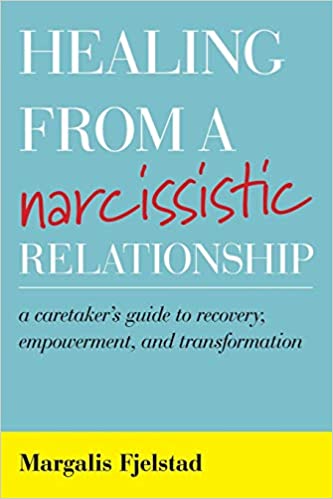
- Margalis Fjelstad, Healing from a Narcissistic Relationship. If I could only recommend one resource, this would be it.
- For Internet resources, Dr. Ramani and Dr. Todd Grande are good (there are other clinicians on YouTube as well; these are just the two I found most helpful).
- Vikki Stark, Runaway Husbands and Planet Heartbreak. Stark is a licensed therapist who conducted a survey and follow-up interviews on Wife Abandonment Syndrome. This may not be your situation, but if it is, you’ll likely find her stuff very helpful. She also leads retreats for women recovering from WAS.
- Again, this may not be your situation, but cheating often goes with NA: if that’s the case for you, I strongly recommend Leave a Cheater, Get a Life and its companion Chumplady website and Reddit communities. Even if you don’t cotton to Schorn’s slightly ribald style, her communities of “chumps” navigating discovery, discard, divorce in real time are incredibly helpful.
- Craig Malkin, Rethinking Narcissism. I do recommend this but with a strong caution. This book is really good for reframing our understanding of narcissism not as a digital (yes or no) situation but an analog one (on a sliding scale). We all can and should have self-love: the key question is whether or not we exploit others in service of it. This insight really helped me when I would read lists of narcissistic traits and think, but wait, is it wrong to think I’m special? Don’t we teach little kids to think that? Here’s my caveat, however: be very careful with the final chapter on treating narcissism. In my judgment, Malkin’s evidence for his claims here is thin, based on short-term, limited interventions and measurements. But even if it’s valid, you can’t be the one to treat your abuser. And note that Malkin doesn’t claim narcissism can be cured–no clinician does, any more than they would claim that alcoholism can be cured.
 The Rookery
One thought on “Recovery from Narcissistic Abuse”