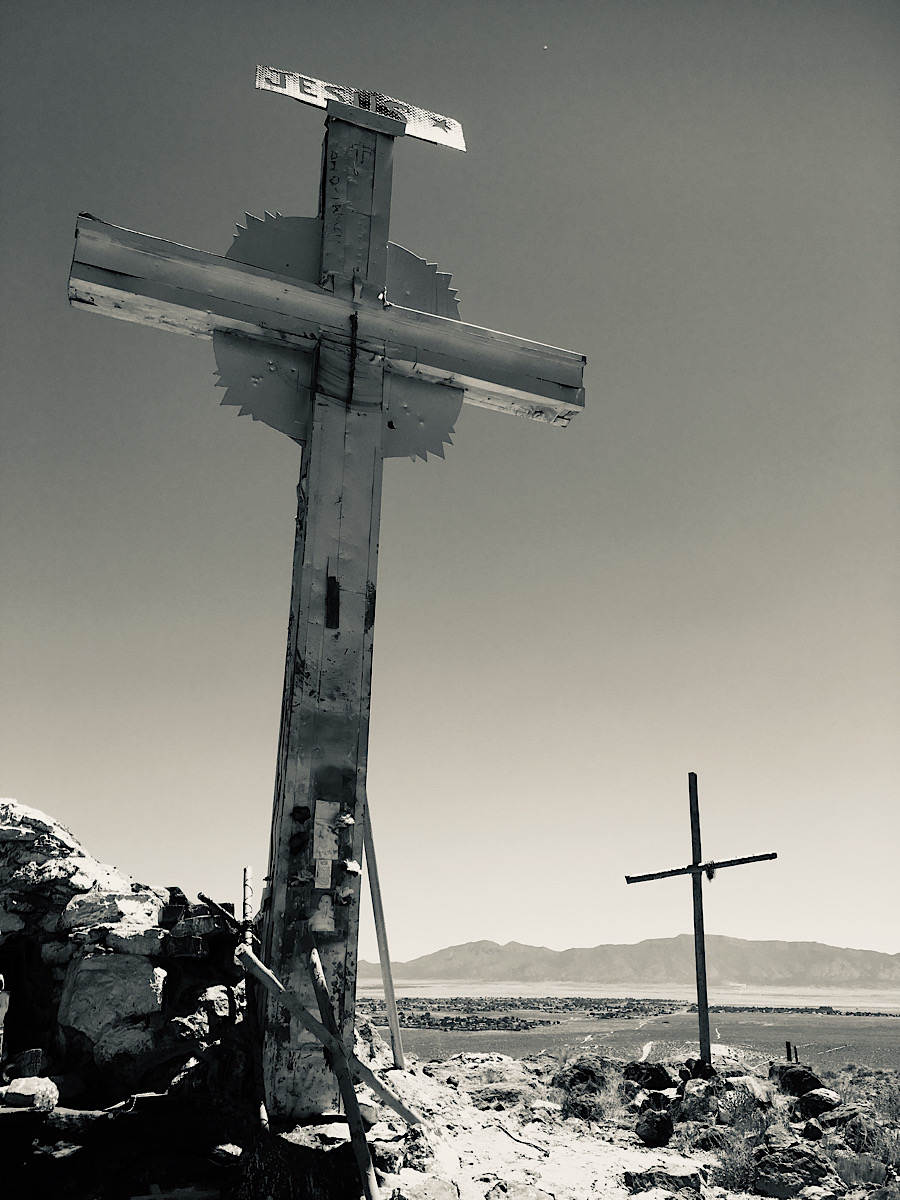
I’m posting this story today in honor of the 50th birthday of my lifelong friend Michele, whom I met in first grade at Montgomery Elementary School in a friendly competition for the affections of a boy named Tag, who turned out to be more interested in snapping his fingers rapidly over his math worksheets than he was in either of us. Lose some, win some: here’s to the next 50 years!
The first dream I had that came true, I dreamt a hot-air balloon landed in our field. And then it did–the same balloon with the same pattern of blue, green, and yellow zig-zags. The pilot handed out pins that looked like the balloon to all the kids who came over to watch it being deflated like a bounce house and packed into duffle bags. When I showed the pin to my parents and told them I knew the balloon was coming because I dreamt it, they said it was called déjà vu. Everyone got those feelings.
The second time, I dreamt our youth pastor’s little girl fell down the stairs at her house and broke her arm. She showed up at church that Sunday with a cast on. This time when my mother told me it was déjà vu, I told her it couldn’t be because what I’d seen in the dream and at church weren’t the same. Which was how I found out my mother wasn’t in a mood for backtalk.
The third time it happened, I dreamt Grandma Roberts died. She wasn’t my actual grandma, just an elderly lady at church who smelled like fabric softener and snuck us candy during service. I woke up crying, and when my mother asked me what was wrong, I told her. When she got the call in the afternoon that Grandma Roberts had died of an aneurysm, she and my father hauled me in to see our pastor, and not in a Praise the Lord kind of way. As my mother laid out the options, which ranged from schizophrenia to demon possession, Pastor Steve looked across his desk at the three of us, one to the next. He waited until my mother had sputtered to a halt, and then he ran a hand over his mustache. “Becky,” he said to me. “Have your parents explained Dispensationalism to you?”
I nodded. I was 12, but yes, they had. Our church was that way. Pastor Steve made a rolling motion with his hand, so I said, “It means that Jesus and his disciples performed miracles to make a big impact on the culture, because no one had heard of Christianity. Now that everyone knows, or pretty much everyone except some isolated tribes in the Amazon, we don’t need miracles anymore. So, God took them back.” Pastor Steve smiled the kind of smile you end up with when you’re trying hard not to.
“That’s right. That’s right. Very good. Prophecy…” he strung the word out while he thought of what to say next, “was one of those old miracles. Now that we have the complete Biblical canon, we no longer need prophecy. However,” he held up his hand to stop my mother from interrupting. “It’s not prophecy for a little girl to want to see a balloon land in her yard, or to worry about breaking her arm, or an older lady dying. I think what’s been happening to Becky is normal. You should give it to the Lord and try not to worry about it.” He looked at my mother. “Shall we pray?”
After that, I stopped telling my parents about my dreams. I didn’t have them as often as I got older anyway, which was a relief. I started to feel a kind of sympathy for God, if he had to know everything before it happened. It wasn’t any fun.
The night before I met La Cuerva, I had a dream with three crosses standing on a hill that looked nothing like the felt-board Calvary in Sunday school. This hill was all black rock and sagebrush. Lightning flashed, and clouds swirled in front of the crosses so I couldn’t see who was on them at first. When the mist cleared, I didn’t see Jesus and the thieves. I saw myself, naked, blood streaming from my wrists, my flat chest, and a crown of thorns on my head. The cross-me looked down at the dream-me and said, “Father, forgive her, for she thinks she’s something special.”
I woke up in a cold sweat, pulled my wrists free from the sheets and held them up in front of my eyes. It was Saturday, early. No one was up, not even my older sister Naomi, who had insomnia. I got dressed quickly, rushed through my morning chores, dumping chicken feed in the horse troughs by mistake and sloshing the burning-cold water all over my jeans. I saddled my horse Jasper with numb fingers, and we rode out down the acequia. I realized I knew the hill with the crosses. It was Tomé Hill.
Tomé Hill had loomed in plain sight for my whole life, blocking out half our view of the mountains. To be honest, it creeped me out a bit, the long lines of Catholics shuffling up the trail every Holy Week, mumbling over rosaries, some on all fours. But this morning there wasn’t a soul around. I pulled Jasper up short right where the trail started up from the little parking lot by the ditch, and I looked up at the hill. You couldn’t see the three crosses–two the color of dried blood, one of bone–from here. But you could from everywhere else in the valley, even from I-25. Someone had put them up after World War II as penance for killing so many Germans, or something along those lines. I could have ridden Jasper to the top, but I didn’t think that would be respectful, so I tied him to the hitching post and started up on foot.
The trail is longer than it looks with a false summit. But finally I was standing at the foot of the crosses. They were more weather-beaten and shabbier than they looked in my dream. It helped, seeing them there empty. I looked at the little concrete shrine at the foot of them–at the candles in their glasses with the Virgin decals, the red-white-and-blue rosaries, a print-out of a woman who had died made into a watercolor by the summer monsoons. A marble block was chiseled with the lopsided words, “Perdon, Dios Mio.” Only a Superman t-shirt, too little, made me feel sad. I looked past the crosses to a ridge of rocks on the rim of the hill. Beyond that there was nothing but sage and rattlesnakes for ten miles till the mesa butted up into the jagged, blue wall of the Manzano mountains.
I saw then that someone was sitting in the rocks, a woman with a blue-black waterfall of hair. I was deciding what to do when she turned and saw me. She smiled, and it wasn’t that flat, pinched one people make when they want to be left alone; it was wide, like a question. As I got closer–which I hadn’t even realized I was doing–she said, “Am I in your spot?”
I felt my face get hot. The woman was what my mother called “striking.” She had a long, strong nose and flashing black eyes. She scooted over on the big, flat rock she was sitting on to make space for me. Not knowing what else to do, I clambered up and sat down in the warm place she had left.
For a while we just looked at the Manzanos. It was coming on winter, and an early snow roofed the peaks like shiny tin. I stole a look at the woman. She was wearing a quilted flannel, jeans, and suede boots. Long silver feather earrings with turquoise beads flashed when the icy breeze moved her hair.
“Those are pretty earrings,” I blurted. The woman smiled her wide smile again. She reached up, took off the earrings, and held them out to me. When I just blinked at her, she shook them gently in her palm so they jingled.
“I make them,” she said. “I have plenty.” Obediently I reached out and took them and stuck them in my shirt pocket. “What’s your name?”
“Becky Sanchez,” I said.
The woman swung her right hand out toward me from the elbow. “Clara Candelaria,” she said. “Most folks around here call me La Cuerva.”
“Raven?” I asked as I shook her hand. It felt small and thin for how tall she was even sitting down.
She took her hand back and touched her nose, laughing. And I didn’t know why she was laughing–at me for calling her a raven or herself for thinking I didn’t know Spanish because I had blond hair. My father’s family all spoke it, but I couldn’t, even though I could understand everything people said about me. I was a pretty typical güera that way.
“What are you doing here? I mean….” My lips and ears burned. La Cuerva cocked her head.
“I come up here when I have a puzzle to solve. I feel like I can see it all more clearly from up here. What about you?”
“I’ve never been up here before. I had a dream about it. I have dreams sometimes.” I felt myself blush again. But La Cuerva just turned and looked at me steadily in a way that didn’t feel uncomfortable. I thought, she has dreams, too. At that moment, I fell totally and blindly in love with La Cuerva.
She stood up and put her hands in the small of her back. “Well then, next time we meet, we might be able to help each other, Becky Sanchez. Doesn’t Proverbs say one woman’s face sharpens another? Or Ecclesiastes? Somewhere.” She put a hand on my shoulder to steady herself as she climbed down from the rock. “Hasta luego, ‘jita.” I watched her until she disappeared over the first summit, and then I peeled my frozen legs off the boulder and stumbled back down the trail to my horse.
In spite of her quoting the Bible, La Cuerva was Catholic. I felt a sinking disappointment when I came up behind her on Tomé Hill one day and saw her praying a rosary. There were Catholics on my dad’s side, of course; my Aunt Maya was one. But when he would talk about growing up Catholic, he didn’t have much good to say. In Sunday School we learned that Catholics weren’t Christians because they worshipped the Pope and the Virgin, which was idolatry.
But my mother always said that whether you were a Christian or not in the end was between you and Jesus and nobody else. And La Cuerva certainly talked a lot about Jesus, how much He loved her, what He might want her to do in this life. I couldn’t tell exactly what she did in her life, but it was definitely more than making jewelry. She lived on the edge of the Isleta reservation. People on both sides brought her her “puzzles.” She never told me names, but someone thought their husband was cheating on them. Someone else couldn’t find something their grandfather hid before he died. A man had a baby and wasn’t sure it was his. A woman wanted a baby but couldn’t have one. La Cuerva would solve these puzzles for people, or try to.
When I started to drive the following year I stopped at her house sometimes on my way home from the King’s Academy in Peralta, staying only as long as I could and still beat my parents home from work. She would be working on her jewelry, or sometimes she would be meeting with clients, and I would wait outside on the portal.
Her house was an old adobe that meandered room to room under a cottonwood the size of a thunderhead. The kitchen was my favorite; it always smelled of coffee, sage, and roses. Drying herbs hung from the vigas overhead. The furniture in the living room by the wood stove was faded and lumpy but still comfortable somehow. She had two cats that were not friendly. In the nicho in the hall across from the dining room sat a faded, cracked wooden bulto of Santo Niño de Atocha. La Cuerva had fixed a little shrine around him with flowers, offering bowls, and one of those tall glass candles from the Mexican grocery store with the saints on them. It was always lit. This was the only place in her house that gave me the willies. Mostly we sat in the kitchen and talked, about her clients or school or boys or, once in awhile, one of my dreams.
Once when I came to see her, there was a strange truck in the drive and a man standing in her kitchen. He was Indian, tall, very beautiful, with his hair tied half back and powerful hands stuck in his back pockets, one wearing a turquoise wedding ring. I started to back out of the screen door, muttering something about coming back later, when La Cuerva, who was standing by the sink with her arms crossed, said, “Come in, Becky. Sam was just leaving.” Her voice had a sharp edge to it I hadn’t heard before. Sam smiled at me as he left, but his eyes were dark. When his truck drove away, La Cuerva took off one of her gloves–she was peeling chiles–and reached into a pot by the stove. She brought out a big pinch of blue cornmeal, crossed the dining room to her shrine, and put the cornmeal in a little bowl in front of the Santo Niño. She crossed herself and then came back into the kitchen.
I helped her peel chiles. Neither of us said anything for a long time: there were just the yellow cottonwood leaves bobbing outside the kitchen window, the rich burnt-grass steam rising from the chiles, and a radio playing swing music somewhere in the back of the house. Finally, I asked, “Who’s Sam?”
La Cuerva shook her head, short and quick as if she were brushing off a fly. “Sam Jojola is the one puzzle I could never solve.” And that was all she ever said to me about him. I wondered if she’d ever been married. Maybe she had been married to Sam Jojola. But I was too timid to ask her anything about her love life, even though I told her all about mine, such as it was, consisting of boys I had crushes on but was too scared to talk to.
Sometime maybe six months after I had met La Cuerva, I persuaded my mother to invite her over for dinner. It went fine. My sister loved her, and she charmed my father by asking him about his family. Naturally, it turned out they were related because his great-aunt had married a Candelaria. That’s the Rio Abajo for you–a small world 400 years ago, and keeps getting smaller.
Mom started inviting La Cuerva to dinner once a month. Maybe she felt sorry for her living alone. Maybe she wanted to keep tabs on her since she I was hanging out at her house. We got through about three dinners before things went south.
It started innocently enough with my mother asking La Cuerva what church she went to. She said the St. Augustine mission in the pueblo. My mother nodded. When I glanced at my father, he looked neutral. I had noticed before that Indian Catholics got a pass with him. Maybe he thought that old Catholicism was purer, or that it wasn’t the Indians’ fault that the Protestant missionaries got there 200 years late. Anyway, he and La Cuerva fell into conversation about the Posadas in Tomé, which both of them found fascinating, naturally; all the old-timey Rio Abajo families did. We didn’t do Posadas at our church, but I had gone once with a 4-H friend who went to San Clemente. You followed two little kids dressed up as Joseph and Mary, sometimes with a real donkey, from door-to-door as they sang and asked for a room for the night. And the people whose house it was would sing a song back about how no, there was no room, and they would slam the door. Everyone would laugh, and the crowd had a singing part as well. Our path was marked out through the snow with luminarias–the real old bonfire kind, not the paper bags. You ended up at the parish hall where Joseph and Mary were welcomed in, and everyone had a big feast with carne adovada and capirotada…. But the Posadas my dad and La Cuerva were talking about were different. One of our neighbors found an old script in her attic from Posadas in the 1700s. My father had taken me last year when they performed the play at the Tomé rec center for the first time in 300 years. It had a bunch of nutty medieval characters that weren’t in the normal version–drunken monks, rabbis, pedlars, Knights Templar. I couldn’t make heads or tails of the olden Spanish and was bored. Not La Cuerva and my dad. They were all about it.
I heard La Cuerva say just then, “My grandmother. She’s the one who taught me my curanderismo.”
I stiffened and glanced at my mother, whose brows had just popped into little horseshoe shapes. She asked, surprisingly sweetly, “You’re a curandera?”
La Cuerva nodded. She didn’t look afraid or embarrassed.
“But…doesn’t the Bible tell us not to practice witchcraft, even if it seems to be doing good?”
Naomi looked like she wanted to dissolve under the table. My father looked back and forth between my mother and La Cuerva, like, “This is going to be good.” La Cuerva wiped her mouth with her napkin and sat back.
“Witchcraft tries to force God and nature to do what you want. Curanderismo is a petition for help. To me, it’s just another form of prayer.”
I thought my mom would argue that point, but she just pressed her lips together. Naomi changed the subject to the football game that weekend between Los Lunas and Belen.
After La Cuerva left, I heard my parents arguing in their bedroom. I couldn’t sleep. I heard Naomi pad into the kitchen, open the refrigerator door, and shoot whipped cream straight from the can into her mouth. I watched the window over my bed until it turned gray. Then, I got up and rode Jasper to Tomé Hill.
La Cuerva wasn’t there. I sat by myself and watched the long shadow of the Manzanos peel back off the valley. When I rode back home for breakfast, my mother was waiting for me. She told me I wasn’t to see La Cuerva anymore, that although she was a well-intentioned person, nevertheless, she was lost, and as a witch she undoubtedly had dark spirits around her that could do me harm. The way my father passed through the kitchen during this talk, I could tell he did not agree but was not going to overrule my mother.
I wasn’t going to, either. But since La Cuerva had basically become my best friend, now I was stuck in my room, re-reading The Lord of the Rings. I also rode Jasper a lot, and since I couldn’t go to Tomé Hill anymore, I rode in the bosque.
I loved the bosque, especially in the early fall when the monsoon mud had dried and there were no horseflies to make Jasper crow-hop. We could ride the paths for hours under the yellow vaults of the cottonwood branches. The bosque smelled of cinnamon, mud, and incense. There was one spot two miles down from our house where the trail went out to a point, and when the water was up, the point became an island. Jasper would take me across, and we would sit on the island and watch the sky come down the Rio Grande, watch the bass smack ripples in it.
It was that fall I had the coyote dream. In the dream I was walking in the bosque by myself near sunset. A wind that I couldn’t hear tumbled leaves down around me, and they carpeted the path in gold, as if it were lit up for Posadas. A coyote suddenly crossed into the trail ahead of me. We saw coyotes all the time; I wasn’t afraid. But this one stopped, turned to look at me, lowered its head, and bared its teeth. Its eyes glowed green in the late light, and it spoke, showing its teeth: “Este no es la sendera pa’ ti.” Then, it leapt for my throat. I woke up with my hands thrown out in the air in front of me and my heart trying to bang its way through my ribs.
I went to see La Cuerva. I didn’t know what else to do. She was sitting with her two sisters out on the portal, sorting pinto beans. None of them looked much like the others except in the eyes. Yolanda was round and beautiful, with dimples and hair so black it shone bright blue sometimes. Monica was tall and thin like La Cuerva, thinner even, but red-headed with freckles. As I came up she smiled and handed me a bowl, and I sat down to sort with them. La Cuerva went in to get me a cup of coffee like they each had. “Not exactly,” Yolanda giggled, and I saw a bottle of Jim Beam sitting next to the open burlap sack of frijoles pintos on the table.
La Cuerva handed me the coffee cup, hooking her hair behind her ear with her long, beringed fingers. “You had a dream,” she said, sitting back down at the table. I looked at her sisters, but they just kept working. I took a deep breath and told them the dream. When I finished, I blurted out:
“I’m sorry, I’m sorry I haven’t been to see you.”
When La Cuerva looked at me, there were at least two things in her eyes, but she said, “You were right to do like your parents said, Becky.” The relief that washed over me at that moment made my hands shake; or maybe it was the coffee.
“What does it mean? The dream. What’s going to happen?”
La Cuerva pursed her lips. For a moment the only sound was fingers brushing through beans like a bead curtain. Finally, she said, “What do you think it means?”
I had to make myself say it: “I guess I’m supposed to stay out of the bosque.” La Cuerva said nothing. I picked a stone from the beans and flicked it off the porch. I was surprised to feel tears starting in my eyes. “But if I can’t go there, I have nowhere to go.”
It was Yolanda who said, “You can come here, ‘jita.”
I did start going to La Cuerva’s again. But then after Christmas I finally got a boyfriend. His name was Derek Jenkins. He was a senior at King’s, and even though Naomi wouldn’t talk to me for two months because somehow I had been supposed to know that she had a crush on him, I was really happy. Derek was a reader, like me. He and I went on rides together on the ditch, read C.S. Lewis, and talked about big things, like the nature of Truth and whether it was or was not equivalent to Beauty as Keats argued. My parents liked him. I stopped visiting La Cuerva and felt both guilty and better because I wasn’t sneaking behind my mother’s back.
One Saturday early in May I came back from helping my father pick up a load of alfalfa and found Derek in the kitchen with my mother. He was pale, and I could see tears in my mother’s eyes. She told us that Derek’s cousin Lisa, who had disappeared back around Halloween, had been found–cut into pieces and buried on the mesa with two other girls who had been missing for a few years. A jogger found her when his dog came out of the sagebrush with a decomposed wrist.
I remembered hearing about Lisa. It was before I had started dating Derek, and he didn’t like to talk about it. But I had seen her face on billboards, and faded blue ribbons still flapped all down her parents’ chain link fence. The killer turned out to be an auto mechanic in Belen.
“He would go down in the bosque and wait until a girl came through by herself….” my mother was saying, shaking her head. The blood suddenly drained out of my arms and legs. I thumped down into a chair by the table, puffing up a cloud of alfalfa dust from my jeans.
“Becky!” My mom was pushing a glass of ice water into my hand, and Derek was bending over me.
“What is it?” he asked. Probably because I was still dizzy, I told him. I told both of them about the coyote dream. Before I was even done I knew it was a mistake. My mother gripped the back of my chair until the wood creaked. Derek’s face was so tight he looked like someone else. “When was this?” he asked, his lips a flat line. “When did you have that dream?”
My heart was pounding so hard it made my voice skip in my throat. “I dunno…. The fall. Maybe? September?”
“Why didn’t you say something?” His voice was hoarse as if he were just keeping himself from shouting at me. “Why didn’t you tell me? Why didn’t you tell Lisa?”
There was no way to say with my mother standing there that no one believed me about my dreams. And there was no way to say with Derek standing there, his face torn in half over his cousin, that I hadn’t known either him or Lisa well enough then to walk up to either of them with something that crazy. But saying nothing wasn’t the right answer, either. Derek turned and walked out of the kitchen, and he never spoke to me again, not to tell me he was breaking up with me, not to ask for his leather-bound copy of The Two Towers back.
A couple days later I was lying in our hammock staring up at the sparkling net of elm leaves when I heard feet in the grass and turned to see my father carrying two glasses of iced tea. He handed me one and sat down with the other on an old cottonwood stump that made one of the seats around our fire pit.
“Rough week,” my father said. I kicked my bare feet in the grass and looked down at the tea, murky like a glass of river water. He always put so much powder in it it wouldn’t dissolve all the way. When I looked up again, my father was watching me, and he looked worried. I had never seen him look worried, even when he had scooped me up out of our field with a broken collarbone after Jasper had bucked me off. The tea in my stomach suddenly felt very cold.
My father cleared his throat and said, “Your mother and I did some research, mi’jita,” he was murmuring so I had to lean forward to hear him. “It turns out there are…medications you can take to stop the dreams. They use them for soldiers who have PTSD. We…got you a prescription.”
Everything–my father, the trees, the sky–suddenly seemed to take a big step back. I couldn’t have reached them if I tried.
“But it saved me,” I whispered. “You saw it. The dream. I could have saved Lisa, too, if I told people and they believed me.”
My father ran a hand over his hair. He had just cut it. It surprised me how much gray was in it.
“Dad,” I blurted, tears cinching my throat. “Why me?”
“I don’t know, mi’jita.” His face was red. He stood abruptly, reached over, patted one of my knees. “Don’t worry. Like Philippians says, ‘Be anxious for nothing, but in everything with prayer and supplication let your requests be made known to God. And the peace of God, which passes all comprehension, will guard your hearts and minds in Christ Jesus.’” He took his tea and went into the house. I went to the barn, saddled Jasper, and rode to Tomé Hill.
La Cuerva was in her usual spot. She was kicking her sandaled heels on the side of the big rock, and the wind from the stormclouds over the mountains fanned her hair like a magpie’s tail. I came up beside her and sat down.
“My parents are going to make me take pills to make the dreams go away.”
La Cuerva turned to look at me. “Do you want them to?”
I looked down at my boots. “You heard about Lisa Jenkins?”
“I did. I’m so sorry.”
“I asked my dad, why me, but he didn’t get it. I meant, why me and not her? And those other two girls. What’s special about me?” My eyes stung in the wind. La Cuerva said nothing. I muttered, “Maybe nothing. And when the dreams go away, I’ll just be nobody.”
La Cuerva put an arm around my shoulders and pulled me over so that my head rested on her shoulder, and her head rested on mine. I felt her chuckle in my hair, dry and warm. “Join the club, ‘jita.”
The sun started to set. The Manzanos turned gold and blue all at once. Above them the clouds heaped themselves into a bonfire big enough to burn Heaven down.
 The Rookery