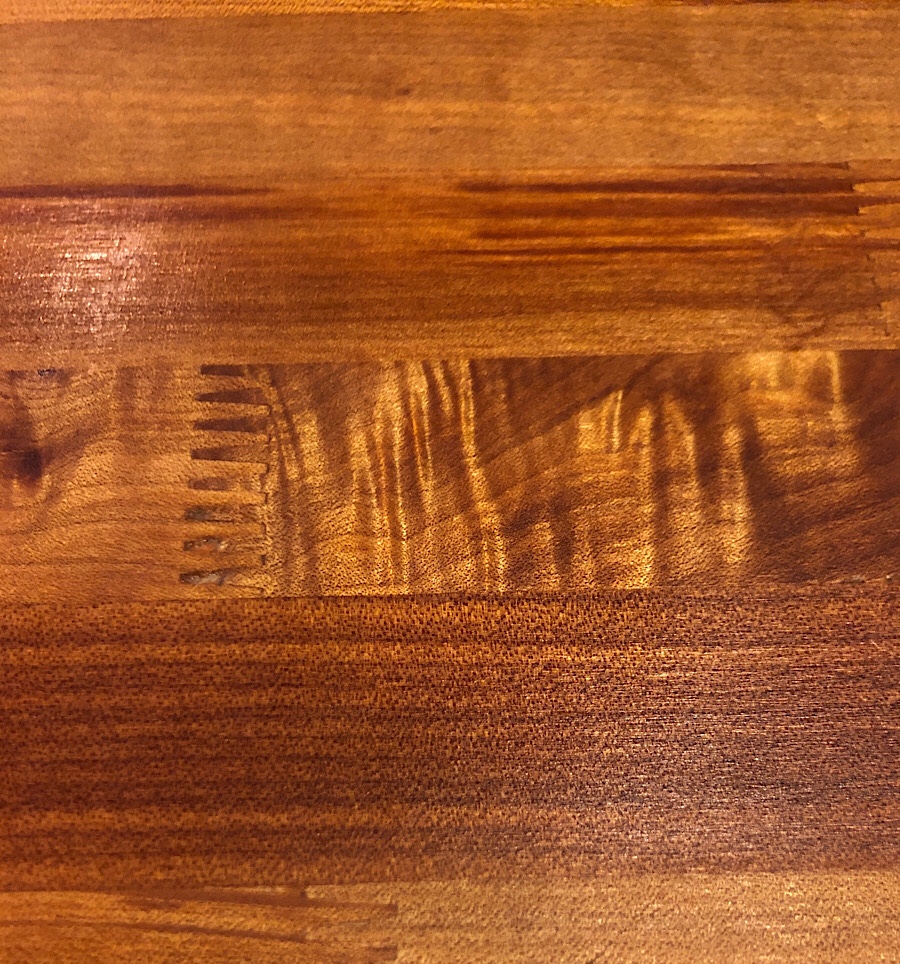
Or garlic smells…. My sister just refinished this beautiful red maple cutting board for me out of a chunk of the countertop of my old house. The story behind those counter tops is interesting: they’re the old beds from the county jail. They had to get rid of them because folks who were drunk were rolling off them and hurting themselves, so the county replaced them with beds with a railing. But the contractor who did the demo didn’t have the heart to trash like 125 slabs of 3-inch butcher-block red maple, so they just leaned a couple up outside their office with an “inquire within” sign. My yoga studio at the time was just upstairs from their office, and when I came down after class one day during my kitchen remodel, there they were: $80 a 7-foot slab. I got my new countertops for $400 (well, plus all the sawblades and hours it took my contractor to rip 3-inch cross-cut maple butcher block). And we left the bottoms intact so you could still see the graffiti the detainees etched in there with ballpoint pens (not having anything sharper on them). It was surprisingly clean—kind of along the lines of “I miss Mom.” My cutting board has the faint trace of a bird on the bottom that we didn’t sand all the way out on purpose.
Anyway, taking care of butcher block is pretty easy; you can find lots of posts on it. It involves regular (decreasing over time) rub-downs with mineral oil and beeswax. However, I had a harder time finding a solution to the allium smells that build up in the wood. Overall, wooden cutting boards are anti-microbial (more so than plastic, according to some studies), but as they’re porous, strong aromatic smells linger. What I do is make a paste of baking soda and water and rub that on the board well at the end of the week, let it dry, then brush it off. It doesn’t 100% eliminate all the odors, but it knocks them down to like 5%. And since baking soda doesn’t absorb oil well, it doesn’t dry out the wood too badly; it also polishes up the board a bit if you rub with the grain. I like it!
 The Rookery