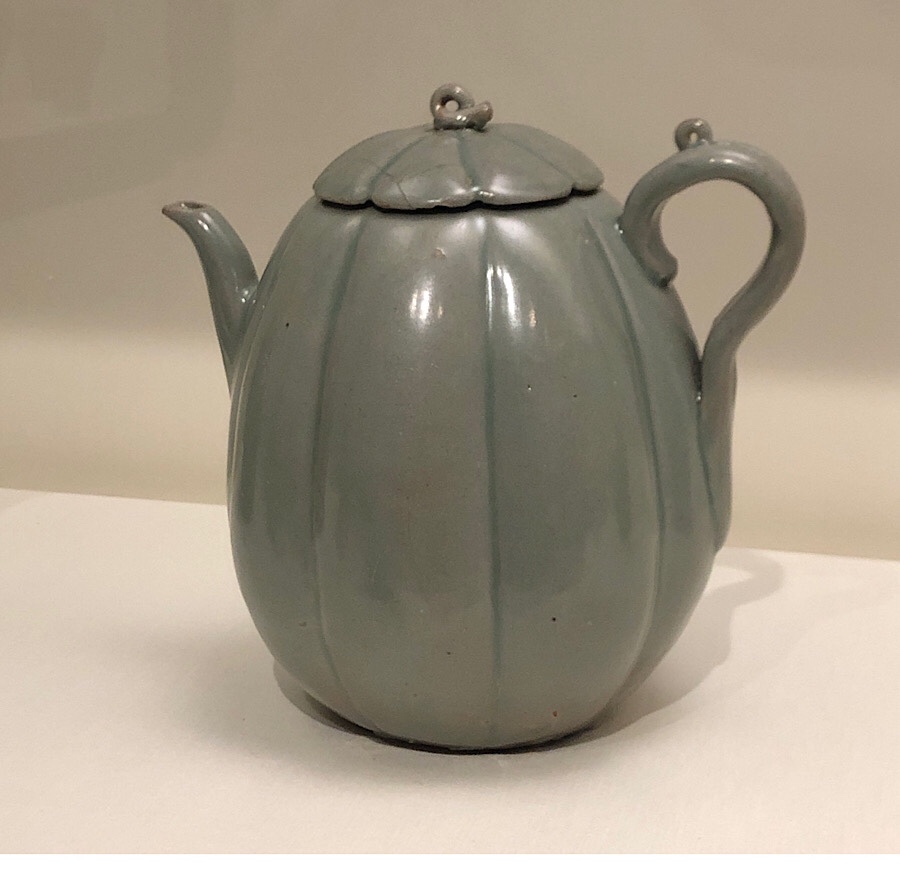
Korean celadons began being produced in the Goryeo dynasty (918–1392 BCE) roughly contemporaneously with Song celadons, and that’s not accidental: diplomatic and trade relations between the two regimes facilitated the transfer of techniques for mixing the iron-rich celadon glazes, as well as the kiln structures best suited for reduction firing. Initially, Korean celadons imitated their Chinese patterns, but fairly quickly they evolved into distinctly Korean forms. I don’t know how to describe these forms other than “Korean,” except maybe by using the word “organic”–shapes found in nature, like those of gourds, pumpkins (see the picture I took above at the Asian Art museum of a 14th century ewer) bamboo, the moon, etc. seem to play a strong role; and, my western eye finds the clean lines of Korean celadons very modern looking. Celadon continues to be produced today in the same area in southwestern Korea where the Goryeo kilns were active–Jeolla province, which is also famous for the manufacture of onggi.
Ceramics Saturdays: Korean Celadons
 The Rookery