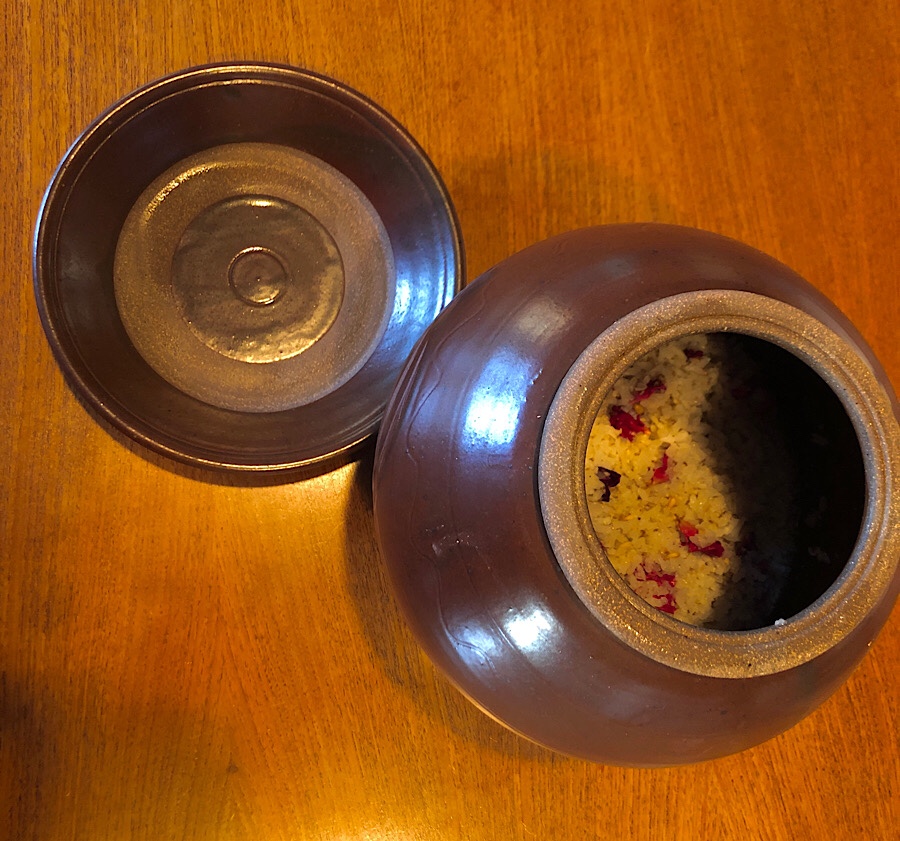
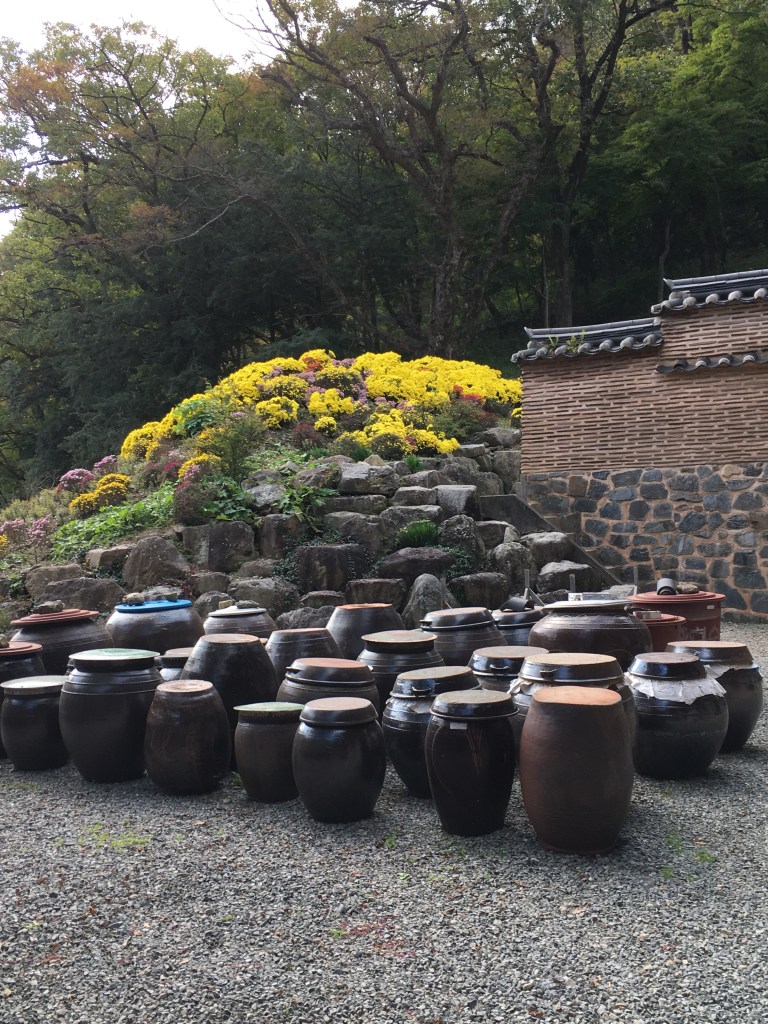
I’ve wanted an onggi since I saw the beautiful jang garden at Baekyangsa Temple (see below). And I wanted one of the traditional ones they still make in Jeolla-do. There’s nothing like an onggi for managing fermentation: it allows carbon dioxide to escape without allowing molds and other pathogens to settle in the ferment. Because they’re naturally cooling, onggi keep the ferment in the ideal temperature range, and their semi-porous clay does so without imputing off flavors.
I discovered, though, that high-quality onggi in the larger sizes you need for kimchi, etc., are pretty hard and expensive to find and get shipped to the States without breaking. After some research, I finally found an American potter, Adam Field, who studied at a famous onggi pottery in Gyeong-gi and now makes the jars stateside. So, I drove out to Queens in San Francisco last weekend to buy myself a 1-gallon onggi. It’s gorgeous, and I wanted to put it to use right away.
But I had a decision to make: whatever you use the onggi for leaves a ghost of itself in the clay; so, if you make something strong like kimchi, everything you make in it afterward will taste a bit like kimchi. And I already had a batch of kimchi going in my Artzone container in the frig. So, I decided to try making makgeolli, which I’ve been wanting to try ever since I saw Episode 9 of Hotel del Luna about a deity who lives in a well and makes the makgeolli made from it magically savory. Makgeolli is sort of a cross between beer and soju, usually made at home and consumed unpasteurized soon after fermentation, which takes about 10 days. Makgeolli is traditionally drunk from small brass or aluminum bowls with fried seafood or vegetable pancakes, or sometimes fried chicken. And, you can add things like chamomile or fruit to it to change the flavor, just as with soju.
I decided to try to brew a makgeolli with rose petals, since I still had some around from my roses last year. I started with a kit from Hyesun House that includes enough nuruk (enzyme), yeast, and chapssal (sweet/sticky) rice to make 1.5L. It’s super easy to start the fermentation: you just cook the rice, stir in the nuruk, yeast, and water, and put it in your onggi (Maangchi’s recipe has you dehydrate the cooked rice before putting it in the onggi and increase the water added—I’ll try that next time). I did that first step last night. What comes next is I stir the ferment twice a day until it’s really bubbly and starts to separate, then let it sit for another 6 days or so until the bubbling stops. Then, strain and bottle. I’ll keep you posted.
 The Rookery