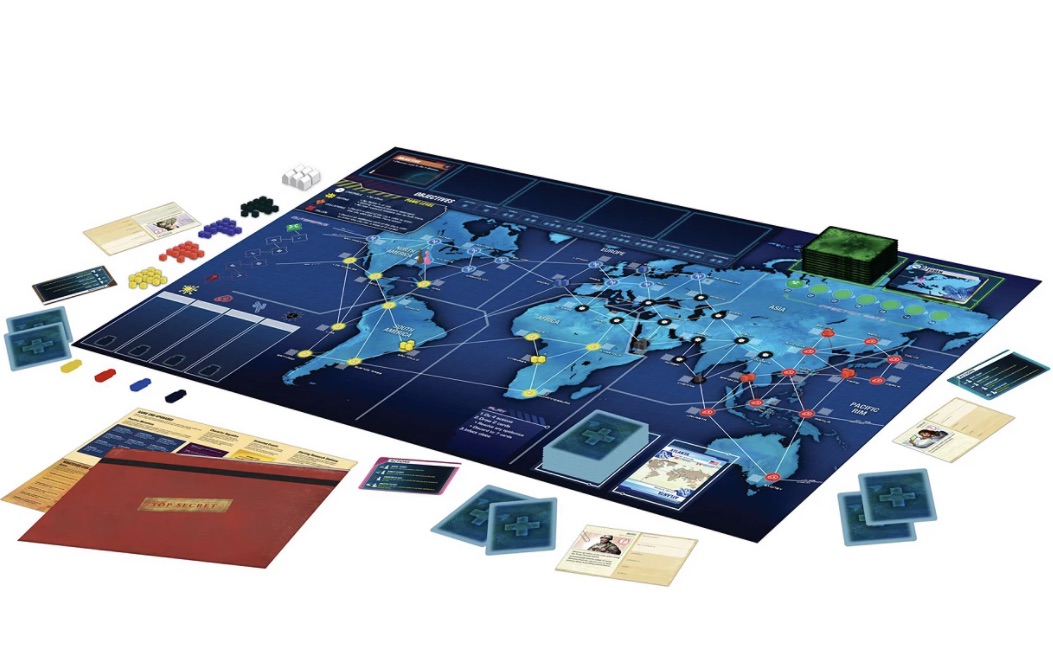
Before you jump to the wrong conclusion: I did not start playing this board game during the COVID-19 pandemic. I actually started playing the game series in 2017. There are 4 games so far in the series: Pandemic, Pandemic: Legacy (Season One), Pandemic: Legacy (Season Two), and Pandemic: Legacy (Season Zero), in order of release. I continued to play the series through the actual pandemic and found it both eery and therapeutic, teaching me helpful lessons not only about pandemics but also about community and working with others–lessons that have made me more hopeful overall about our resilience and our ability to solve problems together as humans.
Pandemic is a collaborative game where players move around a global map to try to stop the spread of one or more bio-political contagions. Each player has a character with different abilities (e.g., moving other players around, sanitizing cities) that can be restricted or lost due to exposure to the contagion. The game ends when (a) all game objectives have been completed (things like revealing a hidden city or sanitizing one area of the map); or, (b) when the limit of allowable outbreaks has been reached or a certain number of rounds have been played (marked by the exhaustion of the deck of city cards needed to achieve objectives). Pluses and minuses of the game: A big plus is the collaborative play, which (as long as you’ve got a healthy group dynamic) strengthens common culture and social bonding among players; another is the evolution and customizability of the Legacy games–you can only play each game once because it changes as it progresses through the 12 “months” of the “season”; the third is that the game is HARD but not impossible, so it constantly presents a new challenge. The minuses are set-up time (often takes up to an hour); and, you really have to bring your A-game if you want to win, so it’s not a casual way to burn a Friday night. The group I played with developed a rule that we wouldn’t start a game after 8 pm because if we did, we found ourselves trying to solve complicated logistics at midnight, which generally led to losing that game.
But ultimately why I recommend Pandemic is that it teaches you that one key to a healthy community is making sure everyone is as equally involved in making group decisions as possible. The game actually rewards this: it’s a great example of diversity producing more robust decision-making. If you let a strong personality dominate, you’ll lose–because there’s no way that one person, no matter how smart, is going to see all of the vectors at play in any given round, or their longterm consequences. If you let someone sit quietly and don’t draw them into the decisions, again, you’ll lose because you can’t win if the group isn’t firing on all cylinders. Our group started out as a group of 4 with one dominant player who proved intolerant of disagreement with their strategies. The game became so stressful for us that we eventually stopped playing, and we ended up losing Season 2 as a result of the lopsided decision-making in early months. The problem player ended up leaving the group, and the remaining 3 of us decided to replay Season 2 (we bought the other color-scheme and started over). This time, we won handily: not because we knew what was going to happen–that’s actually not terribly useful information–but largely because a player who had been shut down before came forward with fabulous strategies, and because nobody was opting out emotionally due to the stress of being bullied. Our revised group is now playing Season 0, winning consistently, and having a ball doing so (the aliases are a hoot).
So, I highly recommend starting a Pandemic of your own with a group of people you want to learn more about. You’ll be glad you did.
Hint: If you do, start with the base game in Legacy Season One and play it repeatedly until you’ve won 3 times. Then, you’ll have mastered the base mechanics of the game and will be ready to handle the extra Legacy rules–which are indeed EXTRA.
 The Rookery