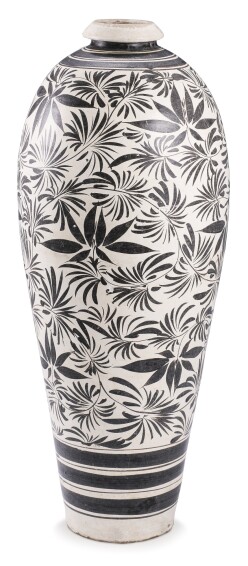
Cizhou ware is both easy and hard to identify. Easy because the distinctive black-on-white designs are difficult to mistake; hard because the style was so popular that it can’t be pinned down to a single kiln or time period–which greatly affects its value.
Cizhou-style wares were produced from the Tang to Ming dynasties, first in the north in Hebei province and later in the south in Jiangxi province. The paste varies by kiln site, but it’s the glazing that’s diagnostic–black designs on a white-slip base with a transparent over-glaze (though polychrome examples do exist). Cizhou ware is not listed among Song dynasty court tribute wares, and most exampes are relatively large and utilitarian–vases, meipings, and headrests.
Cizhou ware today is probably most reputed for serving as the foundation for the famous blue-and-white wares of the Ming dynasty: the Mongol conquerors of the Yuan dynasty relocated Cizhou artisans south to Jingdezhen, where, over the next hundred years or so, their techniques for decorating larger pieces were adapted to the new color scheme and to emerging imperial tastes for ornate, large-format wares (vases, etc.). Extant Song-era Cizhou wares vary strikingly in value based on the elegance of form and the fineness of decoration: small bowls gavel for $100 or less while intricate pieces like the meiping above can go for $250K (at Sotheby’s in 2016).
 The Rookery