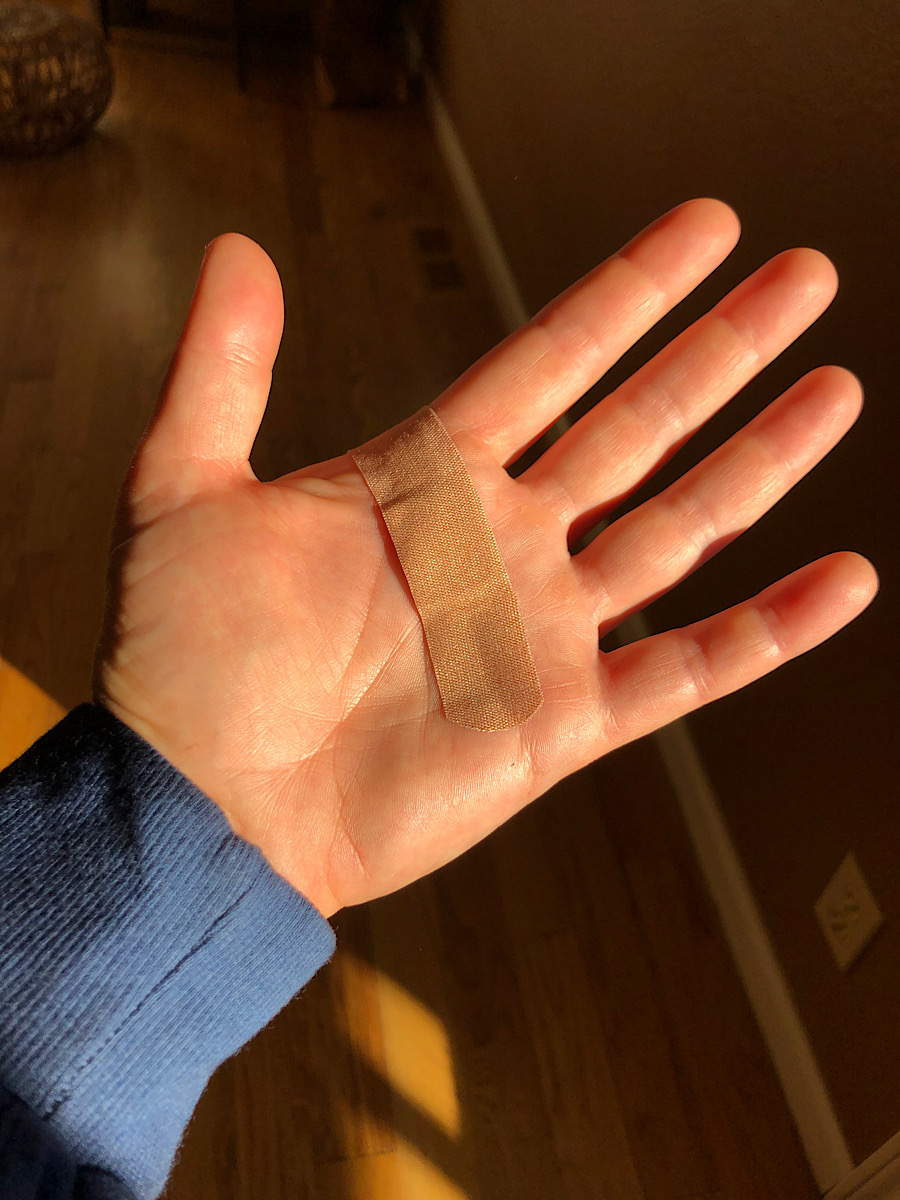
I think I’ve mentioned I’m a bit of a clutz even though (I think) I try really hard not to be. One place this becomes really obvious is the kitchen. Though the frequency with which I burn and stab myself has definitely decreased with time, I’d say I still give myself a stitches-grade knife wound about once every five years. This newest addition to the scar family was obtained while trying to separate slices of frozen bread; it’s about 1/2″ wide and about 3/8″ deep, I’m guessing based on the tip profile of the J. A. Henckels 5 1/2″ prep knife that did the trick. It didn’t need stitches, and I think I missed the tendons (though based on the numbness in the right side of my index finger, I’d say I cut some nerve fibers). So far it’s not infected, knock on wood, but it sure does hurt like a son of a gun.
It was while I was trying to sleep last night despite the throbbing pain in my palm that a couple things occurred to me. The first was that the people in movies who get knifed in the stomach and then continue to fight or run away or, heck, even talk–those people are acting. I could barely function all day with a stab wound the size of half a postage stamp in my palm.
The second thought that I had, because it was my palm, was of course about Jesus. He didn’t get a half-inch cut in one palm: he got giant spikes through both hands (wrists most likely). And another through both feet. And then his body weight hung significantly on those wounds for six hours until he died. These are historical facts. And I couldn’t even conceive of that level of agony: it simply wasn’t scaleable from the searing pain in my palm. How do you scale something to infinity?
What really got me was that Jesus, just like a movie actor, could have yelled, “Cut!” at any time. He had the power to stop the suffering He was going through, to come down off the Cross; He had already performed dozens of bigger miracles than that. If I were Him, I wouldn’t have stayed up there a hot second; I couldn’t have.
So why did He? I think Charles Spurgeon put it best (quoted by Tim Keller in his sermon “Does God Control Everything?” preached October 24, 2012):
“Jesus Christ was up on the cross, nailing, bleeding, dying, looking down on the people betraying Him, and forsaking Him, and denying Him, and in the greatest act of love in the history of the universe, He stayed.”
Jesus endured the agony because He loved me. Because He wanted to lay His cross across the unbridgeable gap created by my sins and imperfections and bring me back to His side. His desire for me was stronger than the agony He was experiencing. And so He stayed.
If I can’t conceive of the agony He experienced, you can bet I can’t conceive of that level of love. Then, what good is it to try? Well, lately I’ve been struggling with feelings of worthlessness again–I think because it’s about the time of year two years ago that my divorce was finalized, that I cut off contact with my ex-husband, that I let his birthday go by without wishing him all the happiness in the world for the first time in two decades. In the interim: a pandemic, isolation, grief, loss. It’s hard not to internalize all of that negativity and emptiness. But the pain in my palm reminds me that’s not an option. If Jesus set my worth above His own ungraspable suffering, if He died to redeem me, then it’s not just disrespectful to devalue myself, it’s delusional–like denying gravity.
And like gravity, or the size of the universe, just because I can’t grasp Jesus’s love for me, my worth in His eyes, doesn’t mean it’s not real. I just have to trust the traces I can grasp: like the drift of a maple leaf down to the path in front of me; Orion in the southern sky; and, a little half-inch wound in the palm of my hand.
 The Rookery