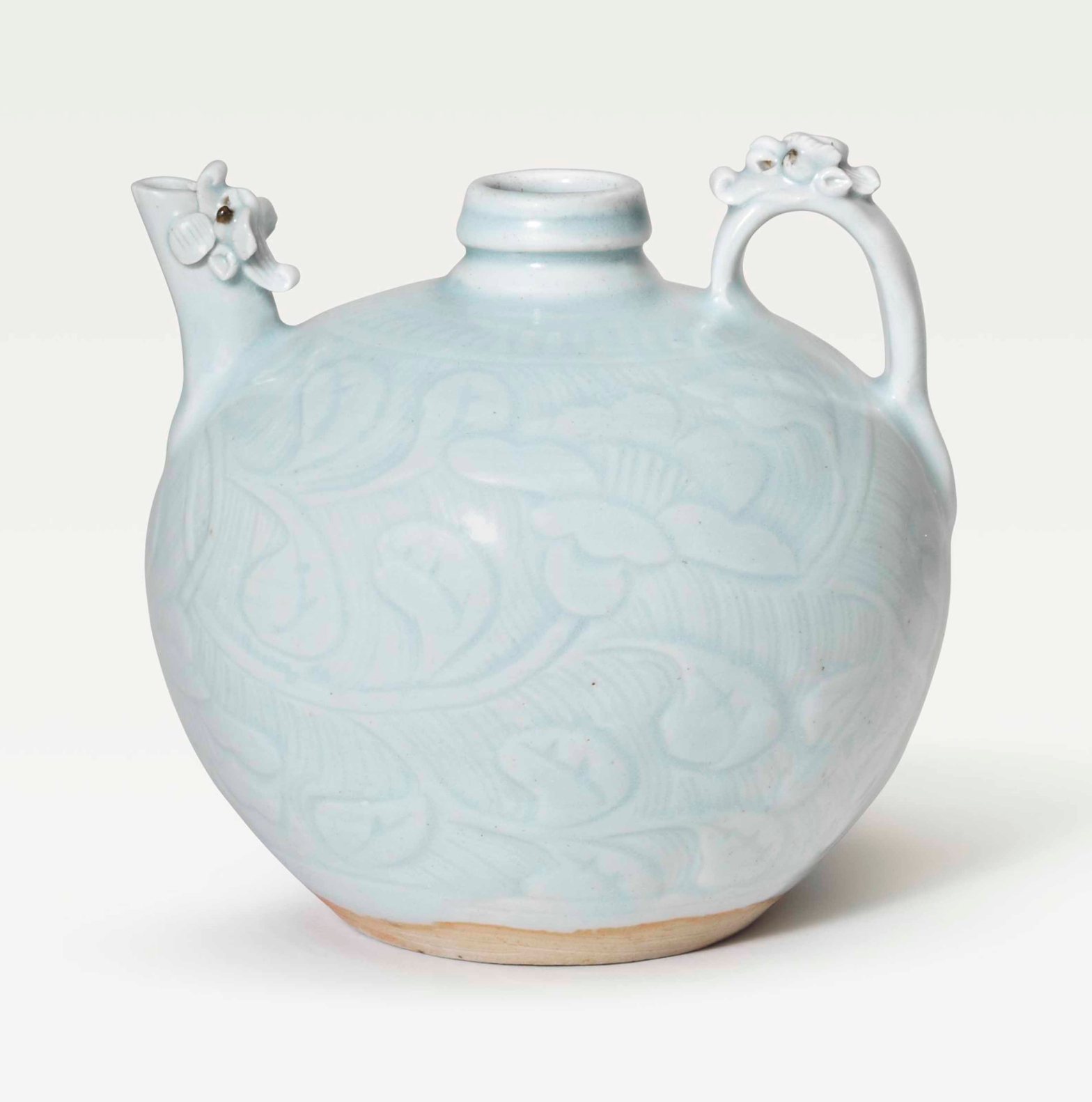
Qingbai ware was produced during the Southern Song and into the beginning of the Yuan dynasty in the 14th century at sites around Jiangxi, mostly at the Jingdezhen kilns but elsewhere, even Jizhou, as well. It was never an imperial ware: it was designed for the merchant class, to mimic Ding wares. But Qingbai achieved some important innovations, including the addition of kaolin clay to the body, which allowed very thin walls and a smooth, translucent paste in the best examples; and, the addition of small amounts of iron to the glaze that produced, in the reducing atmosphere of pine-fired kilns, a delicate blue-green hue: qing means green or blue, as in the color of water, and bai means white. The forms of Qingbai ware were quite similar to their Ding inspirations, and many of these carried over into the Ming era, when they were simply painted in blue and white instead. Qingbai became collectible several hundred years after the Song dynasty ended. Pieces range dramatically in price depending on quality, from $1K or less to as much as $500K, which was what the dragon ewer above gaveled for at Christie’s in 2016.
Ceramics Saturdays: Qingbai ware
 The Rookery