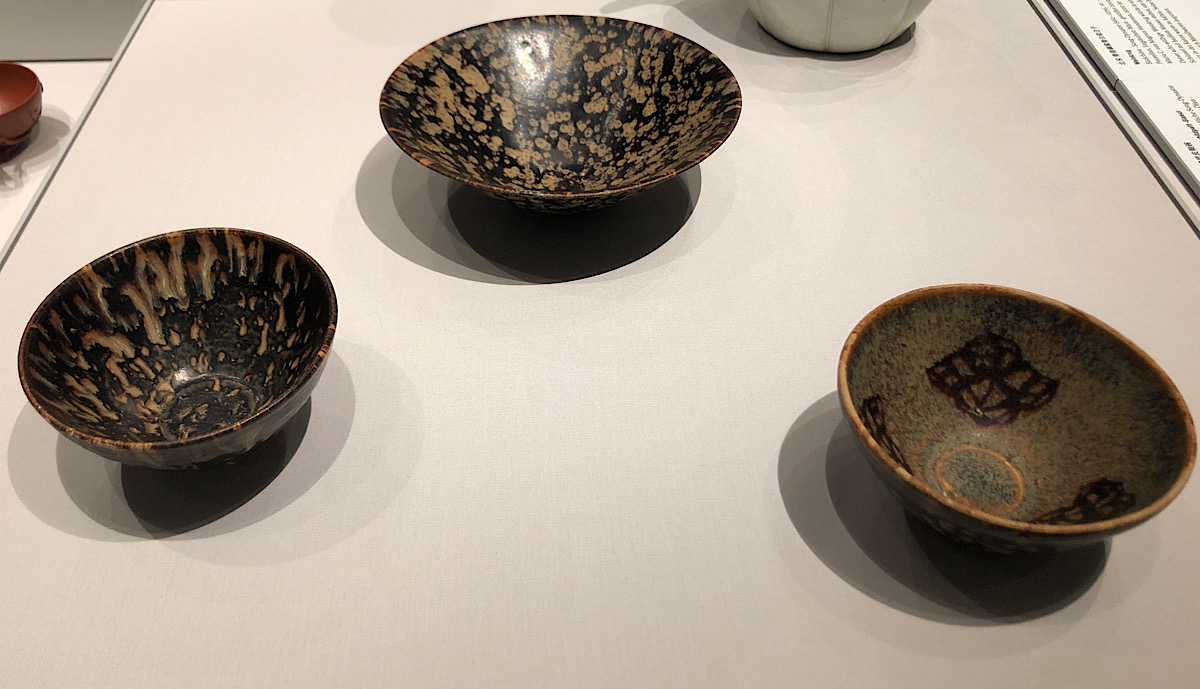
Though we’re through the Five Great Kilns now, there are still some really spectacular Song ceramics you should know about. We’ll start with my favorite kiln: Jizhou. Fired in Jiangxi during the Southern Song (1127-1279), these wares weren’t intensely prized at the time: their body was a relatively drab and coarse gray-brown, and their glaze generally an unremarkable iron black. The shapes were very straightforward and plain (though the conical shape of Jizhou tea bowls is distinctive and modern-looking). Jizhou ware was all about the decoration: “tortoise-shell” and “pheasant feather” splotches of mottled red-brown glaze against the black background; ghostly painted “deer spots,” moons, plum trees, and auspicious characters; and, various ingenious resist designs, which involved the application of a papercut or leaf dipped in glaze that would burn away during firing and leave its shadow behind–black on brown or delicate gold on black. When these designs were placed in tea bowls, they were set toward the bottom to be gradually revealed as the cloudy “white” Song-style powdered tea was drunk. When tea ceremony became popular in 17th century Japan, Jizhou tea bowls became highly collectible as their stark black glaze and “scrolldown” reveal of their decorations perfectly complemented the drinking of matcha.
I took the picture above of some Jizhou tea bowls from the Asian Art collection of the Ethnologisches Museum in Berlin. This museum has an incredible collection of Song-era ceramics; unfortunately, they’re badly displayed, so you can only closely observe a fraction of what’s on view. You can find higher-quality images of Jizhou ware on my Pinterest page if you’re interested (Pinterested?). Jizhou ware is variable at auction, its value depending a lot on the form, condition, and provenance of the piece in question: this gorgeously potted shuye tuyang/konoha (tree-leaf-pattern) Jizhou bowl gaveled at $120K in 2015.
 The Rookery
One thought on “Ceramics Saturdays: Jizhou Ware”