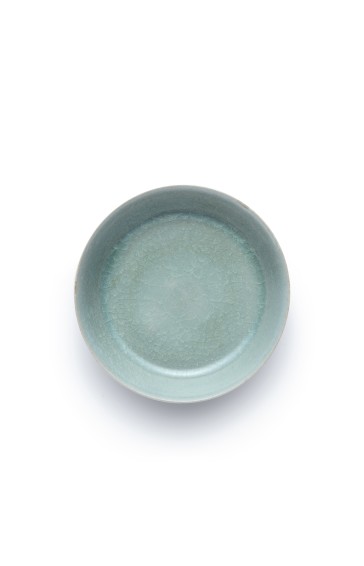
Ru ware is the rarest of the products of the Five Great Kilns of the Song Dynasty: only about 90 examples are still extant, and on the even rarer occasions they come up for auction, they fetch millions of dollars apiece. They were thrown only at a single kiln site in Henan for a period of 20-40 years at the end of the Northern Song (ca. 1100 CE) and collected exclusively by the Huizhong emperor–who rejected any he felt were imperfect. By the 18th century, the Qianlong emperor wrote that Ru-ware pieces were “rare as stars in the dawn sky.” Their appeal, outside their scarcity and imperial provenance, seems to have rested almost entirely in their glazing. Their forms are small and basic; their paste is relatively coarse and low-fired; however, the Ru glaze is an extraordinary celadon–unctuous and crystalline with intricate crazing and a color described as “duck-egg blue” or “sky blue.” You’ll be lucky to ever see one in a museum; I haven’t yet. The brush washer pictured above went for $28M in 2017 at auction at Sotheby’s
Ceramics Saturdays: Ru Ware
 The Rookery