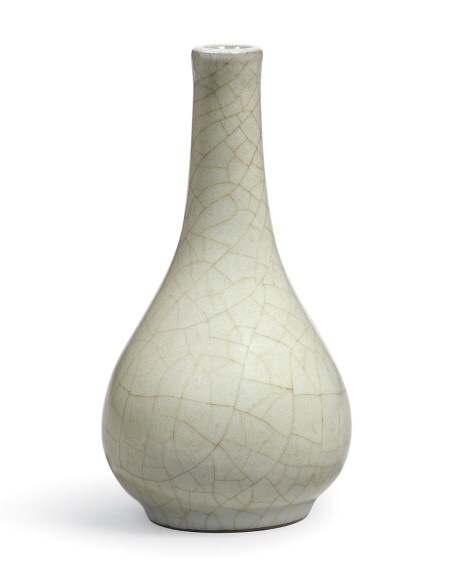
Song Dynasty ceramics marked “guan” were designated for use by the Imperial Court. But the term came to be associated with one of the Five Great Kilns in particular, near Zhejiang during the Southern Song (1127-1279). Guan ware is technically a form of celadon, but the precise glazing technique is not entirely understood. Multiple layers of glaze were applied, and the distinctive “ice crackling” crazing on the final layer was produced by a controlled cooling process. Guan ware, partly for its unique jade-like beauty and partly for its association with emperors, remains highly coveted; the vase above went at auction at Sotheby’s for roughly $1.6M.
Ceramics Saturdays: Guan Ware
 The Rookery