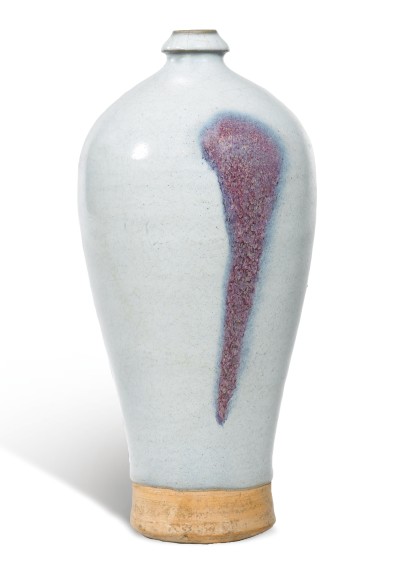
In homage to Tiara Thursdays, I thought I would start a series about ceramics, a minor obsession of mine I’ve previously written about here and here.
We’re starting with the Five Great Kilns of the Song Dynasty (960-1279 CE), each of which produced wares that were collected by emperors, scholars, and aristocrats as soon as they were made. The meiping (wine bottle) pictured above, which sold at auction at Sotheby’s for about $45K in 2015, is from the Jun kiln, which was famous for its sky-blue glazes–literally: the glaze itself has no pigmentation; it refracts light across the surfaces of millions of tiny bubbles much as our atmosphere refracts sunlight, and only the shortest visible wavelengths (blue) make it to our eyes. Many vessels, like this one, also feature artistic, almost modern-looking, splotches of a copper-pigmented glaze that turns purplish red when kiln fired (some pieces are entirely done in the copper glaze). The Jun kilns produced a full range of stonewares, but interestingly only heavier, utilitarian pieces tended to be collected by the imperial court: flower vases of various sorts, spitoons, larger bowls, and brush washers; these make up the bulk of the guan or imperial wares that have survived.
Next Saturday, we’ll do Ding ware. But if the suspense is killing you in the meantime, you can head over to my Pinterest board on Song ceramics.
 The Rookery