I’m a ceramics nut. I’m particularly obsessed with tea bowls from the Song Dynasty in China (roughly 960-1279 AD). Compared to the florid patterns of later periods, Song ceramics are plain, almost austere in their plain black, white, and celadon glazes. But their shapes and the rich nuances in those glazes—one that looks blue but isn’t, like our sky, another with a dizzying network of spring-ice crackles, a third that pins the bones of a leaf golden on a black ground—make them into coveted treasures. Some bowls have survived a thousand years of war, pirates, and fires. Others are named and revered in temples like minor gods. One, a rare specimen of Ding porcelain, was recently bought by a woman at a garage sale for $3 and sold for $2M at auction. But no matter how much they are valued, or coddled, or hoarded, all these pieces have one thing in common: someday they will break.
This world is not kind to fragile things. It takes an immense amount of energy to make something delicate, something that sits right on the line between being here and not. Entropy gnashes its teeth at fragility, trying every day to turn it back to dust. And entropy always wins. Maybe not this year, maybe not even in a thousand. But some day.
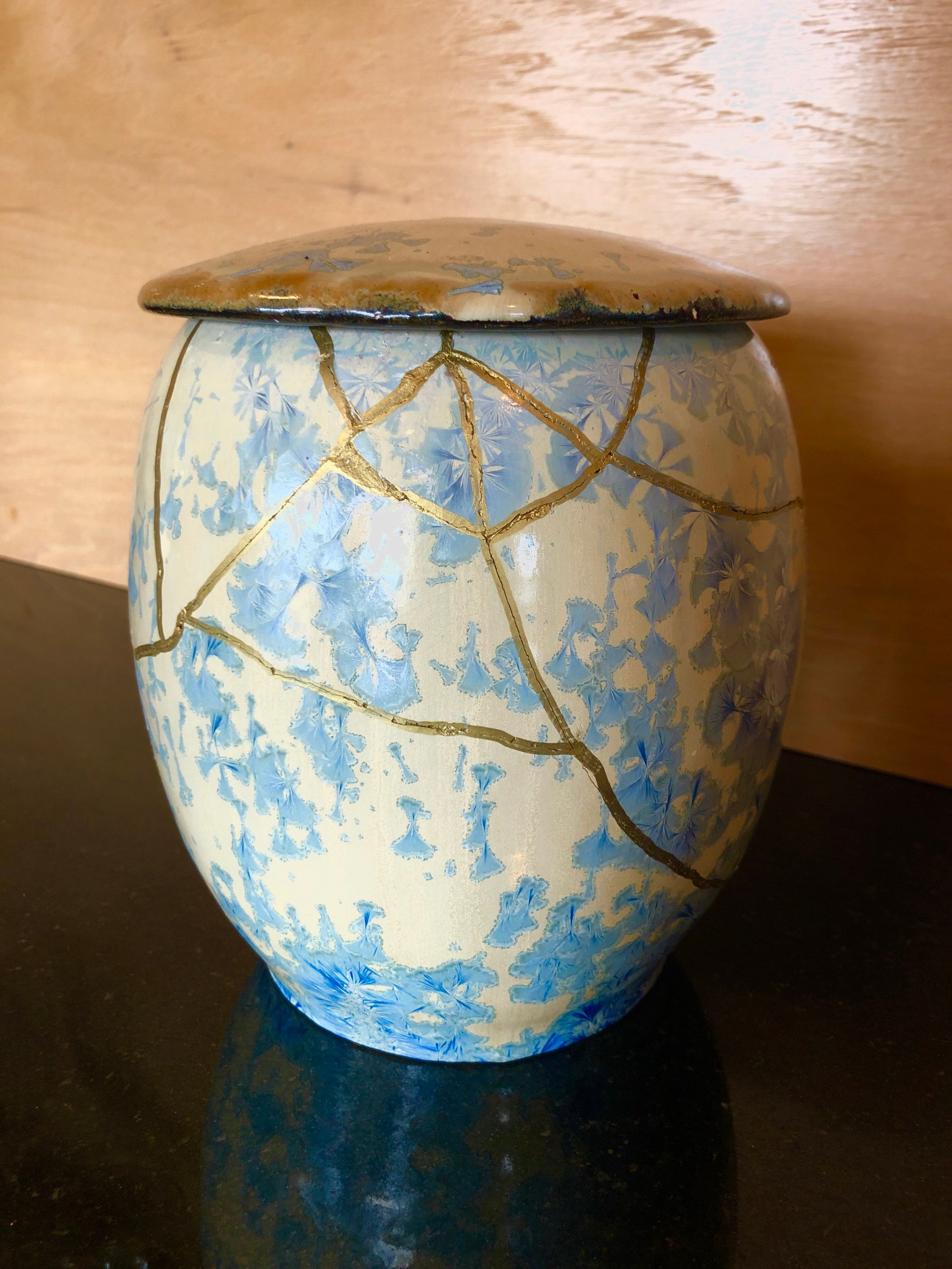
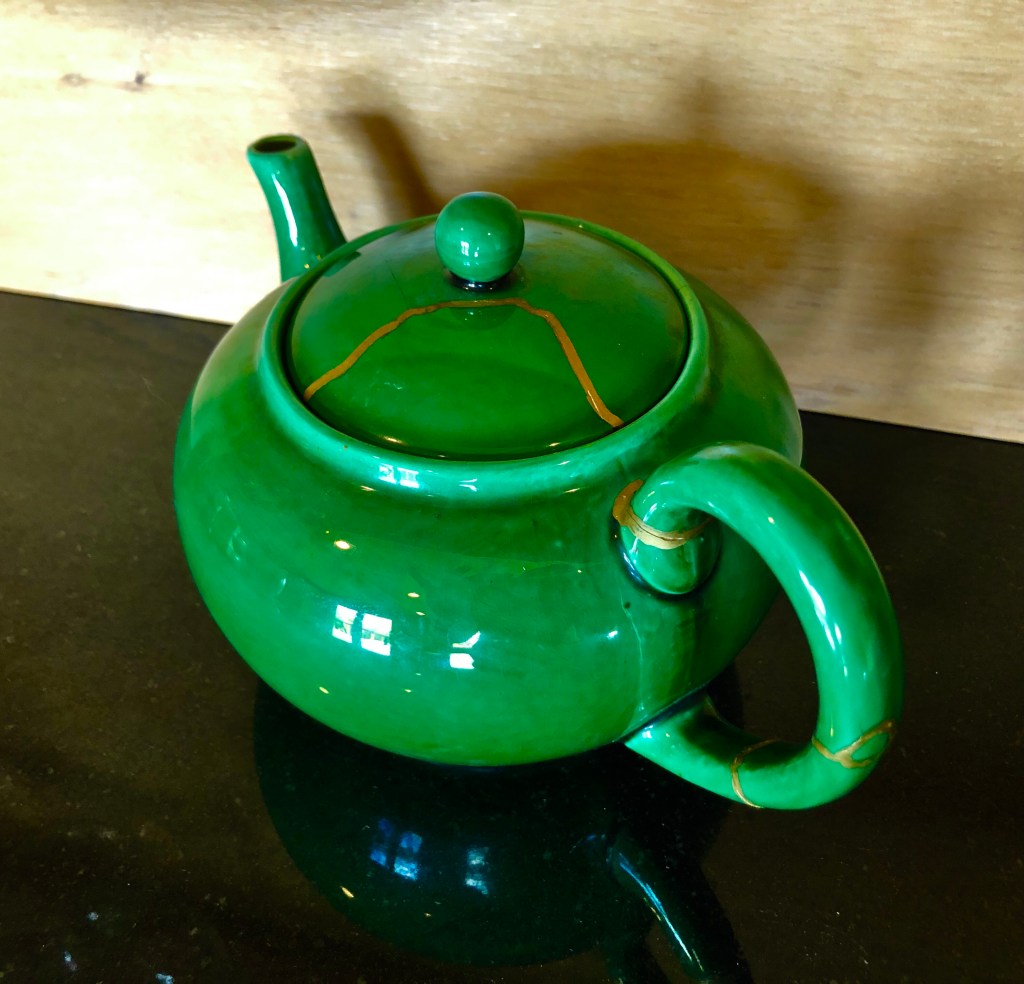
Thank God I’ve never broken a $2M tea bowl. But, ironically for someone who loves ceramics so much, I’m a careless person, and so I have broken many pieces over the years that were dear to me: an emerald-green Japanese teapot from my great grandmother, a dish from a dear friend glazed with a winter scene of two Laplanders feeding reindeer, a cream-colored biscuit jar blotched with beautiful sky-blue crystals thrown for me by another friend. Each time, I’ve cried—wept if we’re being honest—for my stupidity, sure, and my obstinate thoughtlessness that never seems to diminish much no matter how much I wrestle with it. But mostly for the irreversibility of breaking. There’s no unbreaking a bowl. I’ve tried to glue them back together: sometimes I’ve even done a good enough job that you can’t see the crack and can barely feel it or hear it if you tap the piece. But it doesn’t matter. I know the piece is ruined, and I ruined it. And the absurd triviality of the act that led to that ruin—turning my head away for a second, my fingers not gripping tightly enough, bumping my elbow ever so slightly on the corner of the cabinet—galls me so much it feels like rage because I didn’t even decide to break the bowl; it just happened because…I’m me. And so even if there were a time machine I could get in to go back to the minute before I broke the bowl and be more careful, there’s no time machine I can get in that will make me not me. And so I would just break that bowl the next day, or the next.
My divorce felt like breaking a bowl, and being a broken bowl. On the one hand, I lay awake at night torturing myself with all the little things I thought I had done to break my marriage. But worse, deep down I knew that if I could go back in time and not say those things, not do them, it wouldn’t matter; I would just do or say something else like them the next day…because I’m me. And that seemed to make my divorce inevitable because it wasn’t something I did, it was a function of who I was as a person. No wonder my ex left me, I told myself in the middle of those pitch-black nights. I was always a breaker, always broken.
But then on the other hand, even if I could convince myself that was a lie, that I hadn’t been flawed from the start, the divorce broke me. I was a divorcée, which was just French for being a broken bowl—discarded, an object of pity and scorn. Even if another man deigned to love me someday, I would have rough seams that would catch his eyes and fingers, little gaps that could never be filled, a laugh that would thunk instead of ring. After all, there’s no unbreaking a broken thing—not in this life.
And then about a year after my divorce, my friend Jen gave me a greeting card that had a little bowl on it with golden cracks. The card’s inscription reminded me of something I had learned about in my Japanese art class in college—the art of kintsugi. In kintsugi, which means roughly “golden repair,” a broken bowl is put back together using a mixture of urushi lacquer and gold dust so that the fracture lines are not only visible but highlighted, shooting across the glazed surface like golden lightning, or lace. In this way, the inevitable breakage the bowl has experienced isn’t hidden but celebrated. Its scars tell its story in a way that makes it utterly unique and uniquely beautiful. The card Jen gave me said, “Remember this
when you feel broken.”
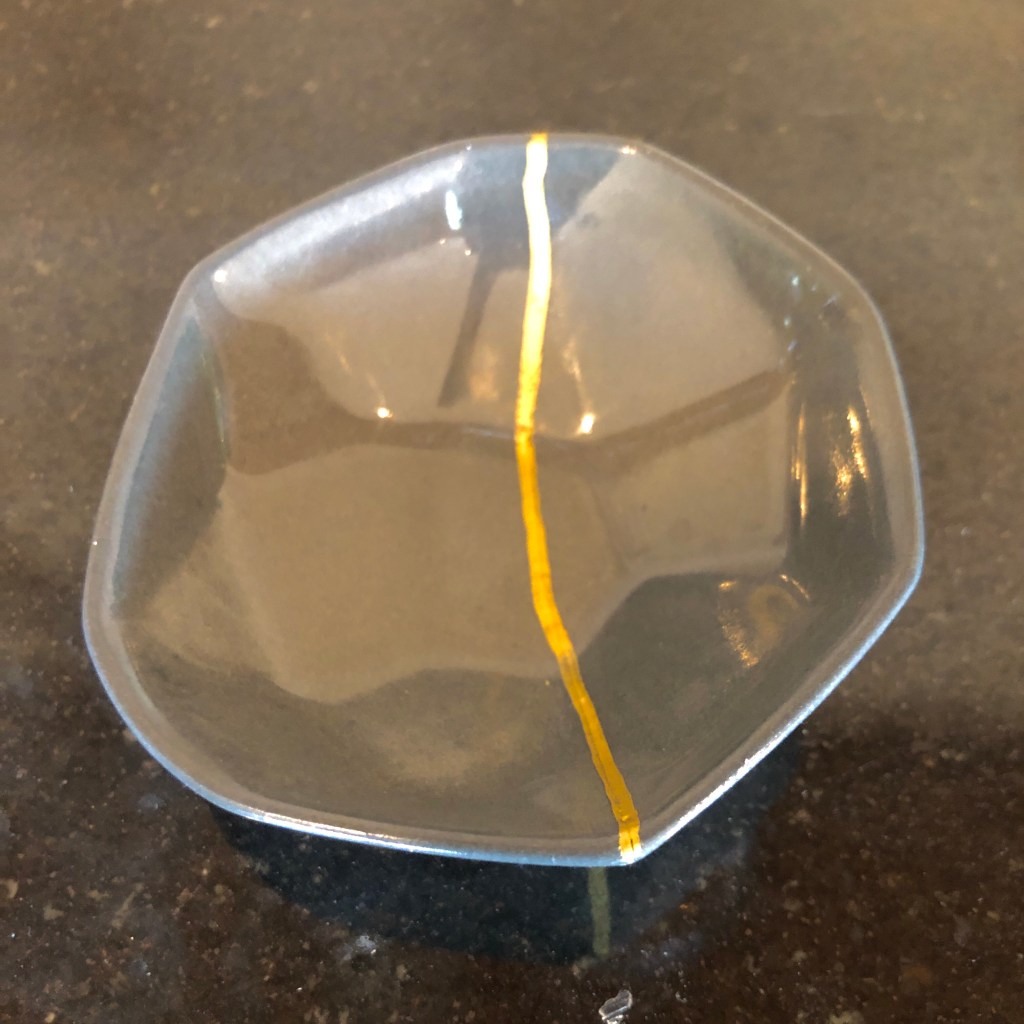
After she gave me that card, I went through my house and took all the ceramics I had broken and glued back together over the years and highlighting the cracks with a gold Sharpie. When I finished, I
was startled by their beauty. I can’t describe the joy I felt, and I know it would seem silly if I could. It was just a gold Sharpie. I hadn’t unbroken anything. But yet, it felt like magic. The golden lines were so artful in their asymmetry, so perfectly imperfect. I would never have thought of them, or chosen them, or designed them. But it was undeniable they made each piece into something beyond itself, something extraordinary.
This is usually the point in a blog post like this where the author pivots to talking about how she pulled herself up by the bootstraps, how by meditation, therapy, exercise, and general mental hygiene she performed the “golden repair” on herself, transforming herself from a broken to a beautiful thing. But I can’t go there because I didn’t break me, and I didn’t put me back together. But I know Who did, so I can tell you at least a little about it.
First, the breaking: my ex didn’t break me, I didn’t break me, God broke me. If this sounds like I’m blaming Him, I’m not. I’m giving His sovereignty over my life its due. My ex deceiving me, cheating on me, and abandoning me was in God’s will for me because if it weren’t…it simply would never have happened (Lam. 3:27). My ex thinks he did exactly what he wanted to me; what he didn’t realize—what he’ll probably never realize—is that he couldn’t have lifted a finger against me if God hadn’t allowed it.
Why did God allow it? That’s a long story that I don’t want to detour into right now, but the bottom line is this: He loved me too much to let me annihilate myself. I had wandered away from Him, hypnotized by the false idols of my ex’s love and approval. But my ex was abusive. And though the emotional and verbal abuse was slowly poisoning me to death, I wouldn’t leave because I was still clinging to the love and approval—which my ex doled out in doses just big enough to keep me hanging on—and to my stubborn pride in my marriage. After 20 years of this toxic dynamic, God had had enough. My Maker, my loving Father, the jealous Lover of my soul would no longer sit back and watch me clutch my idols to my chest while they ate my heart out. So, he smashed them to bits in front of me.
When I realized this is when I started to see how kintsugi worked at a spiritual level. God hadn’t broken me to punish me. He hadn’t even broken me to put me back together the way I was before I met my ex. He had broken me in order to shape me into the woman He designed me to be. What did this look like, practically speaking? First off, my cracks immediately caught the eye of my friends and colleagues. How could they not? My ex wasn’t at all discreet with his adultery: he started escorting his mistress, a colleague of mine, to community events and parties with our friends a week after walking out on me and for the remaining months we were married. But that wasn’t what my friends remarked on when they talked to me: they told me how amazing I looked, how light, how calm. I thought they were lying to cheer me up: after all, I was running on about 4 hours of sleep a night, crying half of each day, and eating basically nothing. Maybe popcorn and Greek yoghurt? And yet when I looked back at pictures from those months, it’s undeniable: there’s a light and openness in my face that hadn’t been there for years, if ever. Sure, my eyes are puffy, and I look a bit drawn, but still, there’s the light.
Where was the light coming from? It was the Holy Spirit shining through, a little bit, at last. I was growing up finally, and you could see it through the cracks. I was a little more patient than I used to be, more compassionate, a little less snappy and defensive. Not a whole lot, but a little. It’s noticeable, to me at least. I listen a bit better. I judge a bit less—both myself and others. And if you think any of that comes to me at all naturally, then just ask my mom 😉 We all get more set in our habits as we get older, not less. If I see someone headed the other direction, I always ask myself what happened. In my case, I know.
In his sermons and books Tim Keller frequently quotes the passage from The Return of the King when Samwise Gamgee wakes up in Rivendell and sees the wizard Gandalf, whom he thought was dead. Sam cries out in astonishment, “Is everything sad going to come untrue?” Keller says yes. He argues this is exactly the effect of God’s sovereignty over creation, perfected through Jesus’s sacrifice on the cross, which gave Him the power not merely to erase pain and evil and sin but to untrue them, which means using them to move us closer to glory.
Now when I try to picture what this process of glorification looks like, I see kintsugi; I see a bowl that has been made stronger and more beautiful through its breaking by its Maker. I see kintsugi in my recovery. And this isn’t gold Sharpie: it’s the light of heaven shining out through the cracks my divorce made in the hard, fragile shell of my shame and pride. Glory cracks. A few here, a few more there, spreading….
At this rate, some day I’ll be nothing but light.
 The Rookery
5 thoughts on “Kintsugi”